
Loading, please wait...
LOT 1572
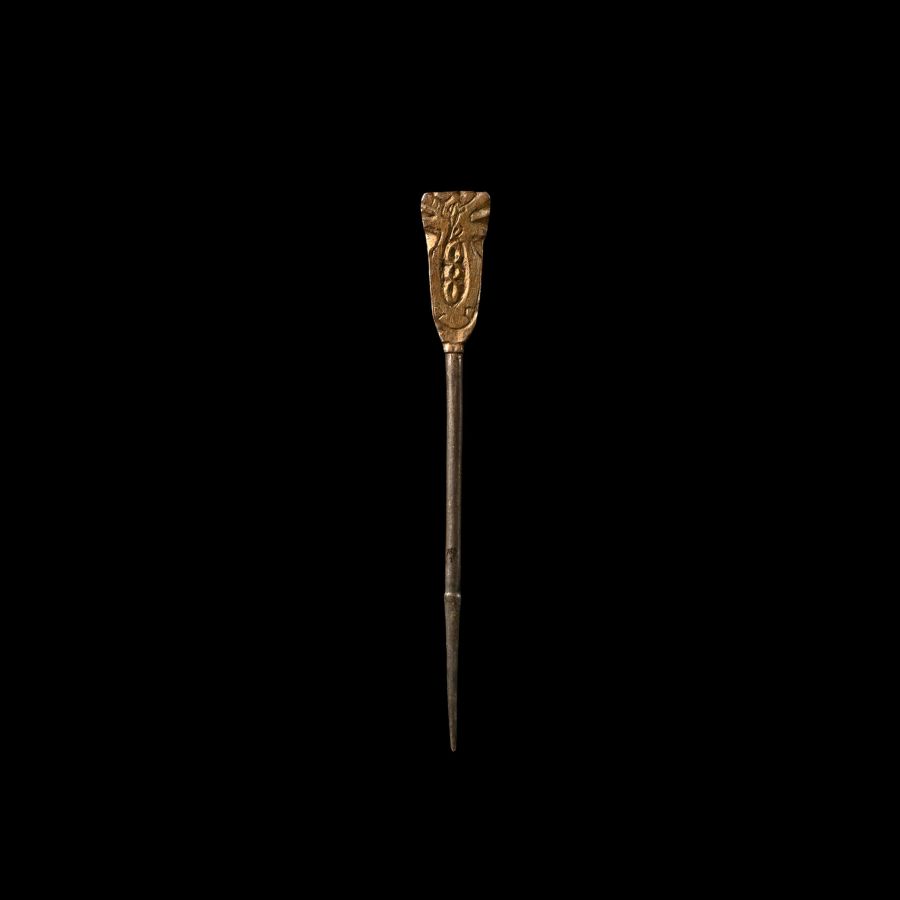
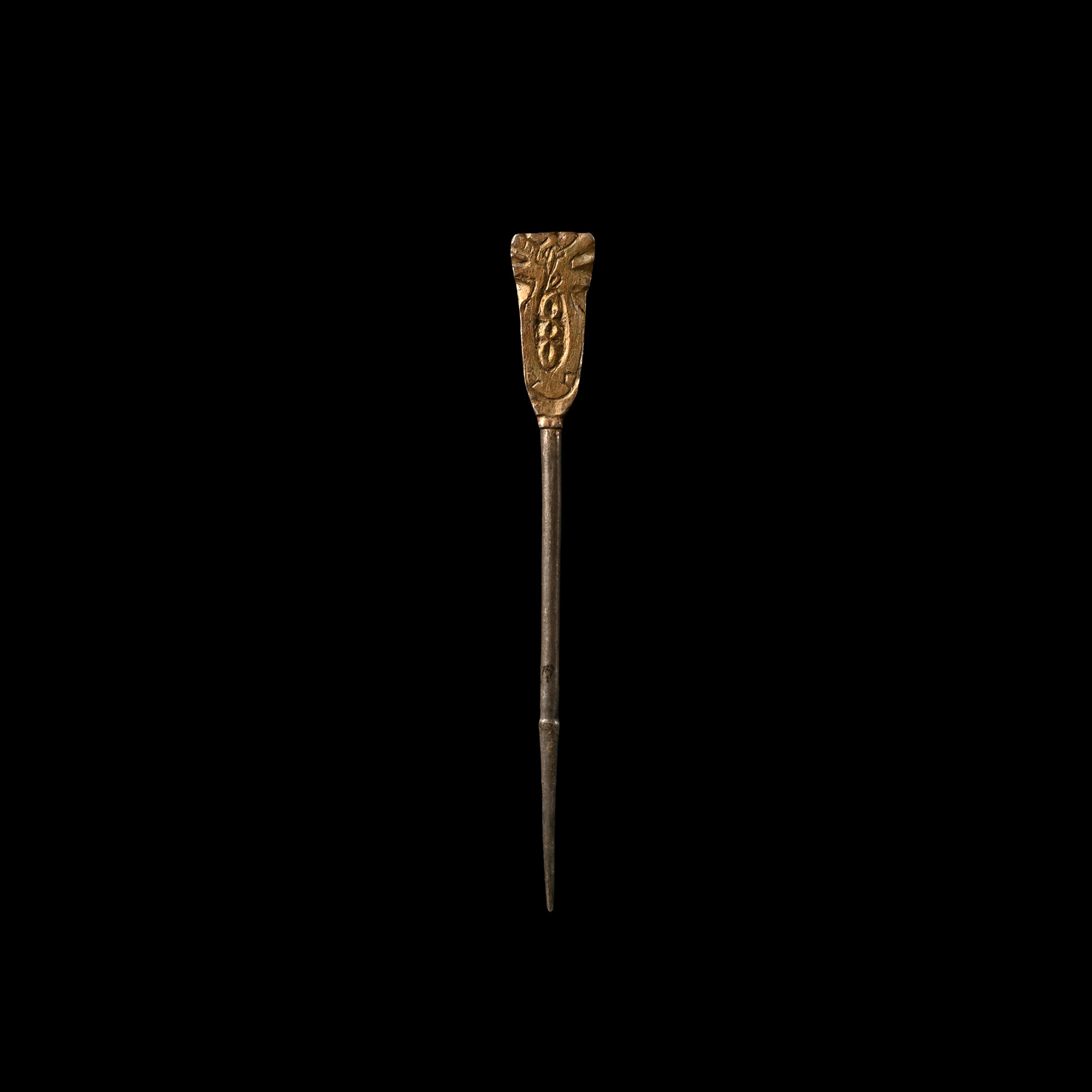
Saxon Silver-Gilt Pin with Beast Heads
8TH CENTURY A.D.
3 in. (2.91 grams, 76 mm).
With a flat, tongue-shaped head connected to the shaft by a rectangular collar; the shaft with a bulbous 'rib’ approximately 20 mm from the tip; the upper portion of the head with radiate detailing and a Trewhiddle Style zoomorph; recessed panel with knotwork motif below, within an elliptical panel with lateral flanches towards the base. [No Reserve]
ProvenanceEx Lord McAlpine collection.
Ex David Miller collection.
Hammond, Aaron, Discovering Jewellery, A Collector's and Investor's Guide, Greenlight Publishing, Ipswich, p.420; and Hammond, B., British Artefacts, volume 2 - Middle Saxon & Viking, Witham, 2010.
LiteratureCf. Webster, L. & Backhouse, J., The Making of England. Anglo-Saxon Art and Culture AD 600-900, London, 1991, p.96-7, fig.69e-f.
FootnotesDress pins of this period are often 'hipped', with a small bulb about two-thirds of the length of the shank in order to secure them in the weave of the fabric. The present piece is very delicate and would have been suitable only for a fine linen or silk garment of the highest quality.
CONDITIONTimeLine Auctions follows a vetting process to ensure the authenticity and legality of all items, reinforcing our commitment to integrity and responsible trading. Each antiquity, antique, and coin lot undergoes thorough examination by a vetting committee of at least ten external specialists, professional trade association members, scientists, and archaeologists: Our Vetting Process
AUCTIONS:
TimeLine is a leading auction house specialising in antiquities, ancient art, collectables, natural history, coins, medals, and books. Our auctions offer museums, collectors, historians, and enthusiasts the opportunity to acquire unique and historically significant pieces.
-
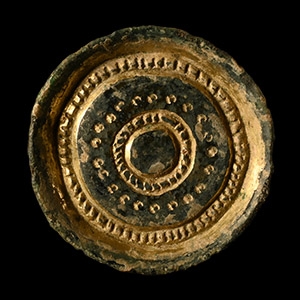
Anglo-Saxon Gold Chip-Carved Bronze Saucer Brooch
Circa 6th century A.D.Sold for (Inc. bp): £312
With central bosses within a pelletted ring, plain band with stamped roundels, billetted outer band and flared rim; pin-lug, pin and catch to the reverse. 7.01 grams, 26 mm
Found Cambridgeshire, UK. -
.jpg)
Anglo-Saxon Bronze Bucket with Hunting Scenes
Late 5th-6th century A.D.Sold for (Inc. bp): £1,300
Fragmentary vessel, cylindrical in form with lateral D-shaped lugs at the rim, each pierced to accept a bronze drop-handle with returned ends; the outer face with decorative frieze executed in pointillé technique consisting of a hunting scene: (1) a nude male with right arm raised to wield a spear overarm, left arm hidden behind a lenticular shield with pointed boss, with a cloak billowing from the left shoulder and wearing calf-length boots, advancing towards (2) a panther with densely spotted pointillé body, in rampant pose with s-curved tail, raised forepaws and with a curled tree behind the body, attacking (3) a nude male similarly equipped to (1), with head turned to the rear, wielding a sword or large knife in his right hand, following (4) another nude male with a cloak, shield and knife which he plunges into the throat of (5) a bear attacking to the left with forelegs raised, its rounded head with small lobed ears while to its rear stands (6) a male with shield raised and cloak billowing, right hand raised holding a rounded trefoil item (perhaps a net), and to his rear stands (7) a nude male with cloak, shield and spear which he thrusts towards (8) the neck of an attacking gryphon, winged, with an erect mane and beaked head in leaping pose behind (1); the figures all executed in pointillé style with pellets for the eyes, navel and nipples; detached base plate, undecorated but showing signs of tinning. 523 grams, 22 cm wide
Found East Anglia, believed Cambridgeshire, UK. From a collection acquired on the UK art market from various auction houses and collections mostly before 2000. From an important Cambridgeshire estate; thence by descent. Accompanied by a copy of Drandaki, A., "ΥΓΙΕΝΩΝ ΧΡΩ KYPI(E)" A Late Roman brass bucket with a hunting scene.
The vessel is of an unusual type: three have been found in Turkey, Italy and Spain, three in England (excluding the present examples) and three others have unknown findspots; this find brings the total of known examples to ten. The rarity of these vessels indicates the high status of their owners. Each of these buckets is decorated with a hunting frieze and most have an inscription in early medieval Greek. Their manufacture is so similar that it is thought that they were produced at a single workshop in the Eastern Empire, possibly at Antioch, in the 6th century AD (Drandaki, n.d.). Their exact use is not certain, but since several of the inscriptions refer to 'good health' this suggests a domestic setting related to bathing. The rounded object held by figure (6) is clearly based on a similar rounded clump which appears on the vessel in Benaki Museum (beneath the word ' KAΛOI') where it is more convincingly executed with a hatched fill (Drandaki, p.39). Only three examples of this type of vessel are previously known from England: one from Bromeswell, Suffolk, within 1 km of the Sutton Hoo cemetery, found in preparatory work for the Sutton Hoo Visitor Centre; one from Chessell Down, Isle of Wight, where the bucket was part of a rich female grave excavated in the 19th century; one from Breamore, Hampshire, found by metal-detectorist, and excavated by Hampshire County Council's archaeology team who discovered that the grave in which it was found formed part of an important early Anglo-Saxon cemetery. The excavation was filmed by Channel 4's Time Team in August 2001; the cemetery held six more burials with bronze containers, though none as grand as this Byzantine example. -
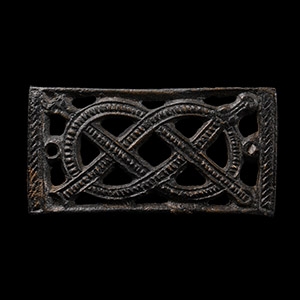
Anglo-Saxon Bronze Entwined Serpent Mount
6th-7th century A.D.Estimate: £200 - 300 (‡+bp*)
Opening Bid: £110
With openwork design of two serpents interlaced, each with billeted body and lentoid eyes, ropework border to the shorter sides; old collector's accession numbers to the underside '91.115' and '15871'. 10.9 grams, 46 mm
UK collection formed 1970s-1990s. Ex property of an English gentleman.
The decorative pattern of this mount is similar to what, according to S. West, is an Anglo-Saxon die found in Suffolk, where legless animal forms are represented lying head to tail, with beaded bodies within a beaded border. Also here the animals are showing interlaced jaws and headed bodies, all contained in a border.
