
Loading, please wait...
_900x900.jpg "Sassanian Carnelian Eagle Gemstone")
_200x200.jpg "Sassanian Carnelian Eagle Gemstone")
.jpg "Sassanian Carnelian Eagle Gemstone")
LOT 1114
Sassanian Carnelian Eagle Gemstone
CIRCA 3RD-4TH CENTURY A.D.
3/8 in. (0.46 grams, 10 mm).
Eagle standing with wings folded, neck extended; supplied with a museum-quality impression.
ProvenanceFrom the collection of a Swiss gentleman formed in Europe from 1970-1980s; thence by descent from the family in London.
CONDITIONTimeLine Auctions follows a vetting process to ensure the authenticity and legality of all items, reinforcing our commitment to integrity and responsible trading. Each antiquity, antique, and coin lot undergoes thorough examination by a vetting committee of at least ten external specialists, professional trade association members, scientists, and archaeologists: Our Vetting Process
AUCTIONS:
TimeLine is a leading auction house specialising in antiquities, ancient art, collectables, natural history, coins, medals, and books. Our auctions offer museums, collectors, historians, and enthusiasts the opportunity to acquire unique and historically significant pieces.
-
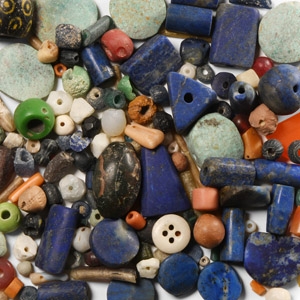
Western Asiatic and Other Mixed Bead Group
1st millennium B.C. and laterSold for (Inc. bp): £72
Including triangular, tubular, oblate, irregular and other types in glass, lapis lazuli, coral and other materials. 112 grams total, 2-22 mm
From the private collection of the late Mrs Belinda Ellison, a long time member of the Egyptian Exploration Society, c.1940-2020. -
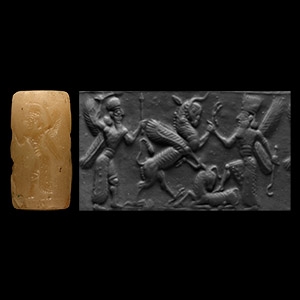
late Babylonian Stone Cylinder Seal with Contest Scene
1000-800 B.C.Estimate: £800 - 1,000 (+bp*)
Opening Bid: £400
With incuse frieze depicting a winged male figure wearing a tall headdress and holding a khopesh hooked sword, one foot placed on the corpse of a goat or ram, grappling with a rearing bull-headed winged beast and gripping its raised foreleg; behind, a second winged male figure with a sceptre and raised club to strike the bull-headed beast from behind; supplied with a museum-quality impression. 32.6 grams, 40 mm
From the property of late Mr SM, London, UK, 1970-1990s, thence by descent. Examined by Professor Wilfrid George Lambert FBA (1926-2011), historian, archaeologist, and specialist in Assyriology and Near Eastern archaeology, in the late 1980s and early 1990s. -
.jpg)
Very Large Western Asiatic Stone Stamp Seal with Animal
2nd-1st millennium B.C.Estimate: £400 - 600 (+bp*)
Opening Bid: £222
Discoid in plan with tiered handle and transverse hole, with gusset to the upper face, chamfered shoulder; underside with intaglio image of a stag with legs bent beneath the body, objects in the field; supplied with a museum-quality impression. 109 grams, 49 mm
Collected from 1969-1999. From the collection of the late Mr S.M., London, UK.
