
Loading, please wait...
_900x900.jpg "Sassanian Carnelian Eagle Gemstone")
_200x200.jpg "Sassanian Carnelian Eagle Gemstone")
.jpg "Sassanian Carnelian Eagle Gemstone")
LOT 1135
Sassanian Carnelian Eagle Gemstone
CIRCA 3RD-4TH CENTURY A.D.
3/8 in. (0.46 grams, 10 mm).
Eagle standing with wings folded, neck extended; supplied with a museum-quality impression.
ProvenanceFrom the collection of a Swiss gentleman formed in Europe from 1970-1980s; thence by descent from the family in London.
CONDITIONTimeLine Auctions follows a vetting process to ensure the authenticity and legality of all items, reinforcing our commitment to integrity and responsible trading. Each antiquity, antique, and coin lot undergoes thorough examination by a vetting committee of at least ten external specialists, professional trade association members, scientists, and archaeologists: Our Vetting Process
AUCTIONS:
TimeLine is a leading auction house specialising in antiquities, ancient art, collectables, natural history, coins, medals, and books. Our auctions offer museums, collectors, historians, and enthusiasts the opportunity to acquire unique and historically significant pieces.
LOT 1135
Sassanian Carnelian Eagle Gemstone
Estimate £120 - 170€140 - 200 (for guidance only)$160 - 230 (for guidance only)
-
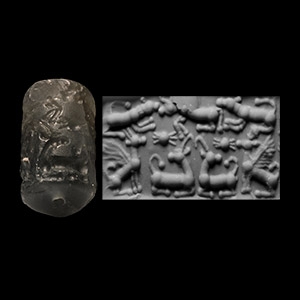
Mesopotamian Rock Crystal Cylinder Seal with Animals
Circa 7th century B.C.Sold for (Inc. bp): £234
With frieze in two registers: above, mainly running felines; below, addorsed pairs of gryphons sitting and bovines resting, solar disc above; supplied with a museum-quality impression. 5.25 grams, 18 mm
Ex London, UK, collection, by family descent before 1988. Accompanied by a previous catalogue information slip. -
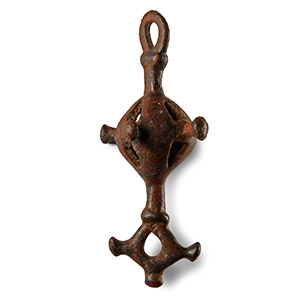
Western Asiatic Bronze Pendant with Cross
1st millennium B.C.Sold for (Inc. bp): £78
Ellipsoid loop developing to a short shank, biconvex bulb with eight vents and four stub arms, short shank below and lentoid loop with stub arms; possibly a liturgical thurible censer. 31 grams, 75 mm
From a collection acquired on the UK art market from various auction houses and collections mostly before 2000. From an important Cambridgeshire estate; thence by descent. -
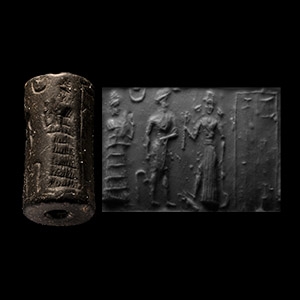
Old Babylonian Stone Cylinder Seal with Ishtar Presentation Scene
2nd millennium B.C.Sold for (Inc. bp): £442
With frieze depicting a king and a suppliant goddess approaching the goddess Ishtar and a faint two-lined cuneiform inscription; supplied with a museum-quality impression. 10.6 grams, 28 mm
Anonymous sale; Christie's, London, 25 April 2001, lot 504 (haematite) and 513 (part). with Petit Musée, Montreal, acquired at the above sale; thence by descent. Property of an East Sussex, UK, gentleman.
