
Loading, please wait...
_900x900.jpg "Sarmatian Bronze Belt Clasp with Hare and Hound")
_200x200.jpg "Sarmatian Bronze Belt Clasp with Hare and Hound")
.jpg "Sarmatian Bronze Belt Clasp with Hare and Hound")
LOT 1457
Sarmatian Bronze Belt Clasp with Hare and Hound
CIRCA 3RD-2ND CENTURY B.C.
2 3/8 in. (19.2 grams, 60 mm).
Openwork rectangular panel with hare-and-hound motif, two lateral fixing lugs. [No Reserve]
ProvenanceProperty of the vendor's grandfather, thence by family descent, circa 1985.
From the private collection of a New York, USA gentleman.
See Arkhipova, E.I., Videyko, M., Yu, V.I., Klochko, L.S., Klochko; Levada, M.E.; Simonenko, O.V., Stoyanov, R.V., Collection of antiquities of the Platonov and Tarut families (in Ukrainian), Kyiv, 2004, fig.8a, p.126, for a similar buckle.
FootnotesBelt plaques with zoomorphic motifs illustrate not only the recognised unity of the zoomorphic art of the steppes, but also the links between the Sarmatians and the eastern nomadic groups. Important in this respect are similar buckles with representations of camels (Krasnogorovka III, Kurgan 11) or Ordos-style bronze plaques from the Kuban.
CONDITIONTimeLine Auctions follows a vetting process to ensure the authenticity and legality of all items, reinforcing our commitment to integrity and responsible trading. Each antiquity, antique, and coin lot undergoes thorough examination by a vetting committee of at least ten external specialists, professional trade association members, scientists, and archaeologists: Our Vetting Process
AUCTIONS:
TimeLine is a leading auction house specialising in antiquities, ancient art, collectables, natural history, coins, medals, and books. Our auctions offer museums, collectors, historians, and enthusiasts the opportunity to acquire unique and historically significant pieces.
-
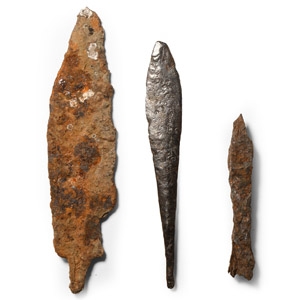
Saxon to Medieval Iron Knife, Bolt, and Arrowhead Group
6th-15th century A.D.Sold for (Inc. bp): £13
Including a leaf-shaped tanged arrowhead, lozenge-shaped arrowhead and other types. 56 grams total, 6.3-11 cm
From a collection acquired on the UK art market from various auction houses and collections mostly before 2000. From an important Cambridgeshire estate; thence by descent. -
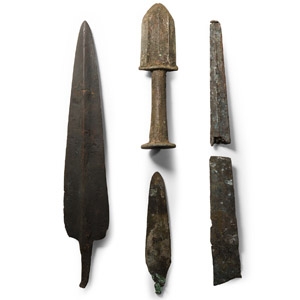
Western Asiatic Bronze Weapon Group
13th-7th century B.C. and laterSold for (Inc. bp): £52
Including a ribbed triangular dagger blade, dagger with trumpet-shaped grip, and other items. 634 grams total, 13-27.5 cm
From a collection acquired on the UK art market from various auction houses and collections mostly before 2000. From an important Cambridgeshire estate; thence by descent. -
.jpg)
Luristan Spear Tip Group
13th-6th century B.C.Sold for (Inc. bp): £234
Comprising four tips with triangular blades; each with a raised midrib and a long tang. 143 grams total, 13.5-18.2 cm
Acquired 1980-2015. Ex Abelita family collection.
Although some of them are different in shape, these arrowheads are apparently related types of a polythetic group. Two basic deltoid forms are represented: one has a sharp, flat blade, the ends of which extend to form wings or barbs, and a prominent midrib extending into a long tang that often has a stop; the blade shape varies from deltoid to more manifestly triangular. The other form has no barbs, but it has a prominent midrib extending to the tang, and a narrow leaf-shaped blade.
