Loading, please wait...

Use mousewheel to zoom in and out, click to enlarge

Details

LOT 1861

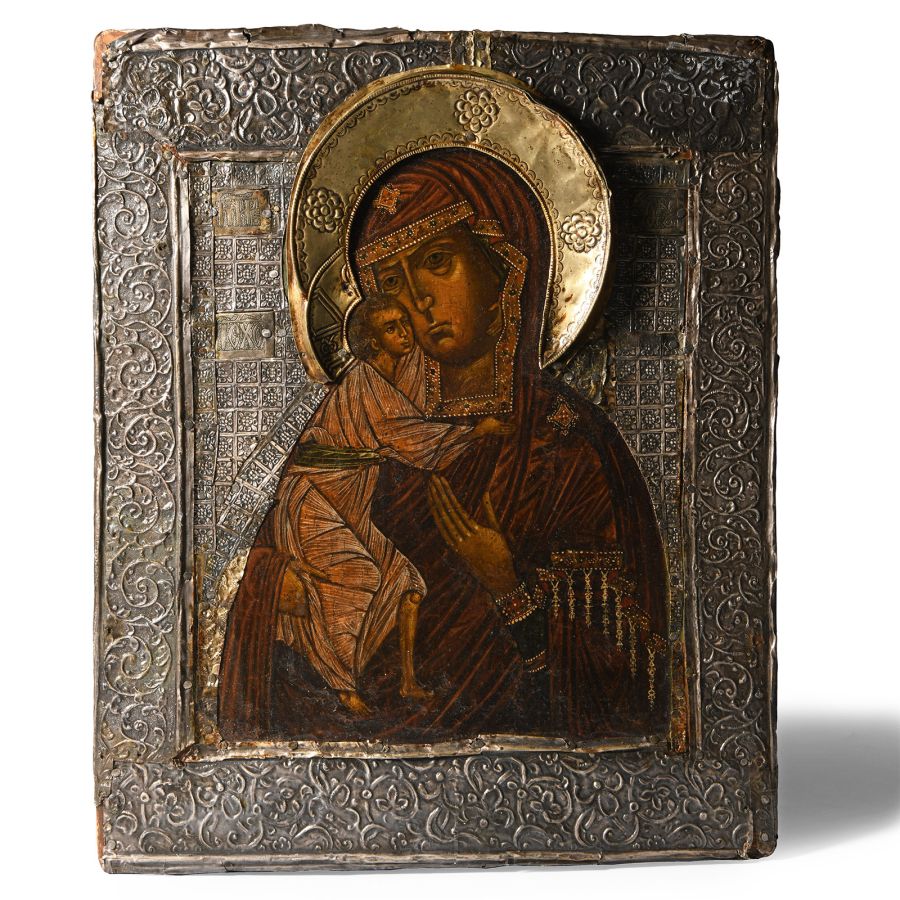
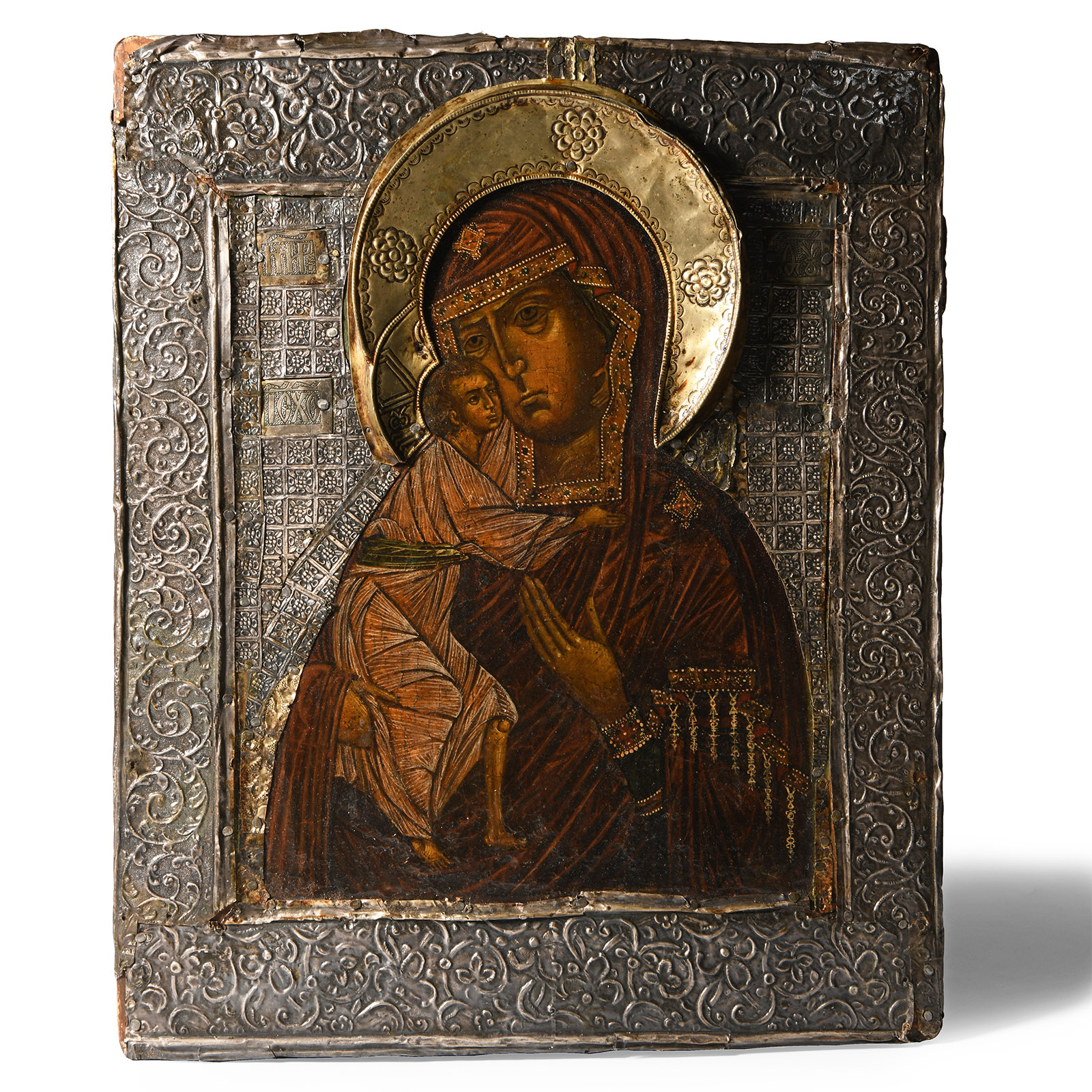
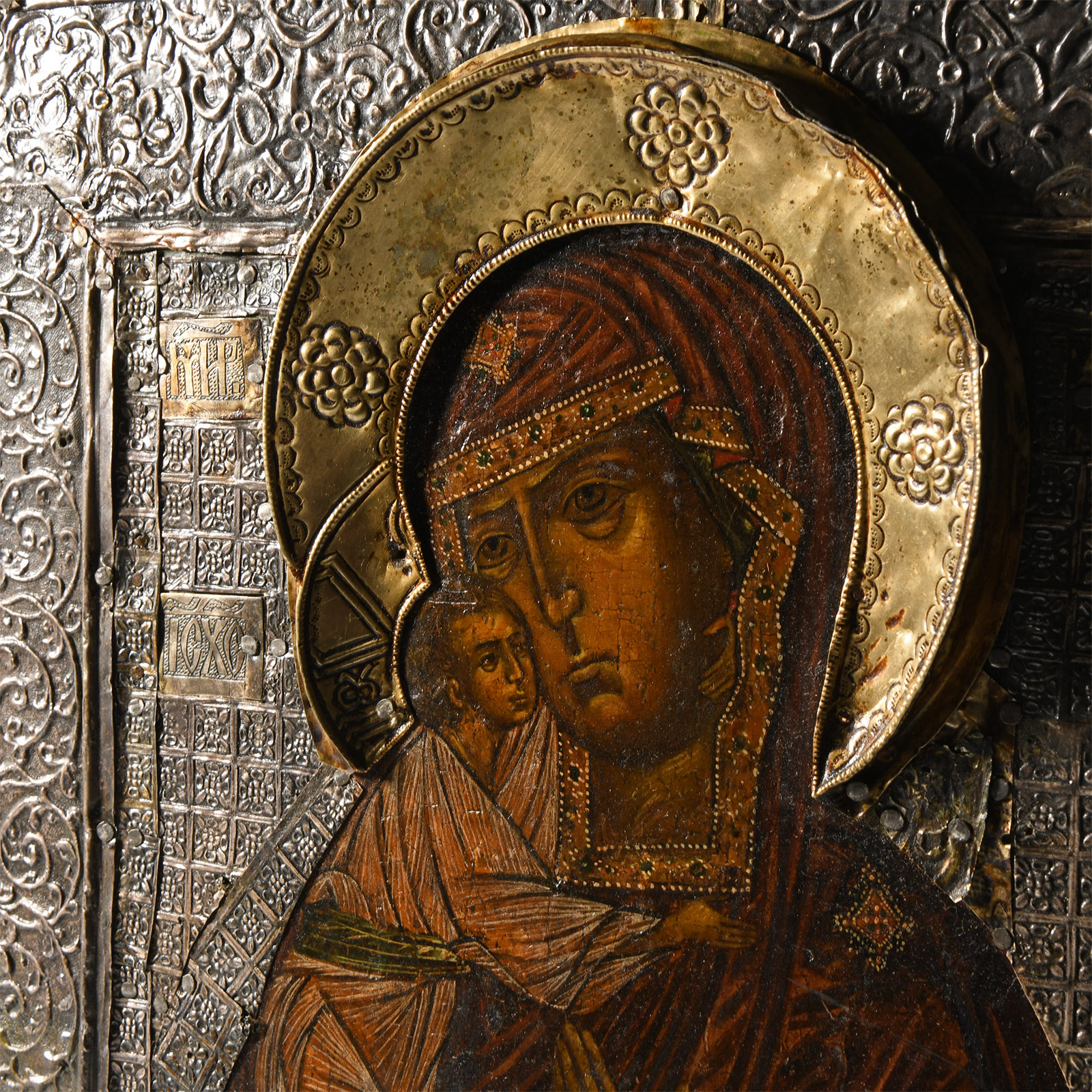
Russian Wooden Icon with Virgin Donskaya with Silver Basma

CIRCA 1700 A.D.

12 3/8 in. (1.05 kg, 31.5 cm high).

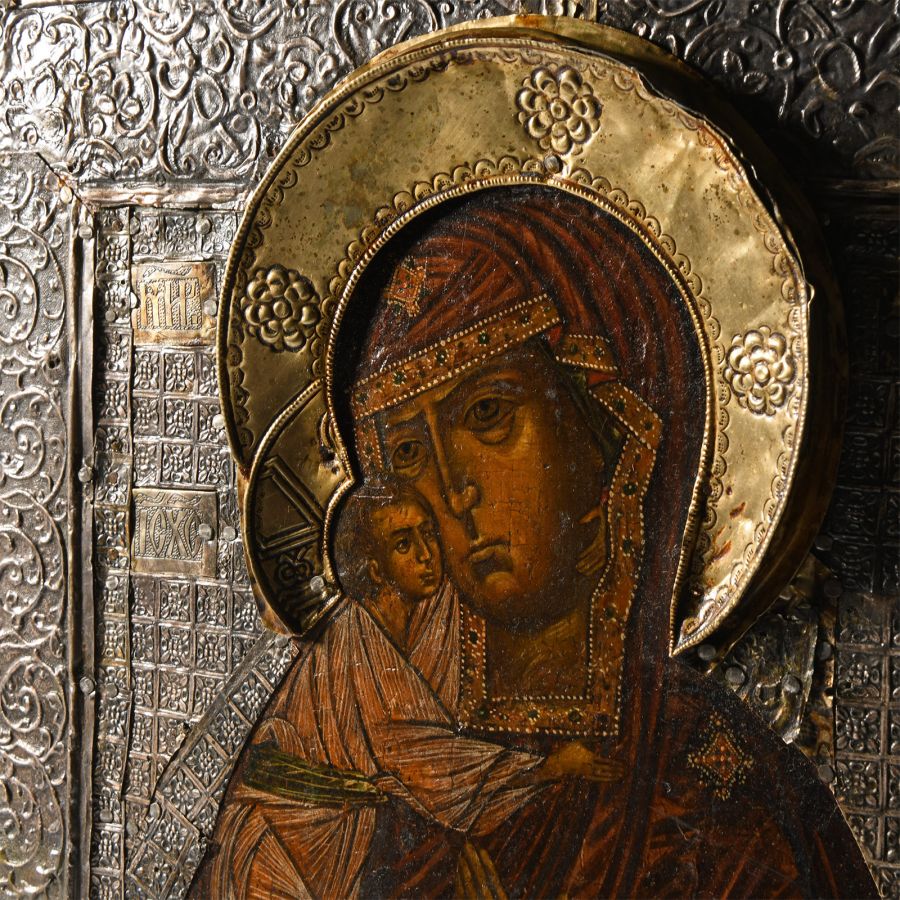
With slots and mounting panels to the reverse; sheet silver basma composed of decorative impressed strips trimmed to the outline of the painted image; icon of 'Virgin Donskaya' (Our Lady of the River Don), Mary wearing a dark purple veil and mantle with jewelled trim and tasselled fringe to the crook of the arm, infant Jesus supported by her right arm; rectangular panels with monograms flanking Mary's head; 'ΜΡ' and 'ΘΥ' (Μήτηρ (τοῦ) Θεοῦ = Mother of God), over the child inscription in Greek letters 'ΙϹ ΧϹ' (ΙΗϹΟΥϹ ΧΡΙϹΤΟϹ = Jesus Christ), three letters (only two visible) inside the nimbus of Christ representing the continuous divine self-existence of Christ as God ('O ѾN' = The Only One who always exists).

Provenance

Ex property of a London lady, part of her family's collection.

Literature

Cf. lyanov, O.G., "Deesis of Andreev's letter of Rublev" from the Annunciation Church of the Moscow Kremlin (on the 575th anniversary of the repose of the venerable icon painter, in Russian) in Monuments of Culture: New Discoveries: Yearbook. 2006-2008 (in Russian), Moscow, 2008, pp.364-394.

Footnotes

The original of this icon (Our Lady of the Don) is a 14th century icon, with the characteristics of the Eleusa (Virgin of the tenderness), by the great painter Theophan the Greek, circa 1382-1395, held in the Tretyakov Gallery, Moscow.

CONDITION

VETTING:

TimeLine Auctions follows a vetting process to ensure the authenticity and legality of all items, reinforcing our commitment to integrity and responsible trading. Each antiquity, antique, and coin lot undergoes thorough examination by a vetting committee of at least ten external specialists, professional trade association members, scientists, and archaeologists: Our Vetting Process


AUCTIONS:

TimeLine is a leading auction house specialising in antiquities, ancient art, collectables, natural history, coins, medals, and books. Our auctions offer museums, collectors, historians, and enthusiasts the opportunity to acquire unique and historically significant pieces.

LOT 1861

Russian Wooden Icon with Virgin Donskaya with Silver Basma

Sold for (Inc. bp): £2,600

Print page

RELATED LOTS

  • Post Medieval Wooden Carving of a Walking Gentleman
    Post Medieval Wooden Carving of a Walking Gentleman
    Circa 19th century A.D.

    Sold for (Inc. bp): £65

    Dressed in a peaked cap, smock, ankle-length trousers and clogs, standing holding a churchwarden smoking pipe to his mouth with his left hand and with his right hand leaning on a stout walking stick; coopered pannier to his back with contents partly protruding at the top, small basket beside his right foot, octagonal base with recess to the underside; probable Dutch workmanship. 1.76 kg, 47 cm high


    From a collection acquired on the UK art market from various auction houses and collections mostly before 2000. From an important Cambridgeshire estate; thence by descent.

    Lot Details

  • The Hursley Tudor Gold Hope is my support till fortune shall help Buckle Posy Ring
    'The Hursley' Tudor Gold 'Hope is my support till fortune shall help' Buckle Posy Ring
    Circa 16th century A.D.

    Estimate: £6,000 - 8,000 (+bp*)

    Opening Bid: £3,200

    The hoop rectangular-section and in the form of a buckled belt with looped end tie and chape with double-bowed and pinned buckle, the outer face inscribed '+HOPE * IS * MI HOLDE' in Roman capitals, continuing 'TILL * HAP * SHALL * HELPE' around the interior; accompanied by a vintage ring box. 2.76 grams, 19.17 mm overall, 16.63 mm internal diameter (approximate size British M, USA 6 1/4, Europe 12.34, Japan 12)


    Found whilst searching with a metal detector near Hursley, Hampshire, UK, on Sunday 26th August 2012. Acquired from Berganza, Hatton Garden, London, 2017. Property of an East Sussex collector. Disclaimed under the Treasure Act with reference no.2012 T805. Accompanied by a copy of the British Museum's Portable Antiquities Scheme report no.HAMP-62C152. Accompanied by a copy of the Berganza invoice. This lot has been checked against the Interpol Database of stolen works of art and is accompanied by search certificate no.11667-197581.

    Dr Malcom Jones writes: 'The 'hope' in question here is the lover's hope to be united with the beloved. Hope indeed springs eternal in the lover's heart - as Chaucer says in his contemporary partial translation of that classic of courtly love, the Roman de la Rose -- Nere hope, ther shulde no lover lyve [Without hope no lover could live], and Y leve yn hope is the message on a 15th century signet-ring found in Gloucester, while en bon espoer is the message of another ring and also on a ring-brooch in the British Museum. An elaborate gold ring recently unearthed bears the legend cest mon desir [This is my desire], with each word separated by an open book, and each book's double-page engraved with two letters, es po yr – i.e. espoir [LANCUM469077]. A beautiful openwork brooch in the shape of a trefoil found in Brighton in the nineteenth century, but since lost, bore the legend, en espoir ma vye endure [in hope my life endures], a sentiment echoed on another ring-brooch in the British Museum -- vie i[n] espoir -- while a ring in the Somerset County Museum insists that esperance me conforte [hope comforts me] -- exactly as the first half of our inscription here: HOPE IS MI HOLDE. A close parallel to the legend on the present ring is found in a series of sententious verses preserved in the 14C BL Harl. 2316 [Whiting H465]: Hope is hard ther hap is foo -- 'Hope is hard where fortune is a foe Hap wile helpen ther hope is froo -- Fortune will help where hope is away' In the medieval period many rings bore posy inscriptions in Latin or French, the languages frequently spoken by the affluent elites. Later, inscriptions in English became more usual, although the lack of standardisation in spelling might surprise the modern reader. The inscription is generally found on the interior of the ring, hidden to everyone except the wearer and most of the sentimental mottoes were taken from the popular literature of the time. In fact, love inscriptions often repeat each other, which suggests that goldsmiths used stock phrases. In the later 16th century, ‘posy’ specifically meant a short inscription. A posy is described in contemporary literature as a short ‘epigram’ of less than one verse. George Puttenham (1589) explained that these phrases were not only inscribed on finger rings, but also applied to arms and trenchers. The practice of giving rings engraved with mottoes at betrothals or weddings was common in England from the 16th century onwards, and continued until the late 18th century. Sources suggest that rings could be acquired ready- engraved, or alternatively engraved sometime after their initial production, by a hand other than the goldsmith’s. Joan Evans assumed that posy rings were principally used by/between lovers and distinguished four contexts for the giving of posy rings by one lover to another: betrothals, weddings, St Valentine’s Day and occasions of mourning. Samuel Pepys’ diary makes clear that posy rings might also mark the marriage of a family member, when bearers could even commission their own rings and chose their own mottoes from books. The rings could also function as tokens of friendship or loyalty.

    Lot Details

  • Post Medieval Bronze Trade Weight Collection
    Post Medieval Bronze Trade Weight Collection
    Circa 18th-19th century A.D.

    Sold for (Inc. bp): £20

    Discoid types with socket to one face, stamped values. 102 grams total, 15-29 mm


    Acquired since the 1970s. From the private collection of a Surrey, UK, gentleman.

    Lot Details

Stay up-to-date with the latest from TimeLine Auctions by joining our mailing list