
Loading, please wait...
LOT 1909
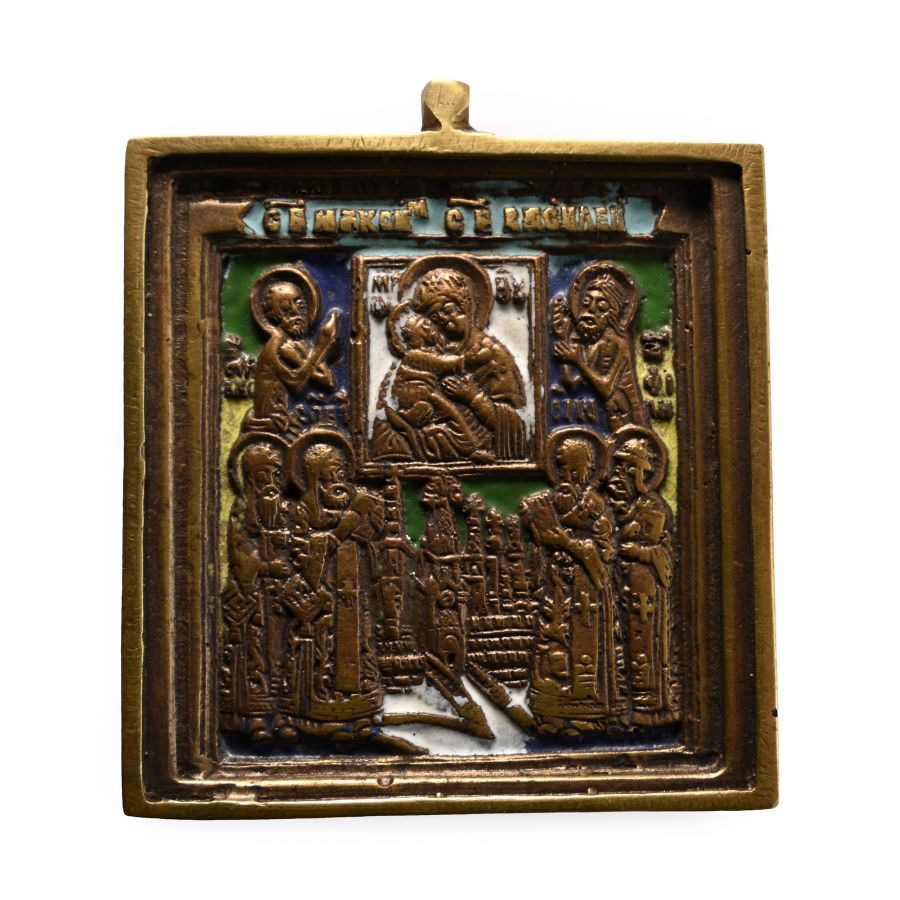
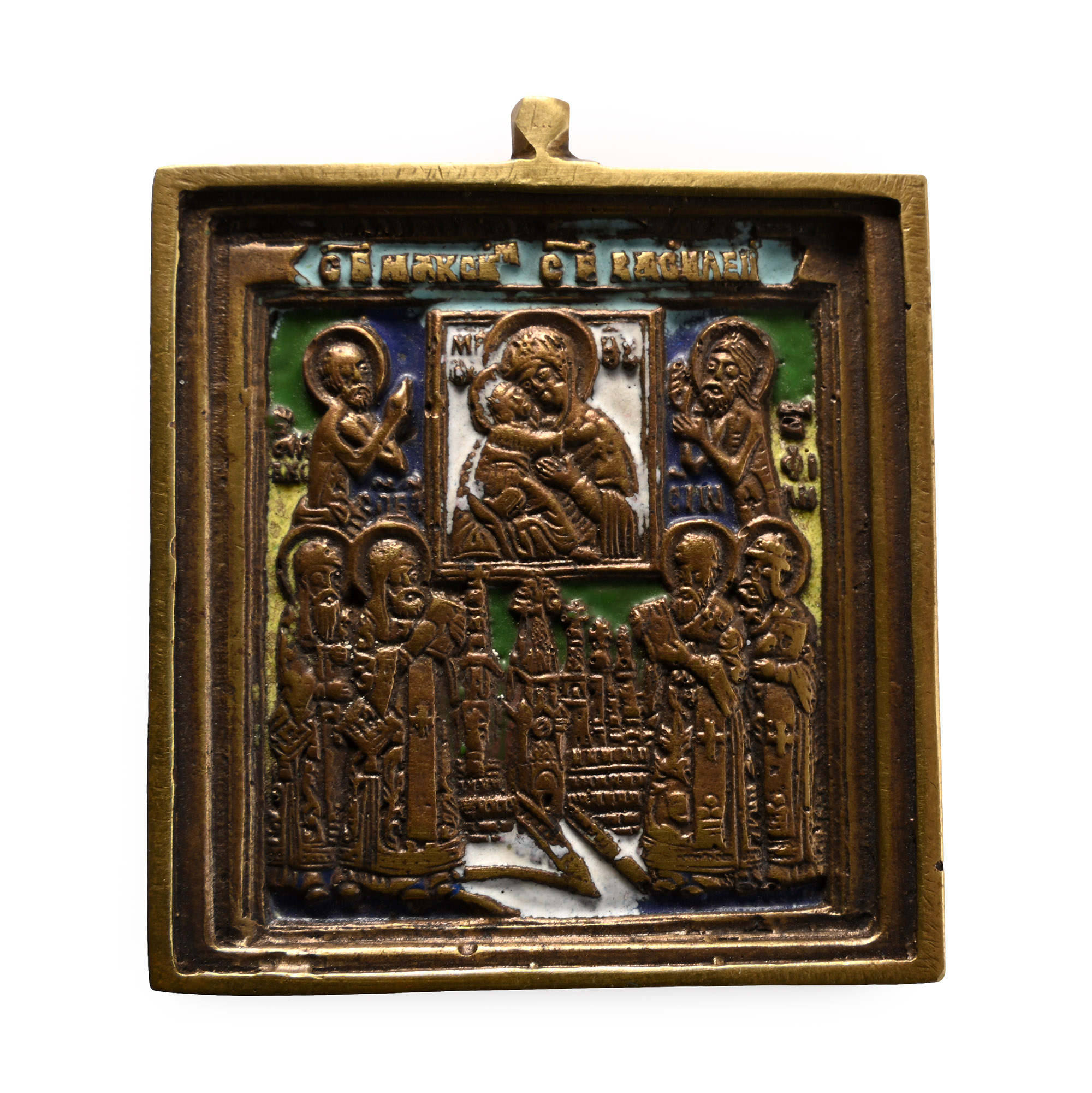
Russian Orthodox Enamelled Bronze Travel Icon with Veneration of the Virgin of Vladimir
19TH CENTURY A.D.
2 3/8 in. (96 grams, 60 mm).
Representing the Vladimir Mother of God with the Divine Child; the half-length figure Mary with covered head turned right and with her left hand raised; holding the embracing infant Jesus in her right hand; above them inscription in Greek letters 'ΜΡ ΘΥ' (Mother of God); flanking the central icon and beneath it the images of the Saints Peter, Paul, Peter of Moscow and John Chrysostomos, Saint Gregory and Saint Dimitri; in the foreground the city of Vladimir.
ProvenanceAcquired from Chris Martin-Zakheim, Iconastas, 5 Piccadilly Arcade, London SW1.
From the private collection of a West London, UK, gentleman, formed since the early 2000s.
Cf. Eighme Ahlborn, R., Beaver-Bricken Espinola, V., Russian Copper Icons and crosses from the Kunz Collection: Castings of Faith, Washington, 1991, nos.25819.106, p.56, for similar iconography.
FootnotesThe original icon prototype of these smaller icons was the icon of the Virgin Mother of Vladimir with the infant Jesus (the original preserved in the Tretyakov Gallery, Moscow), probably the most famous icon of Russia, which was thought to have been created in Constantinople in the early part of 1100s. This image is sometimes referred to as the ‘tenderness icon’, with artists attempting to show the close relationship of mother and son with their cheeks touching as they embrace.
CONDITIONTimeLine Auctions follows a vetting process to ensure the authenticity and legality of all items, reinforcing our commitment to integrity and responsible trading. Each antiquity, antique, and coin lot undergoes thorough examination by a vetting committee of at least ten external specialists, professional trade association members, scientists, and archaeologists: Our Vetting Process
AUCTIONS:
TimeLine is a leading auction house specialising in antiquities, ancient art, collectables, natural history, coins, medals, and books. Our auctions offer museums, collectors, historians, and enthusiasts the opportunity to acquire unique and historically significant pieces.
LOT 1909
Russian Orthodox Enamelled Bronze Travel Icon with Veneration of the Virgin of Vladimir
Estimate £120 - 170€140 - 200 (for guidance only)$160 - 230 (for guidance only)
-
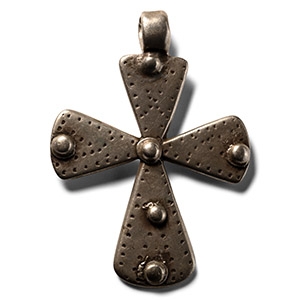
Ethiopian White Metal Cross Pendant
19th century A.D.Sold for (Inc. bp): £39
With triangular arms, applied bulbs and punched decoration. 15.2 grams, 58 mm
Acquired from Chris Martin-Zakheim, Iconastas, 5 Piccadilly Arcade, London SW1. From the private collection of a West London, UK, gentleman, formed since the early 2000s. -
.jpg)
Gemstone Collection
19th-20th century A.D.Estimate: £120 - 170 (+bp*)
Opening Bid: £60
Comprising: profile male and female busts in carnelian and other stones; each supplied with a museum-quality impression. 4.66 grams total, 14-18 mm
Private collection, England. -
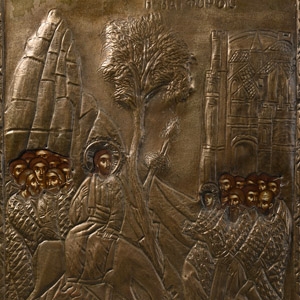
Icon with Riza of Entrance to Jerusalem
20th century A.D.Sold for (Inc. bp): £39
Painted on a wooden board and covered with a brass riza, with mounting panel to the reverse, depicting the entrance of Christ in Jerusalem on Palm Sunday riding a donkey; crowd within the city wall; followers of Christ in the gateway; Christ with golden nimbus and letters 'ω', 'C' reversed and 'Н'; Greek script title above reciting: 'Η ΒΑΙΦΟΡΟC (Βαϊοφόρος)' (the one who is riding the mule); the background with rocks, tree and the walls of Jerusalem; arabesque decoration to the borders and corners; accompanied by a wooden stand. 762 grams total including stand, Icon: 30.5 x 22.5 cm
Ex David Miller, Hemel Hempstead, London, UK. From the private collection of a West London, UK, gentleman, formed since the early 2000s.
The scene represents a well-known part of the Gospels that describe the entry of Jesus into Jerusalem. He makes a grand entrance into the city on a donkey to fulfil the prophecy of Zechariah, “Tell the city of Zion, look, your king is coming to you! He is humble and rides on a donkey and on a colt, the foal of a donkey.” The scene is synthetized in the Greek expression ‘Βαϊοφόρος'.
