
Loading, please wait...
LOT 2090
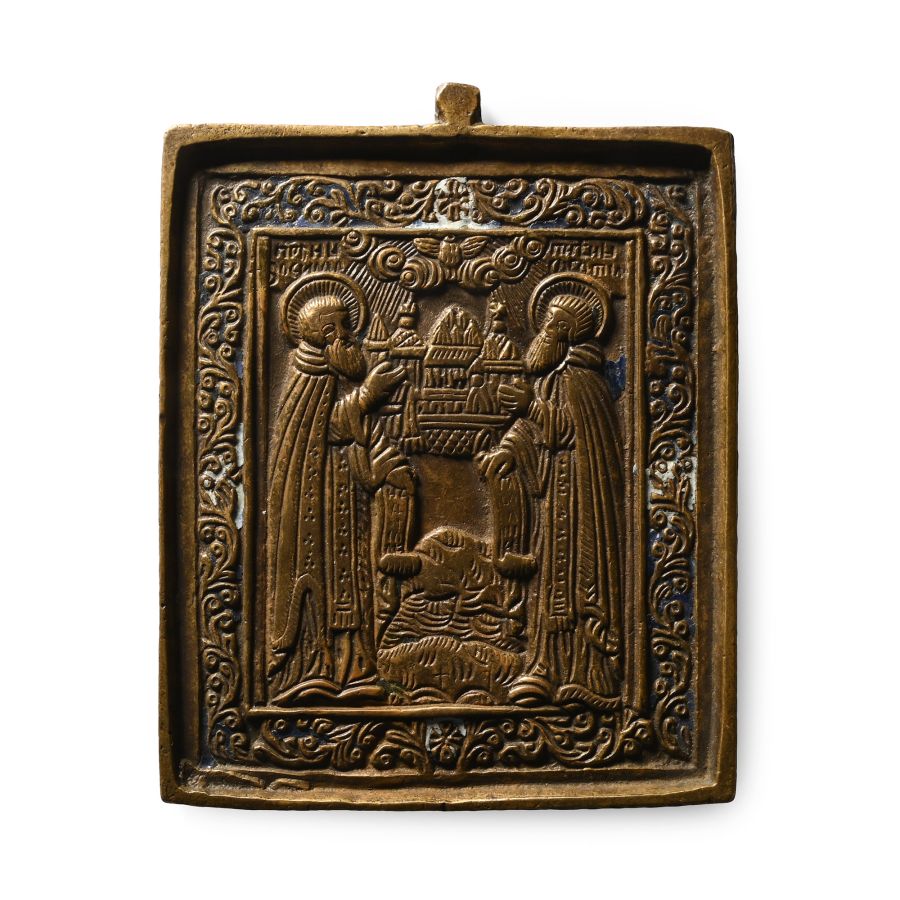
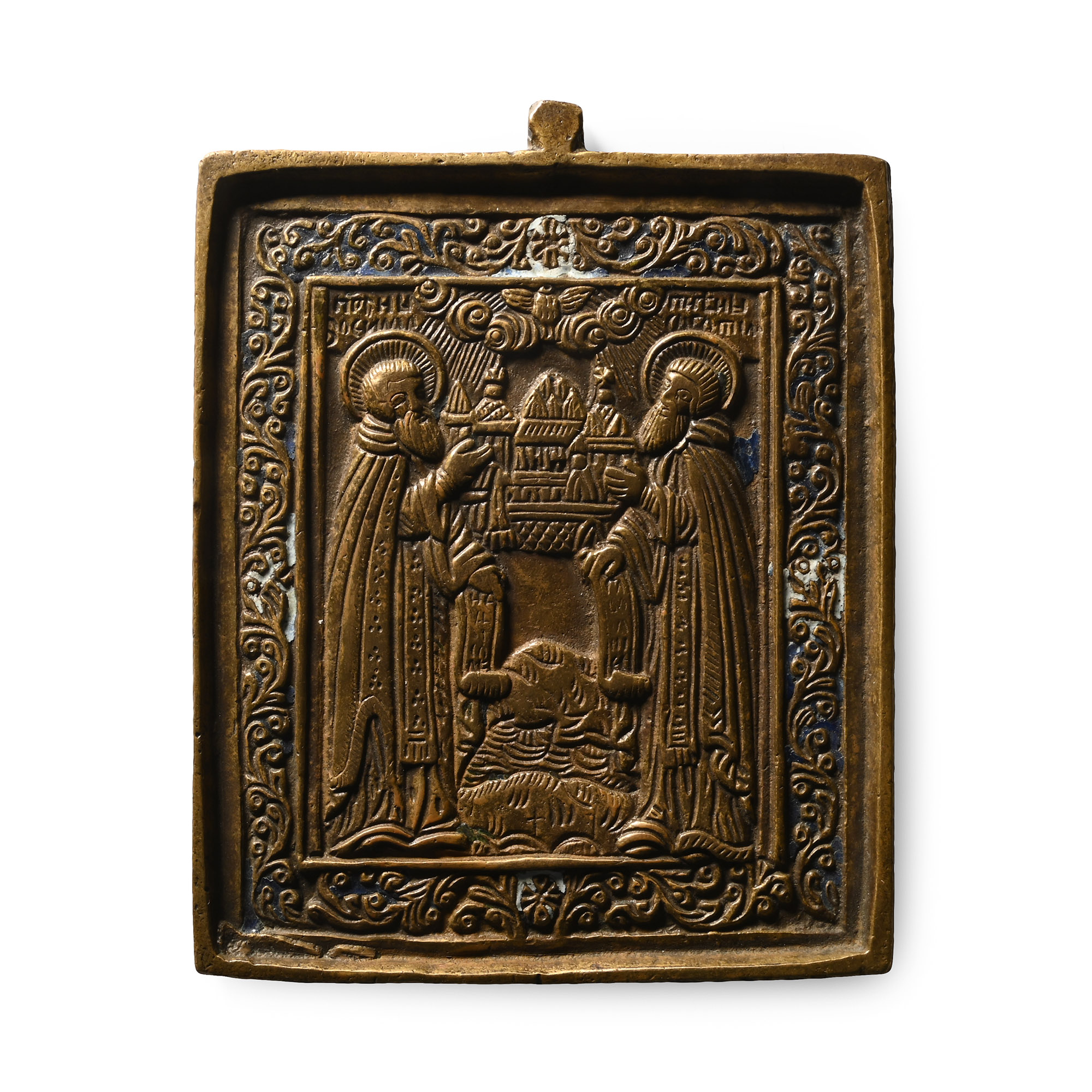
Russian Orthodox Enamelled Bronze Travel Icon with Saints Zosima and Sabbas
CIRCA 1820 A.D.
3 1/2 in. (108 grams, 88 mm).
Depicting Saint Zosima and Saint Sabbas in front of the Solovetsky Monastery; both nimbate and dressed inAbbot’s garments, holding the model of the monastery offered to God, represented in the sky as a dove upon a cloud; arabesque frame; inscriptions in Old Slavonic with the names of the saints.
ProvenanceAcquired from Chris Martin-Zakheim, Iconastas, 5 Piccadilly Arcade, London SW1.
From the private collection of a West London, UK, gentleman, formed since the early 2000s.
Cf. Matthieson, S., Morrison, G., Heavenly Beings, Icons of the Christian Orthodox World, Auckland, 2022, p.66, for a similar icon.
FootnotesSaints Zosima and Sabbas or Sabbatius were highly venerated Orthodox saints, founders of the Solovetsky Monastery, a fortified monastery located in the White Sea in Northern Russia. This double portrait shows Zosima and Sabbas holding up a model of their religious institution, which resembles a small medieval city. Solovetsky Monastery obtained big investments from the city of Novgorod and established itself as one of the richest monasteries in Russia.
CONDITIONTimeLine Auctions follows a vetting process to ensure the authenticity and legality of all items, reinforcing our commitment to integrity and responsible trading. Each antiquity, antique, and coin lot undergoes thorough examination by a vetting committee of at least ten external specialists, professional trade association members, scientists, and archaeologists: Our Vetting Process
AUCTIONS:
TimeLine is a leading auction house specialising in antiquities, ancient art, collectables, natural history, coins, medals, and books. Our auctions offer museums, collectors, historians, and enthusiasts the opportunity to acquire unique and historically significant pieces.
LOT 2090
Russian Orthodox Enamelled Bronze Travel Icon with Saints Zosima and Sabbas
Estimate £120 - 170€140 - 200 (for guidance only)$160 - 230 (for guidance only)
-
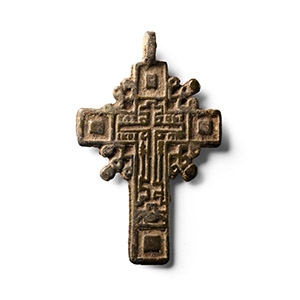
Russian Orthodox Bronze Cross Pendant
17th century A.D.Sold for (Inc. bp): £20
Cruciform with interstitial lobes; obverse with voided cross and Cyrillic legend, raised square panel to end of each arm; reverse with foliage detailing. 6.6 grams, 48 mm
Acquired from Chris Martin-Zakheim, Iconastas, 5 Piccadilly Arcade, London SW1. From the private collection of a West London, UK, gentleman, formed since the early 2000s. -
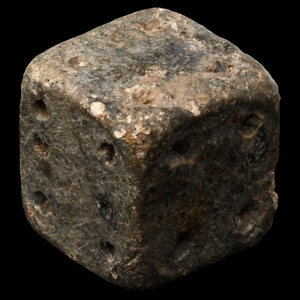
Lead Gaming Dice
17th-18th century A.D.Sold for (Inc. bp): £52
Cuboid with punched pellet markings disposed 1:6, 2:4, 3:5. 24.9 grams, 14 mm
From the private collection of Colin Narbeth, UK, 1990s, with collection reference no.128. -
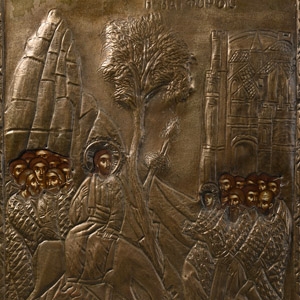
Icon with Riza of Entrance to Jerusalem
20th century A.D.Sold for (Inc. bp): £39
Painted on a wooden board and covered with a brass riza, with mounting panel to the reverse, depicting the entrance of Christ in Jerusalem on Palm Sunday riding a donkey; crowd within the city wall; followers of Christ in the gateway; Christ with golden nimbus and letters 'ω', 'C' reversed and 'Н'; Greek script title above reciting: 'Η ΒΑΙΦΟΡΟC (Βαϊοφόρος)' (the one who is riding the mule); the background with rocks, tree and the walls of Jerusalem; arabesque decoration to the borders and corners; accompanied by a wooden stand. 762 grams total including stand, Icon: 30.5 x 22.5 cm
Ex David Miller, Hemel Hempstead, London, UK. From the private collection of a West London, UK, gentleman, formed since the early 2000s.
The scene represents a well-known part of the Gospels that describe the entry of Jesus into Jerusalem. He makes a grand entrance into the city on a donkey to fulfil the prophecy of Zechariah, “Tell the city of Zion, look, your king is coming to you! He is humble and rides on a donkey and on a colt, the foal of a donkey.” The scene is synthetized in the Greek expression ‘Βαϊοφόρος'.
