
Loading, please wait...
LOT 2093
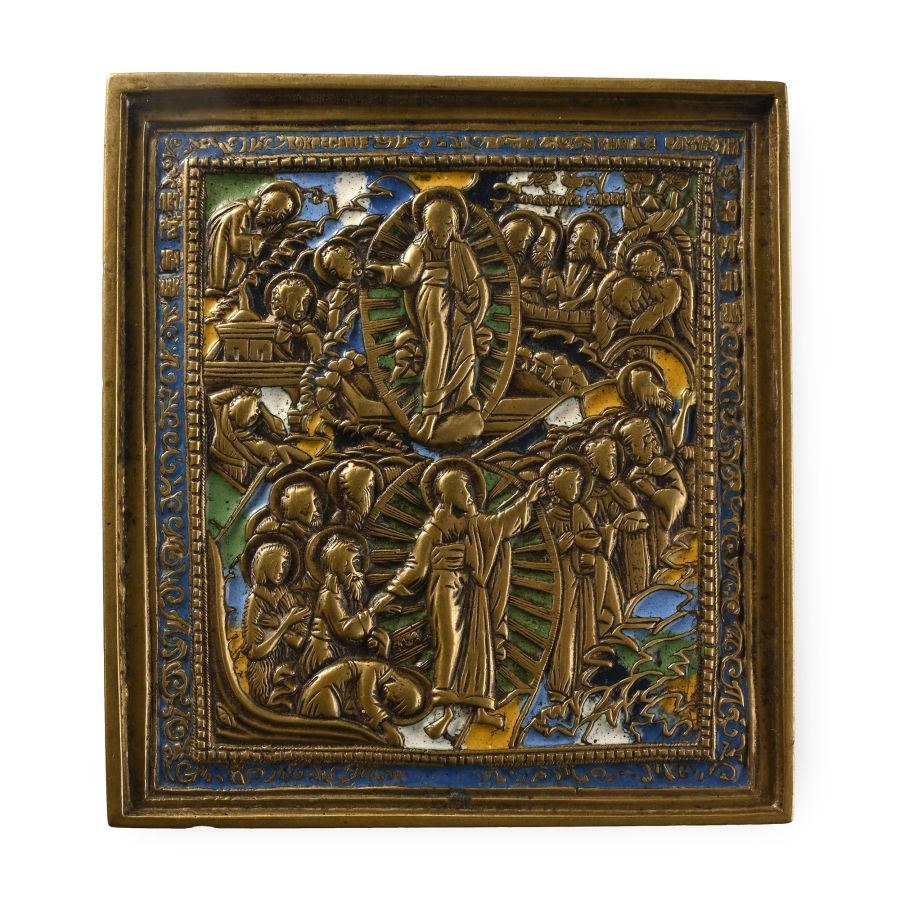
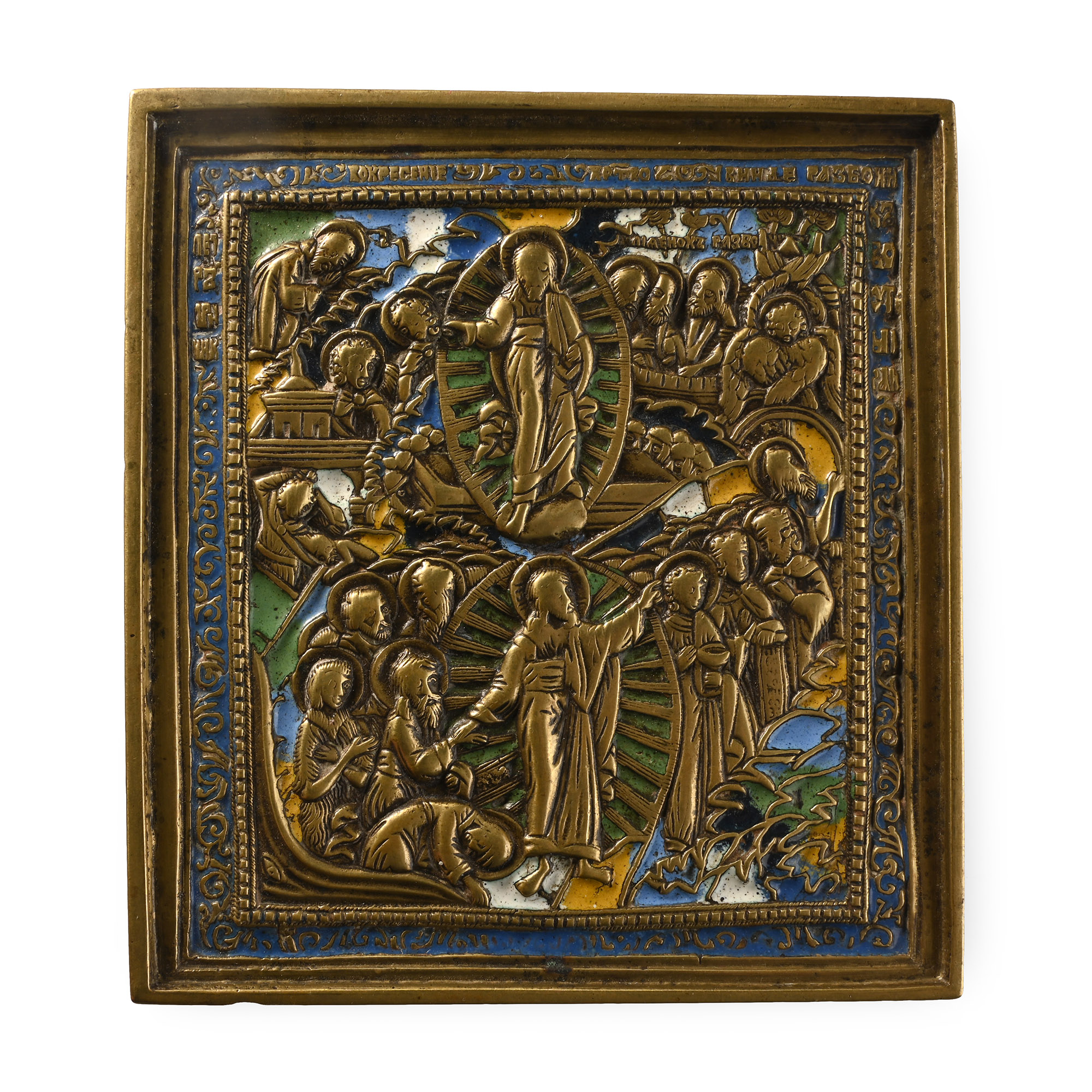
Russian Orthodox Enamelled Bronze Travel Icon with Anastasis
19TH CENTURY A.D.
4 3/8 in. (200 grams, 11 cm).
With blue, yellow, white and green enamel, representing the Anastasis (Resurrection of Christ); the Saviour represented on two registers, in the upper one (Resurrection) emerging from the grave, surrounded by the hesychastic light, with the Roman soldiers falling asleep, and the apostles and a cherubin beside him; in the lower register (Descent into Hades) Christ surrounded by the same divine light, leading the people from the Limbo, Adam and Eve, King David and Salomon and other souls to heaven; the frame decorated with gilt arabesques on blue enamel, inscriptions in Old Slavonic at the top.
ProvenanceAcquired from Chris Martin-Zakheim, Iconastas, 5 Piccadilly Arcade, London SW1.
From the private collection of a West London, UK, gentleman, formed since the early 2000s.
Cf. Eighme Ahlborn, R., Beaver-Bricken Espinola, V., Russian Copper Icons and crosses from the Kunz Collection: Castings of Faith, Washington, 1991, nos.25819.006, p.43; 055 p.47; 057p.48, for similar iconography.
FootnotesThe iconography is typical of the Anastasis or Resurrection of Christ, with the gates of Hades broken under the feet of the Christ, echoing the phrase: 'Christ is Risen From the Dead, Trampling Down Death by Death, and Upon Those in the Tombs Bestowing Life!'
CONDITIONTimeLine Auctions follows a vetting process to ensure the authenticity and legality of all items, reinforcing our commitment to integrity and responsible trading. Each antiquity, antique, and coin lot undergoes thorough examination by a vetting committee of at least ten external specialists, professional trade association members, scientists, and archaeologists: Our Vetting Process
AUCTIONS:
TimeLine is a leading auction house specialising in antiquities, ancient art, collectables, natural history, coins, medals, and books. Our auctions offer museums, collectors, historians, and enthusiasts the opportunity to acquire unique and historically significant pieces.
LOT 2093
Russian Orthodox Enamelled Bronze Travel Icon with Anastasis
Estimate £200 - 300€230 - 350 (for guidance only)$270 - 410 (for guidance only)
-

Neoclassical Carnelian Gemstone with Bacchic Procession
Italy, 19th century A.D.Sold for (Inc. bp): £2,600
The oval intaglio carved with a lively Bacchic procession: a winged putto driving a goat-drawn chariot, grasping a thyrsus with one hand and guiding the reins with the other; before the chariot, another putto dancing and playing the pipes; set in a gold pendant. 7.83 grams, 38 mm
Private collection, UK.
The subject reflects the revival of antique themes characteristic of early 19th-century glyptic art, drawing inspiration from Roman gems and Renaissance engravings after Raphael. Such imagery of putti in Bacchic revels was emblematic of festivity, abundance, and playful triumph, well-suited to the Neoclassical fascination with classical allegory. For a comparison, see the Metropolitan Museum of Art, New York, accession no. 49.97.335, “A frieze arrangement with a putto wearing a laurel crown riding a goat at left and many infants playing musical instruments in front,” Master of the Die after Raphael, c. 1530–60. -
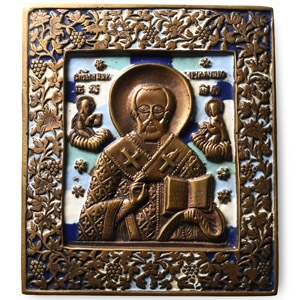
Russian Orthodox Enamelled Bronze Travel Icon with Saint Nicholas
19th century A.D.Estimate: £250 - 350 (+bp*)
Opening Bid: £125
Representing Saint Nicholas of Myra with a book in his left hand and making the gesture of blessing with his right, dressed as a bishop with sticharion, covered by omophorion, and surmounted by an epitrachelion embroidered with crosses; the saint flanked by Jesus and Virgin Mary, Christ holding the gospel, Mary the bishop’s epitrachelion; Cyrillic inscriptions 'Saint Nikolaos the Wonderworker (СВЯТЫЙ НИКОЛА ЧУДОТВОРЕЦ), Iesus Christos (ΙΣ ΧC) and Mother of God (ΜΡ ΘΥ)' on the enamelled background. 348 grams, 10.7 cm
Acquired from Chris Martin-Zakheim, Iconastas, 5 Piccadilly Arcade, London SW1. From the private collection of a West London, UK, gentleman, formed since the early 2000s.
The icon features meticulous craftsmanship typical of Orthodox iconography. The enamel colors, despite the passage of time, retain their vibrant intensity, highlighting the key elements of the depicted images. The refined details and use of enamel give depth and luminosity to the icon, making it a precious example of the Russian Orthodox tradition. -
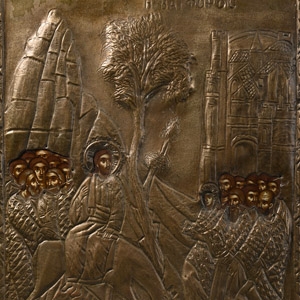
Icon with Riza of Entrance to Jerusalem
20th century A.D.Sold for (Inc. bp): £39
Painted on a wooden board and covered with a brass riza, with mounting panel to the reverse, depicting the entrance of Christ in Jerusalem on Palm Sunday riding a donkey; crowd within the city wall; followers of Christ in the gateway; Christ with golden nimbus and letters 'ω', 'C' reversed and 'Н'; Greek script title above reciting: 'Η ΒΑΙΦΟΡΟC (Βαϊοφόρος)' (the one who is riding the mule); the background with rocks, tree and the walls of Jerusalem; arabesque decoration to the borders and corners; accompanied by a wooden stand. 762 grams total including stand, Icon: 30.5 x 22.5 cm
Ex David Miller, Hemel Hempstead, London, UK. From the private collection of a West London, UK, gentleman, formed since the early 2000s.
The scene represents a well-known part of the Gospels that describe the entry of Jesus into Jerusalem. He makes a grand entrance into the city on a donkey to fulfil the prophecy of Zechariah, “Tell the city of Zion, look, your king is coming to you! He is humble and rides on a donkey and on a colt, the foal of a donkey.” The scene is synthetized in the Greek expression ‘Βαϊοφόρος'.
