
Loading, please wait...
LOT 1908
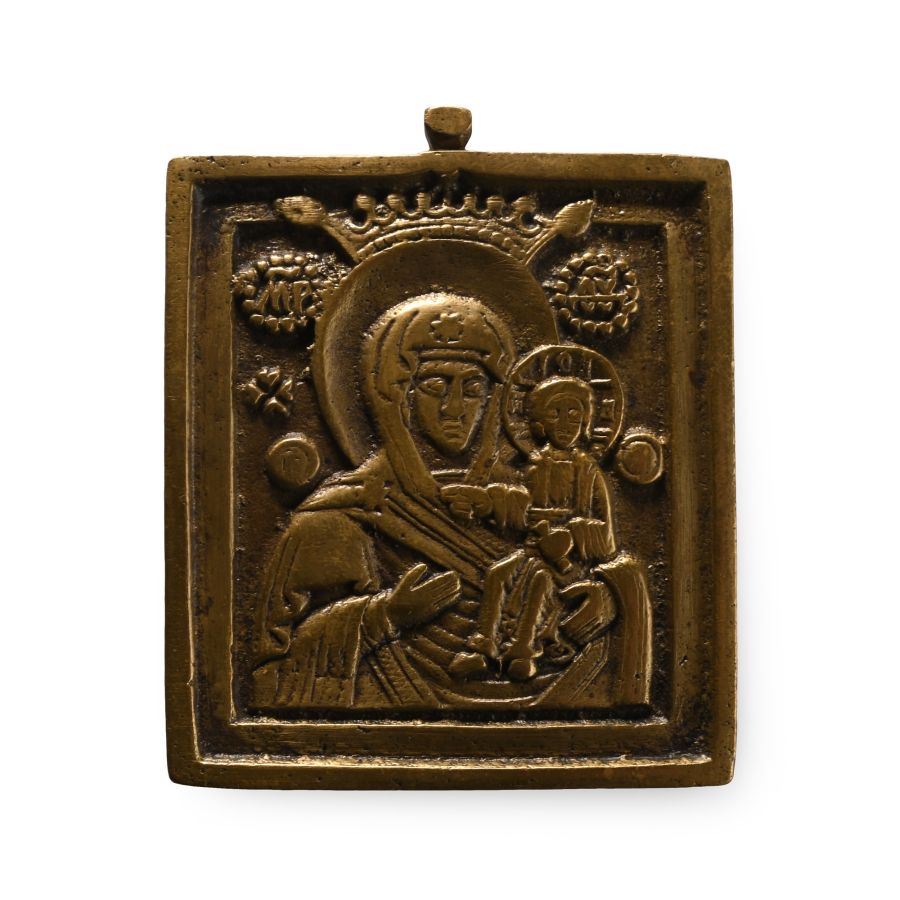
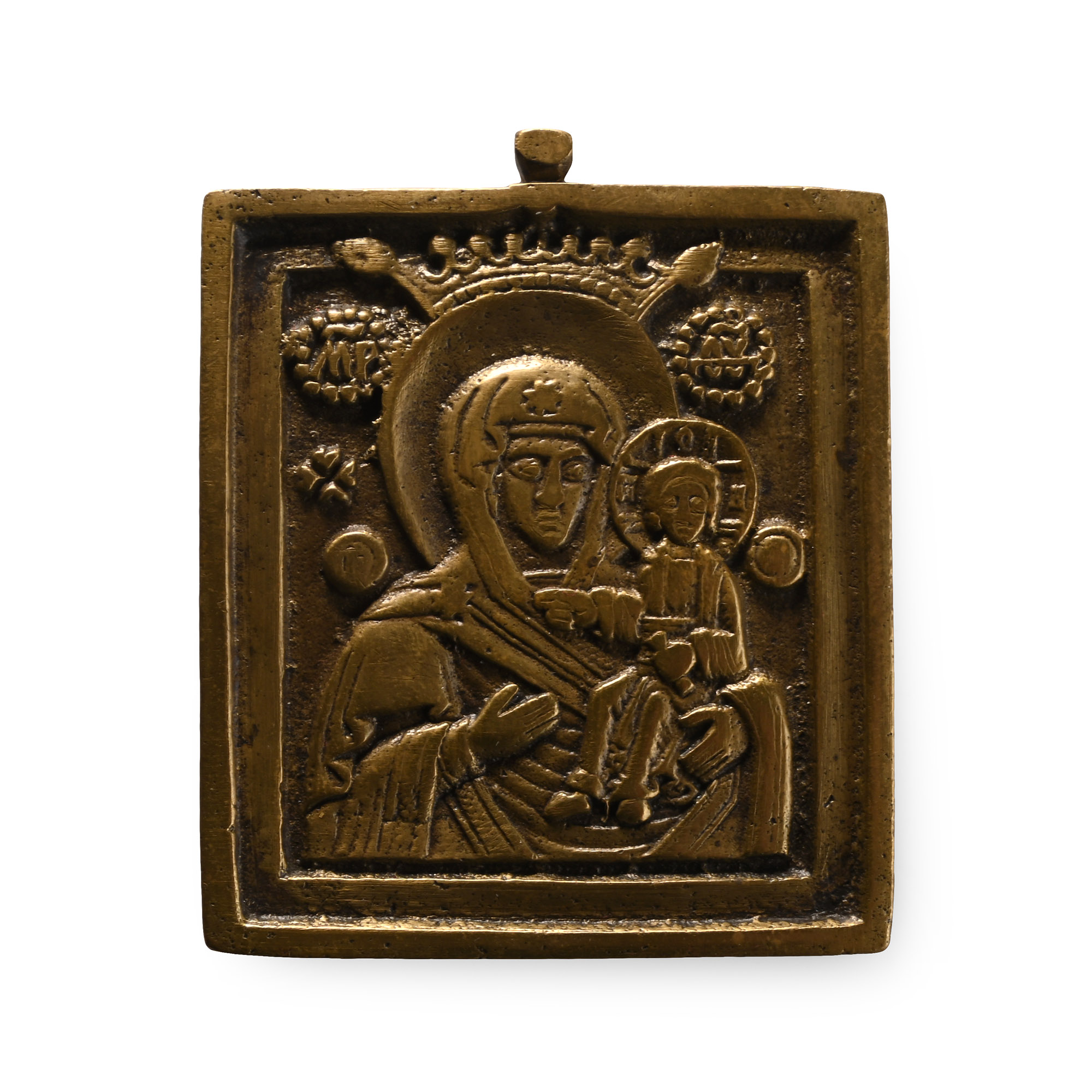
Russian Orthodox Bronze Travel Icon with Kazan Virgin and Child
18TH CENTURY A.D.
2 1/2 in. (53 grams, 63 mm).
Representing the Mother of God of Kazan with the Divine Child; the head covering of Mary marked with a six-point star, infant Jesus extending his right hand in blessing; Greek inscriptions 'ΜΡ ΘΥ' (Mother of God) and 'O Ѡ N' (‘I am’); knop at the top for suspension. [No Reserve]
ProvenanceAcquired from Chris Martin-Zakheim, Iconastas, 5 Piccadilly Arcade, London SW1.
From the private collection of a West London, UK, gentleman, formed since the early 2000s.
Cf. Eighme Ahlborn, R., Beaver-Bricken Espinola, V., Russian Copper Icons and crosses from the Kunz Collection: Castings of Faith, Washington, 1991, nos.25819.078, p.50, for similar iconography.
FootnotesThe original prototype of these small icons, also known as the Theotokos of Kazan, is thought to have originated in Constantinople in the 13th century before it was taken to Russia. When the Turks took over Kazan in 1438, the icon was most probably hidden to keep it safe. Ivan the Terrible liberated Kazan in 1552, and the town was destroyed by fire in 1579, after which the icon was found and brought to the Church of Saint Nicholas. It was subsequently stolen in 1904 and never found again, though there are many copies in existence.
CONDITIONTimeLine Auctions follows a vetting process to ensure the authenticity and legality of all items, reinforcing our commitment to integrity and responsible trading. Each antiquity, antique, and coin lot undergoes thorough examination by a vetting committee of at least ten external specialists, professional trade association members, scientists, and archaeologists: Our Vetting Process
AUCTIONS:
TimeLine is a leading auction house specialising in antiquities, ancient art, collectables, natural history, coins, medals, and books. Our auctions offer museums, collectors, historians, and enthusiasts the opportunity to acquire unique and historically significant pieces.
LOT 1908
Russian Orthodox Bronze Travel Icon with Kazan Virgin and Child
Sold for (Inc. bp): £39
-
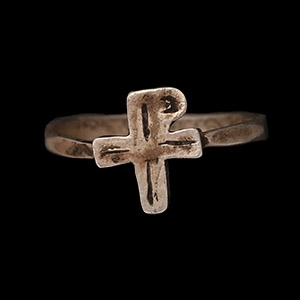
Byzantine Style Silver Ring with Cross
20th century A.D.Sold for (Inc. bp): £117
Comprising a facetted hoop and integral chi-rho Christogram. 2.46 grams, 21.74 mm overall, 17.83 mm internal diameter (approximate size British P, USA 7 1/2, Europe 16.23, Japan 15)
Acquired on the London art market in the late 1980s-1990s. From the family collection of an East London, UK, gentleman. -
![Civil War and Later Lead Musket and Pistol Ball Collection [100]](https://timelineauctions.com/upload/images/items/small/244206-s.jpg)
Civil War and Later Lead Musket and Pistol Ball Collection [100]
Circa 17th-19th century A.D.Sold for (Inc. bp): £182
Mixed group of musket and pistol shot, some with casting nipple still attached, some with impact damage. 1.55 kg total, 8-18 mm
Found Suffolk, UK. -
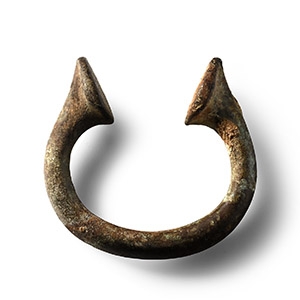
The 'Schooner Douro' Shipwreck Bronze Manilla Currency Bracelet
19th century A.D.Sold for (Inc. bp): £33
Comprising a round-section penannular body and trumpet-shaped terminals; accompanying collector's handwritten note 'Schooner Douro trading from England > Puerto > Sudan (slaver) carrying manillas and beads, armoury and baled goods. Wrecked off Gt. Creberweshan Rock, Isles of Scilly 1943. All hands loss [sic].' 88 grams, 60 mm
From the old private collection of a retired UK gentleman; his collection formed in the 1990s.
