
Loading, please wait...
LOT 1960
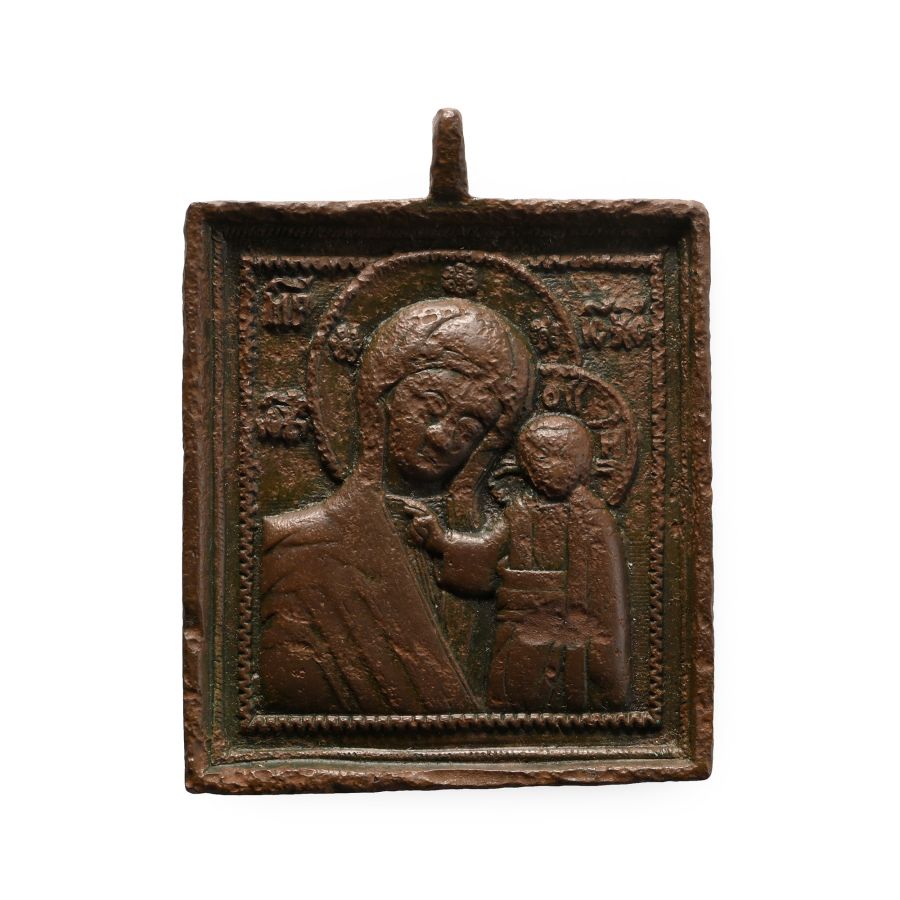
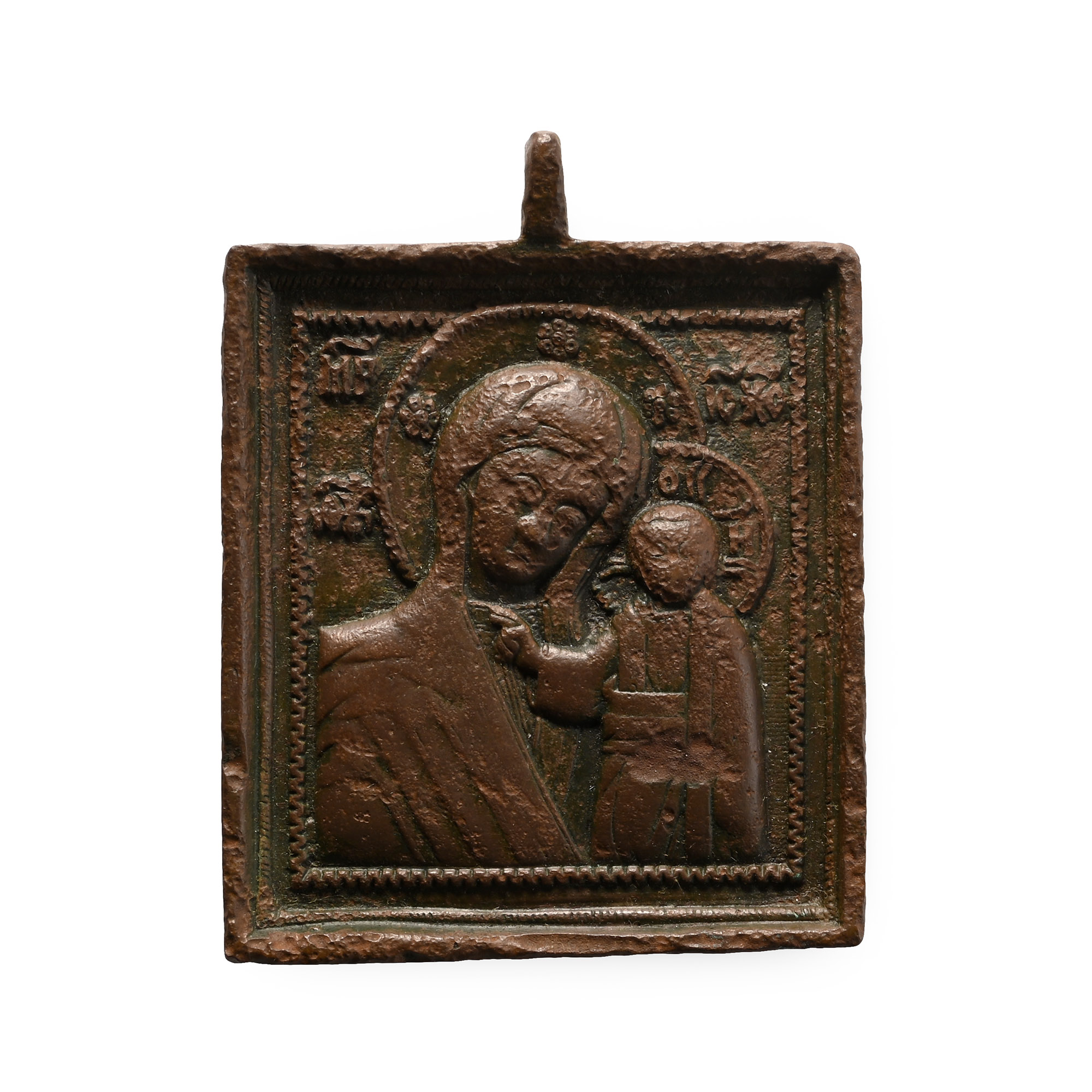
Russian Bronze Travel Icon with Madonna and Child
CIRCA 18TH CENTURY A.D.
2 3/8 in. (34.3 grams, 59 mm).
Depicting the Mother of God of Kazan with the Divine Child; the head of Mary slightly turned left towards infant Jesus extending his right hand in blessing; both figures with large haloes and identifying Greek inscriptions 'ΜΡ ΘΥ' (Mother of God) and 'O Ѡ N' (I am); three flowers in the nimbus of the Virgin; knop at the top for the suspension. [No Reserve]
ProvenanceAcquired from Chris Martin-Zakheim, Iconastas, 5 Piccadilly Arcade, London SW1.
From the private collection of a West London, UK, gentleman, formed since the early 2000s.
Cf. Eighme Ahlborn, R., Beaver-Bricken Espinola, V., Russian Copper Icons and crosses from the Kunz Collection: Castings of Faith, Washington, 1991, nos.25819.078, p.50, for similar iconography.
FootnotesThe original icon prototype of these smaller icons, also known as the Theotokos of Kazan, is thought to have originated in Constantinople in the 13th century before it was taken to Russia. When the Turks took over Kazan in 1438, the icon was most probably hidden to keep it safe. Ivan the Terrible liberated Kazan in 1552, and the town was destroyed by fire in 1579, after which the icon was found and brought to the Church of Saint Nicholas. It was subsequently stolen in 1904 and never found again, though there are many copies in existence.
CONDITIONTimeLine Auctions follows a vetting process to ensure the authenticity and legality of all items, reinforcing our commitment to integrity and responsible trading. Each antiquity, antique, and coin lot undergoes thorough examination by a vetting committee of at least ten external specialists, professional trade association members, scientists, and archaeologists: Our Vetting Process
AUCTIONS:
TimeLine is a leading auction house specialising in antiquities, ancient art, collectables, natural history, coins, medals, and books. Our auctions offer museums, collectors, historians, and enthusiasts the opportunity to acquire unique and historically significant pieces.
-
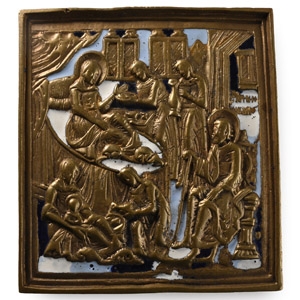
Russian Orthodox Enamelled Bronze Travel Icon with the Birth of the Virgin
19th century A.D.Estimate: £200 - 300 (+bp*)
Opening Bid: £100
Presenting an architectural setting with figures in two chambers framed with cornices, columns and furnitures; the upper chamber showing Saint Anna in birthing bed with two attendants; the lower room with two attendants bathing an infant; on the right Saint Joachim seated upon a cathedra; Old Slavonic inscription reciting ‘The birth of the most holy mother of God’. 230 grams, 98 mm
Acquired from Chris Martin-Zakheim, Iconastas, 5 Piccadilly Arcade, London SW1. From the private collection of a West London, UK, gentleman, formed since the early 2000s.
According to the Protoevangelium of James, Mary's parents were called Anna and Joachim and conceived Mary at a late age. -
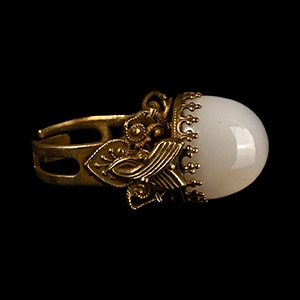
Post Medieval Brass Ring with Chrysoberyl Gemstone
19th-20th century A.D.Sold for (Inc. bp): £59
With openwork expanding hoop, floral detailing to shoulders, bezel with claw setting and inset ovoid gemstone displaying asterism. 10.31 grams, 36.00 mm overall, 17.40 x 19.00 mm internal diameter (approximate size British O, USA 7, Europe 14.98, Japan 14)
From the collection of William Kearney. From the property of a late Lincolnshire, UK, gentleman. -

Large Georgian Gold Wedding Ring
18th-19th century A.D.Sold for (Inc. bp): £390
Lentoid in section, probably a glove ring. 2.55 grams, 24.5 mm overall, 21.76 mm internal diameter (approximate size British Y 1/2, USA 12 1/4, Europe 28.20, Japan 27)
Acquired from the early 1980s. From the private collection of a late Gloucestershire, UK, gentleman; thence by descent.
