Loading, please wait...
LOT 0710
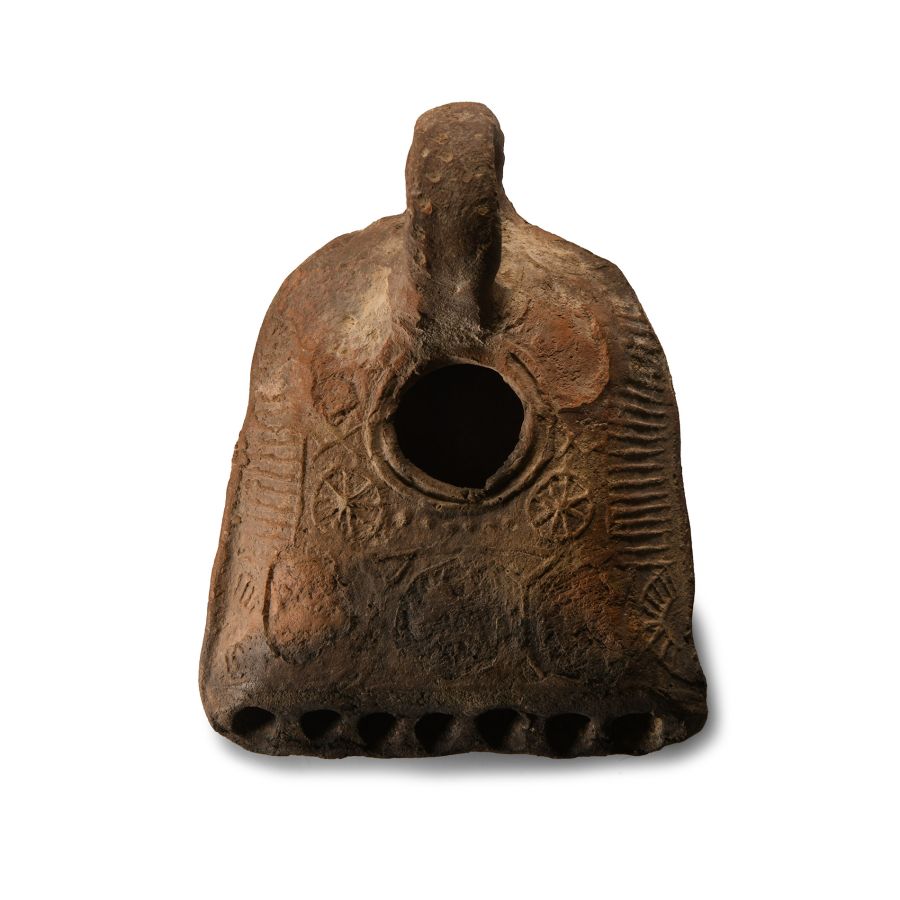
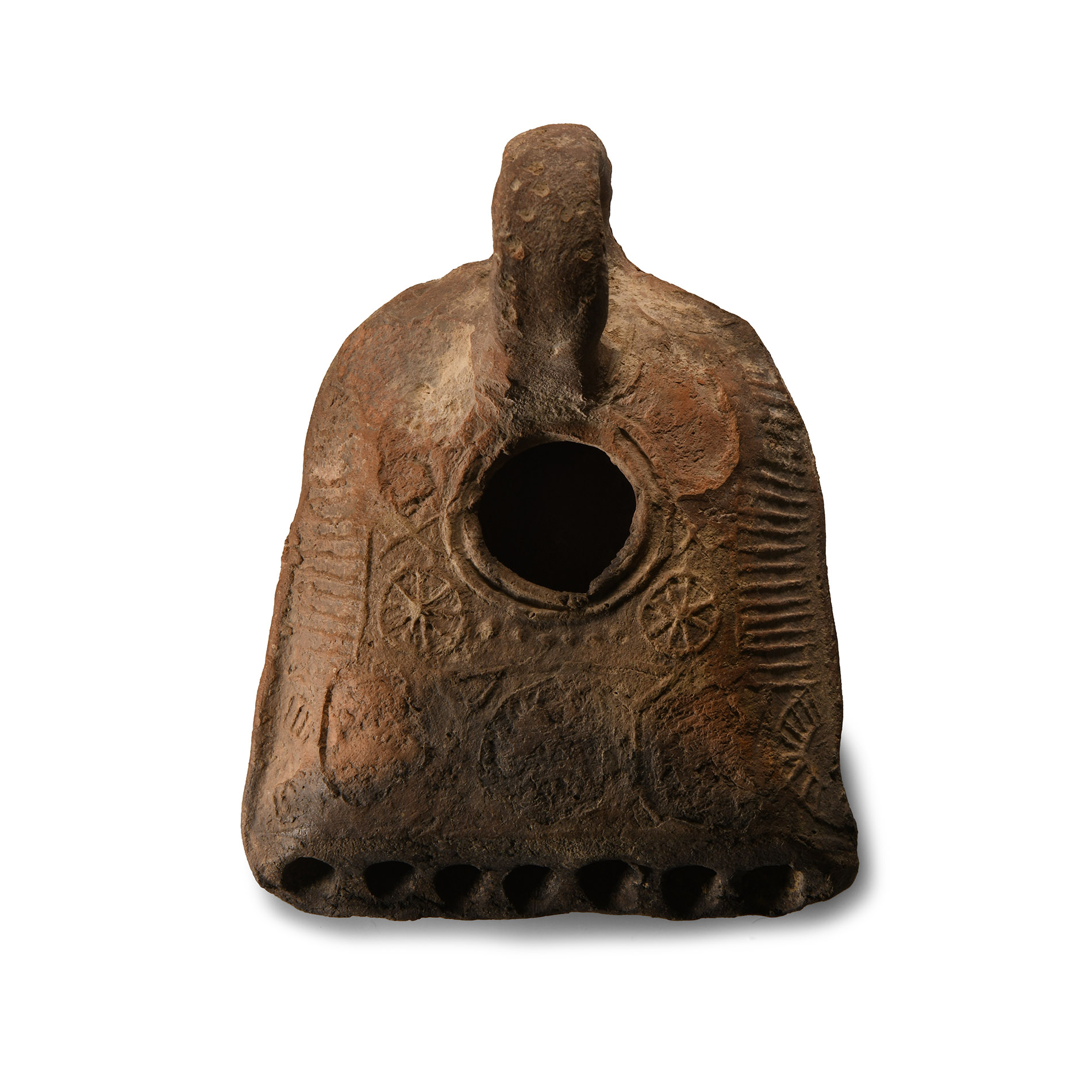
Romano-Jewish Terracotta Oil Lamp with Seven Spouts
4TH-5TH CENTURY A.D.
5 1/8 in. (238 grams, 13 cm).
Hollow-formed tongue-shaped lamp with chamfered sides, loop handle, large filler hole; low-relief rosette and other ornament to the discus, chamfered forward edge with seven nozzles.
ProvenanceAcquired on the German art market, 1989-1995.
with The Museum Gallery, 19 Bury Place, London, WC1, UK, 1998-2003.
Property of a London based academic, 2003-present.
The lamp was probably a variant on the menorah with seven separate lights from a single source.
CONDITIONTimeLine Auctions follows a vetting process to ensure the authenticity and legality of all items, reinforcing our commitment to integrity and responsible trading. Each antiquity, antique, and coin lot undergoes thorough examination by a vetting committee of at least ten external specialists, professional trade association members, scientists, and archaeologists: Our Vetting Process
AUCTIONS:
TimeLine is a leading auction house specialising in antiquities, ancient art, collectables, natural history, coins, medals, and books. Our auctions offer museums, collectors, historians, and enthusiasts the opportunity to acquire unique and historically significant pieces.
LOT 0710
Romano-Jewish Terracotta Oil Lamp with Seven Spouts
Sold for (Inc. bp): £416
-
Roman Terracotta LEG I ITAL Legionary Stamped Tile
Late 1st century A.D.Sold for (Inc. bp): £572
A rectangular block with stamped mark 'LEGT I ITAL' (Legio I Italica) for 1st Legion 'Italic'; with collector's label 'Roman brick made by the Ist Italica Legion at Olpia Oescus on the lower Danube, one of Trajan's strategic bases prior to the invasion of Dacia in 106 AD. LEG I ITAL' 4.35 kg, 19 cm
From the collection of a late East Anglian teacher and antiquarian who retired to the Isle of Wight in Hampshire, UK. He amassed a large collection of objects between the 1960s-1980s. Accompanied by a previous catalogue identification card.
The Legio I Italica ("of Italy") was a Roman legion formed by Nero on September 20, 66 or 67 AD and active until the 5th century AD. Its emblems were the boar and sometimes the bull. There are many sources which name army officials employed in supervision of the construction and reconstruction of temples, baths, city walls, towers and gates. CIL VIII 2728, for example, is a letter by evocatus Augusti who was sent to solve engineering problems on a badly surveyed aqueduct at Saldae in the province of Numidia. Pliny (Epistulae X 17b, 39, 41, 61) repeatedly requested an army architect to be sent from Lower Moesia to help inspect some Bithynian building projects. Therefore it is not strange that tiles marked as belonging to a legion should be found all over the provinces. -
Roman Marble Portrait Head of Gaius Caesar
Augustan, circa 5 B.C.-1 A.D.Estimate: £30,000 - 40,000 (+bp*)
Opening Bid: £16,667
Modelled in the round probably using Parian marble, head of a youth depicted turning slightly to his left, hair trimmed in the Julian style; believed to be of Gaius Iulius Caesar Vipsanianus (20 B.C.- 4 A.D.); mounted on a custom-made stand. 17.4 kg total, 48 cm high including stand
Acquired on the London art market in the 1970s by the previous owner’s late father. with Christie’s London, 25 April 2007, no.260. UK private collection, London. Anonymous sale, Bonhams, London, 16 April 2015, no.130. Accompanied by an academic report by Dr Raffaele D’Amato. This lot has been checked against the Interpol Database of stolen works of art and is accompanied by a search certificate number no.163499-10061.
Gaius Caesar (20 B.C.-4 A.D.) and his brother Lucius Caesar (17 B.C.-2 A.D.) held significant positions in the political and dynastic plans of Emperor Augustus. Born to Augustus' daughter Julia and his advisor Marcus Vipsanius Agrippa, they were adopted by Augustus in 17 B.C. to become his heirs, since he lacked natural-born sons. Portraits of the brothers depicted them as resembling Augustus, indicating their importance within the imperial family. Gaius' portraits were classified into five types, with this head identified as Type IV, likely created in 1 A.D. to celebrate his consulship. A similar portrait of Gaius exists in Corinth alongside his brother and Augustus. In 1 B.C., Gaius was appointed to govern the eastern provinces, where he successfully negotiated a peace treaty with Parthia's King Phraates V. However, tragedy struck when Gaius fell ill in Anatolia and died at 23, following the death of his brother Lucius. These deaths disrupted Augustus' plans for succession and led him to adopt Tiberius, his stepson, who eventually became emperor in 14 A.D. -
Late Roman Bronze Twisted Snake Bracelet Pair
4th-6th century A.D.Sold for (Inc. bp): £182
Matched pair each formed from two twisted rods, with snake-head detailing to the finials. 123 grams total, 71-74 mm
From the private collection of a London gentleman, from his grandfather's collection formed before the early 1970s.