
Loading, please wait...
LOT 0524
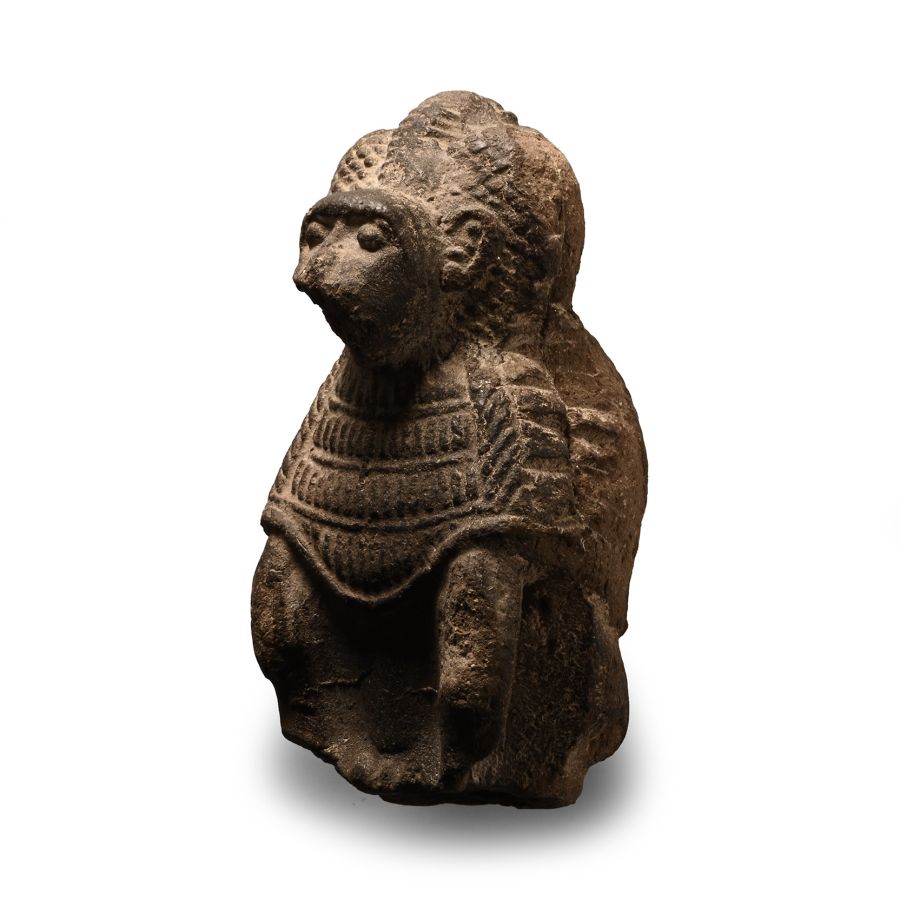
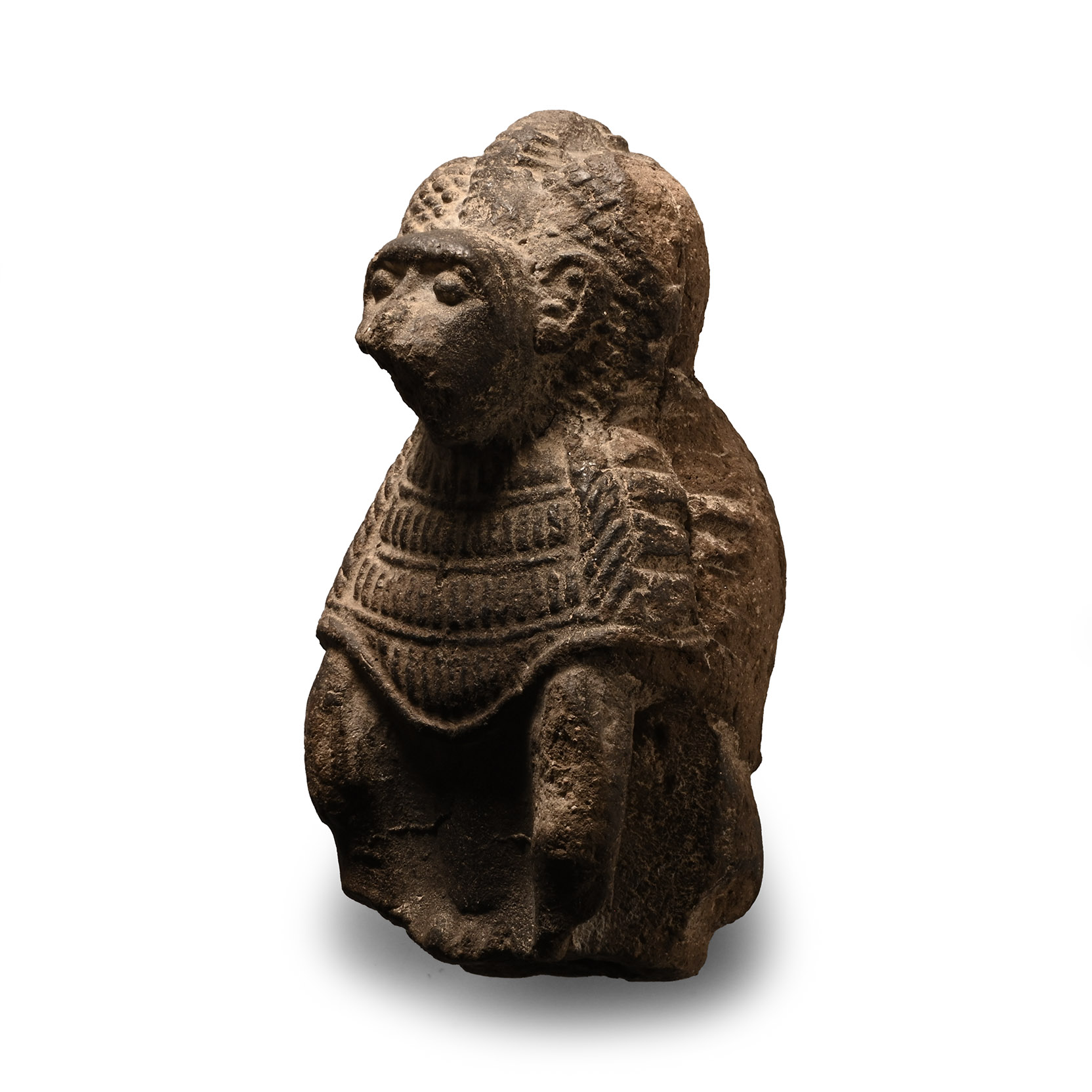
Romano-Egyptian Statuette of Thoth in Baboon Form
ROMAN PERIOD, 30 B.C.-323 A.D.
4 1/8 in. (243 grams, 10.6 cm).
Carved hardstone figure of a Hamadryas Baboon (papio hamadryus), sacred to Thoth, crouching with his forepaws resting on his knees and wearing a segmented and banded hood and collar with elaborately carved textural detailing; face chipped and lower body absent. [No Reserve]
ProvenanceEx Yorkshire, UK, collection, 1960s-1980s.
LiteratureCf. Loffet, H.C., La Collection Emmacha: Antiquités Égyptiennes 2 – Objets divers, Paris, 2013, pp.84-7 no.105, for a stone baboon with a similarly elaborate decorated collar; Bartman, E., The Ince Blundell Collection of Classical Sculpture Volume III. The Ideal Sculpture, Liverpool, 2017, pp.185-6, pl.162a, for a baboon statuette with less stylised rendering.
FootnotesThe baboon was considered an embodiment of the god Thoth. The animal was associated with both the sun and the moon, often depicted wearing a moon and crescent headgear. Together, these aspects symbolised the cycle of rebirth, as it was believed that the deceased travelled through the night and was reborn at dawn. Thoth was highly regarded for his connection to knowledge, healing, and writing. Scribes would wear a Thoth baboon amulet to ensure continued professional success. In the Roman era, Thoth became the 'primary pseudonymous authority for diverse priestly texts' (Frankfurter, D., Religion in Roman Egypt,New Jersey, 1998, p.240). As some religious centres with animal cults were maintained in the Roman Period, it is possible that this figurine was a votive offering to the god. Baboon figurines have also been discovered in Isis sanctuaries in Rome. This discovery may indicate the mythological connection between the two deities, as Thoth provides words to Isis, enabling her to revive her husband, Osiris.
CONDITIONTimeLine Auctions follows a vetting process to ensure the authenticity and legality of all items, reinforcing our commitment to integrity and responsible trading. Each antiquity, antique, and coin lot undergoes thorough examination by a vetting committee of at least ten external specialists, professional trade association members, scientists, and archaeologists: Our Vetting Process
AUCTIONS:
TimeLine is a leading auction house specialising in antiquities, ancient art, collectables, natural history, coins, medals, and books. Our auctions offer museums, collectors, historians, and enthusiasts the opportunity to acquire unique and historically significant pieces.
-
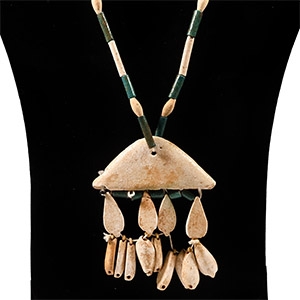
Egyptian Faience Necklace with Pendant
1400-1100 B.C.Estimate: £1,000 - 1,400 (‡+bp*)
Opening Bid: £333
Alternating white and turquoise tubular beads with oval spacer bead; a collar terminal as a central pendant with two rows of petal-shaped beads incorporating tubular and ring spacers suspended below. 41 grams, 76 cm long
Acquired in the mid 1980s-1990s. Private collection, Switzerland, thence by descent. Private collection, since the late 1990s. -
.jpg)
Egyptian Stone Stela with Royal Offering Scene
Ptolemaic Period, 3rd-2nd century B.C.Estimate: £18,000 - 24,000 (‡+bp*)
Opening Bid: £7,778
Round-topped stela with decoration on two registers; the lunette, featuring a winged sun disk with pendant uraei; the main panel with a frieze in sunk relief depicting the pharaoh wearing the double crown, facing left offering the hieroglyphic symbol for 'fields'; a goddess stands behind him, possibly Isis, wearing a tight-fitting robe and sporting a tall two-plumed headdress, with one hand raised in praise; facing the pharaoh is the falcon-headed god, possibly Horus or Her-wer, wearing a double-crown, and behind him stands the ibis-headed Thoth wearing the Atef crown, both gods hold a was-sceptre; repaired, mounted on a custom-made stand. 19.45 kg total, 55 cm including stand
Acquired in the mid-1980s-1990s. Private collection, Switzerland, thence by descent. Private collection, since the late 1990s. Accompanied by an academic report by Egyptologist Paul Whelan. This lot has been checked against the Interpol Database of stolen works of art and is accompanied by search certificate number no.12200-222172.
The overall tripartite composition is comparable to numerous stelae of the Ptolemaic Period and can be dated to the 3rd-2nd century B.C. The decorative lunette and/or sky bands and bold sunk relief winged sun disc are characteristic of this period, as is the fringed detailing of the female’s garment. The offering of the ‘field’ symbol is also a frequent depiction of the stelae of this period, which can be understood as a ‘catch-all’ device representing an offering of all the produce from the fields. Such stelae were often produced as stock products to which clients would have their names and other details added. Therefore, the stela is likely an example of a stela awaiting a purchaser. After the purchase, the hieroglyphic labels would be added to the figurative tableau, and a dedicatory text would be carved into the plain rectangle in the lower part. Sometimes, however, it appears that a purchaser could not afford the additional expense of a professionally engraved inscription, and so would scratch a short dedication in the lower panel as seen, for example, in the stela for Horudja from the Delta site of Tanis and now in the Musée du Louvre (inv. no. AF 11682). -
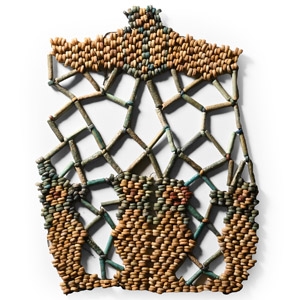
Egyptian Faience Mummy Bead Panel with Four Sons of Horus
Ptolemaic Period, 332-30 B.C.Sold for (Inc. bp): £117
Restrung as an openwork panel with a winged scarab above and the Four Sons of Horus below as two opposing pairs; restrung with some later beads. 34.6 grams, 15 cm
From an early 20th century Home Counties, UK, collection.
These elements would have been placed on the chest and body below a beadwork mummy mask. Winged scarabs were often used as funerary amulets and believed to symbolise the deceased's rebirth and regeneration. The Four Sons of Horus protected the deceased's internal organs. Here, on the left, is the erect-eared jackal-headed Duamutef who protects the stomach, followed by the falcon-headed Qebehsenuef, who protects the intestines, then the human-headed Imsety, protector of the liver and, finally, the baboon-headed Hapy on the right, protector of the lungs.
