
Loading, please wait...
LOT 0053
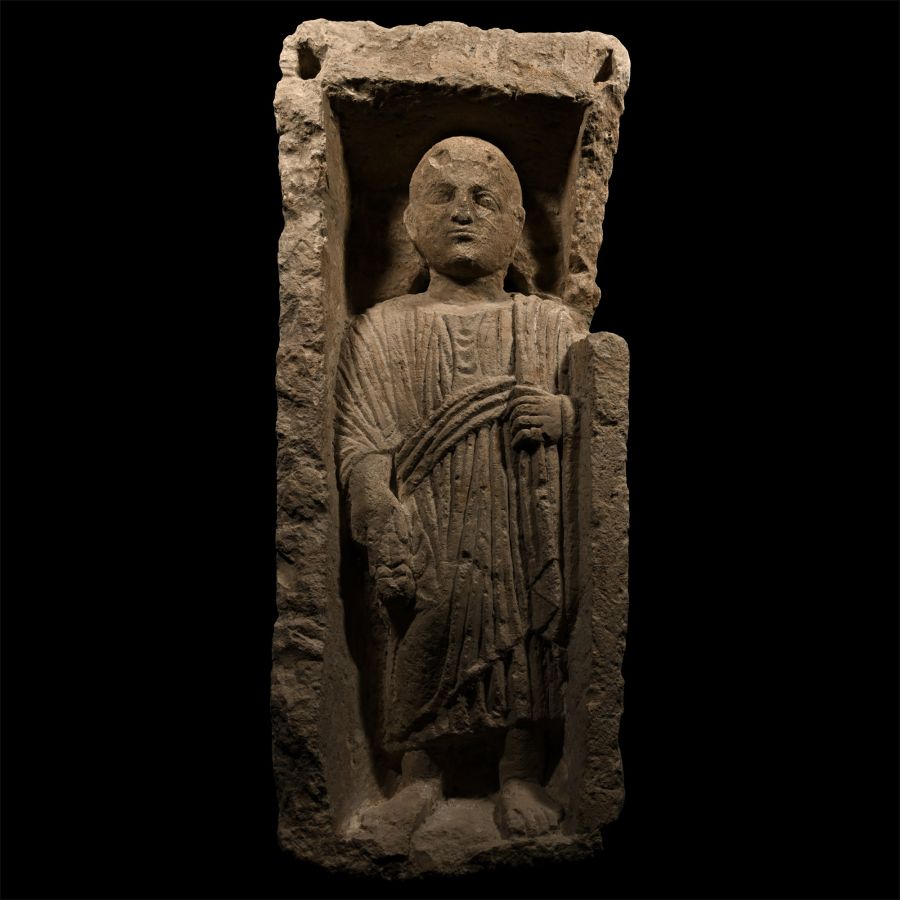
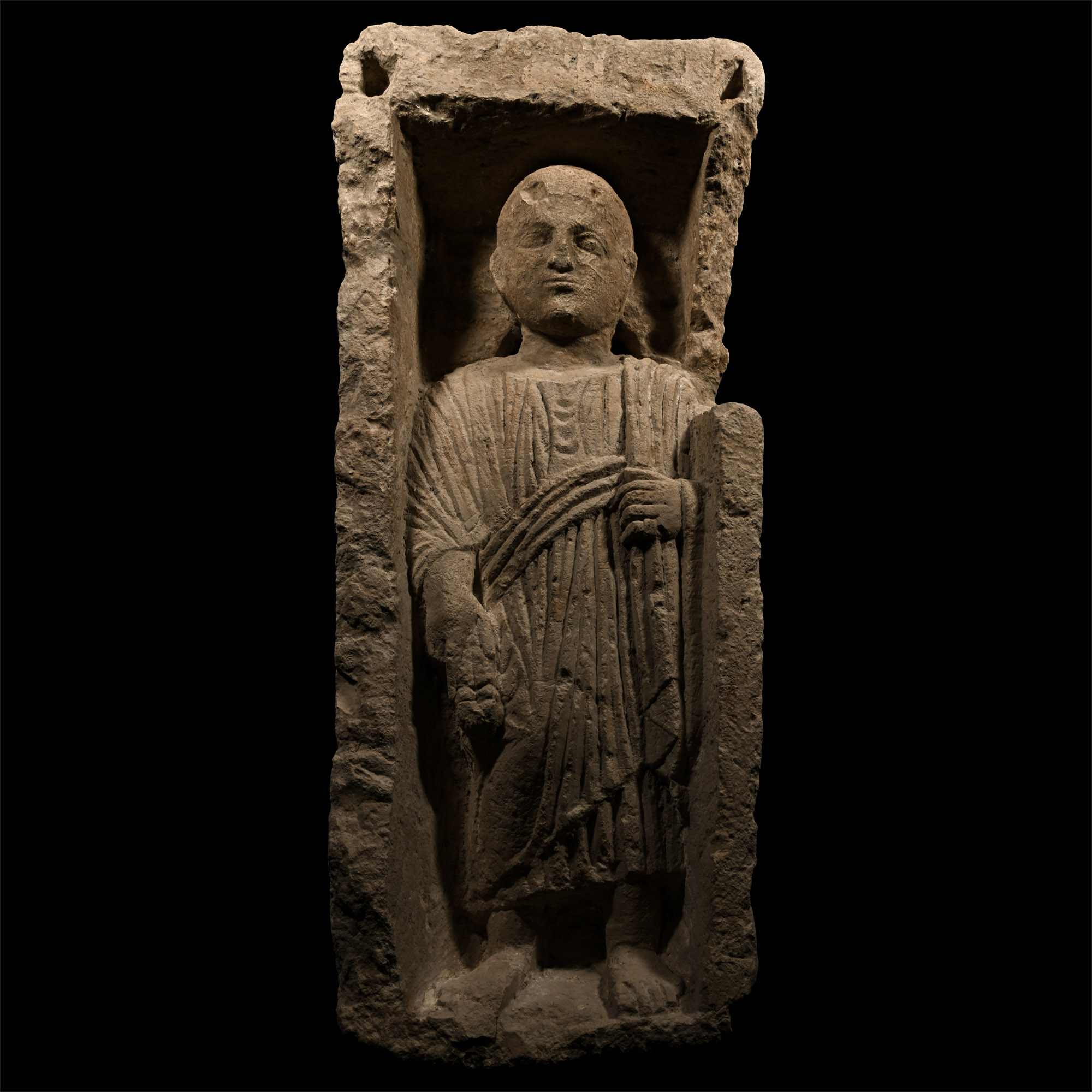
Romano-Egyptian Limestone Stele of a Nobleman Holding an Offering to the Gods
3RD-4TH CENTURY A.D.
32 1/4 in. (50 kg, 81.5 cm).
Modelled in the half-round as a man standing on an integral plinth, round face with short curly hair, wide eyes, a slender nose and a small mouth; wearing a Greek himation wrapped around his body and feet enclosed in Romano-Egyptian sandals; the left arm lowered and holding a cluster of grapes; his right arm bent at the elbow and holding a roll; remains of red and dark brown pigment on the face and clothing.
ProvenanceProperty of a Surrey lady; acquired by her father Christopher Terry circa 1980.
Accompanied by an academic report by Dr Raffaele D'Amato.
This lot has been checked against the Interpol Database of stolen works of art and is accompanied by search certificate number no.12603-233353.
This lot has been cleared against the Art Loss Register database, and is accompanied by an illustrated lot declaration signed by the Head of the Antiquities Department, Dr Raffaele D'Amato.
Cf. Ashour, S., ‘Unpublished Group of Bahnasa Reliefs’ in Archaeological & Historical Studies 13, Alexandria, 2010, pp.65-106, figs.5, 7, for similar stele.
FootnotesLimestone niches with polychrome representations of the deceased were common in Roman Egypt, and lasted until the time of the Arab conquest. The man depicted on this stele certainly belonged to the high contemporary nobility as is evidenced by his well-pleated clothing, which identifies him as a member of local Graeco-Roman aristocracy.
CONDITIONTimeLine Auctions follows a vetting process to ensure the authenticity and legality of all items, reinforcing our commitment to integrity and responsible trading. Each antiquity, antique, and coin lot undergoes thorough examination by a vetting committee of at least ten external specialists, professional trade association members, scientists, and archaeologists: Our Vetting Process
AUCTIONS:
TimeLine is a leading auction house specialising in antiquities, ancient art, collectables, natural history, coins, medals, and books. Our auctions offer museums, collectors, historians, and enthusiasts the opportunity to acquire unique and historically significant pieces.
LOT 0053
Romano-Egyptian Limestone Stele of a Nobleman Holding an Offering to the Gods
Sold for (Inc. bp): £3,640
-
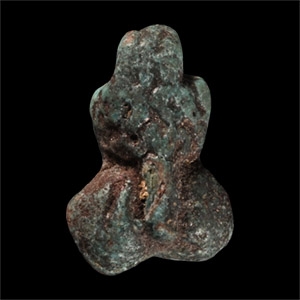
Egyptian Faience Phallic Amuletic Pendant
Ptolemaic Period, 332-30 B.C.Estimate: £100 - 140 (+bp*)
Opening Bid: £50
Formed as stylised phallus with large testes and part of the lower abdomen, suspension loop above. 1.54 grams, 18 mm
From the collection of a late London, UK, gentleman, 1970s. This lot is accompanied by an illustrated lot declaration signed by the Head of the Antiquities Department, Dr Raffaele D'Amato.
Small phallic amulets in ancient Egypt symbolised fertility, protection, and vitality. Often worn as jewellery or carried as personal charms, these amulets invoked the generative power of the male form, which was closely tied to life, creation, and strength. They were commonly used to ward off evil, ensure male potency, and protect children or the wearer from harm. These amulets reflect the Egyptian belief in the protective and regenerative power of sexuality, and their use spanned both everyday life and funerary contexts. -
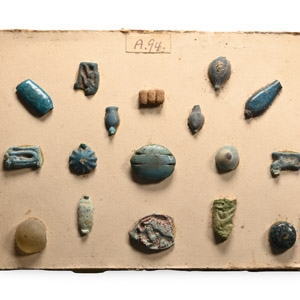
Egyptian Faience Bead and Amulet Collection
Late-Ptolemaic Period, 664-30 B.C.Sold for (Inc. bp): £520
Including floral, poppy seed, uraeus, an eye bead, a bull with solar disc, a standing deity holding a sceptre, and other types; mounted on cardboard backing with collector's label 'A.94.'. 24 grams total, 11.4 x 8.4 cm
From the private collection of Walter Thomas Gaze Cooper (1895-1980). This lot is accompanied by an illustrated lot declaration signed by the Head of the Antiquities Department, Dr Raffaele D'Amato. -
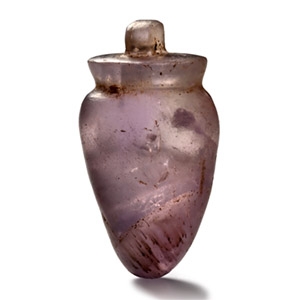
Large Egyptian Amethyst Heart Amulet
Late Period, 664-332 B.C.Estimate: £600 - 800 (+bp*)
Opening Bid: £300
Carved in the round with integral suspension loop. 8.79 grams, 31 mm
From early 20th century Home Counties, UK, collection. This lot is accompanied by an illustrated lot declaration signed by the Head of the Antiquities Department, Dr Raffaele D'Amato.
According to ancient Egyptian beliefs, the heart (ib) was considered the centre of intelligence, emotions, and behaviour. It was also believed to store an individual's memories. During the Weighing of the Heart ceremony in the afterlife, the heart could speak on behalf of the deceased and account for their lifetime of actions before Osiris. For this reason, heart amulets were placed on the mummy to safeguard the organ and ensure a favourable outcome during judgment.
