
Loading, please wait...
LOT 0449
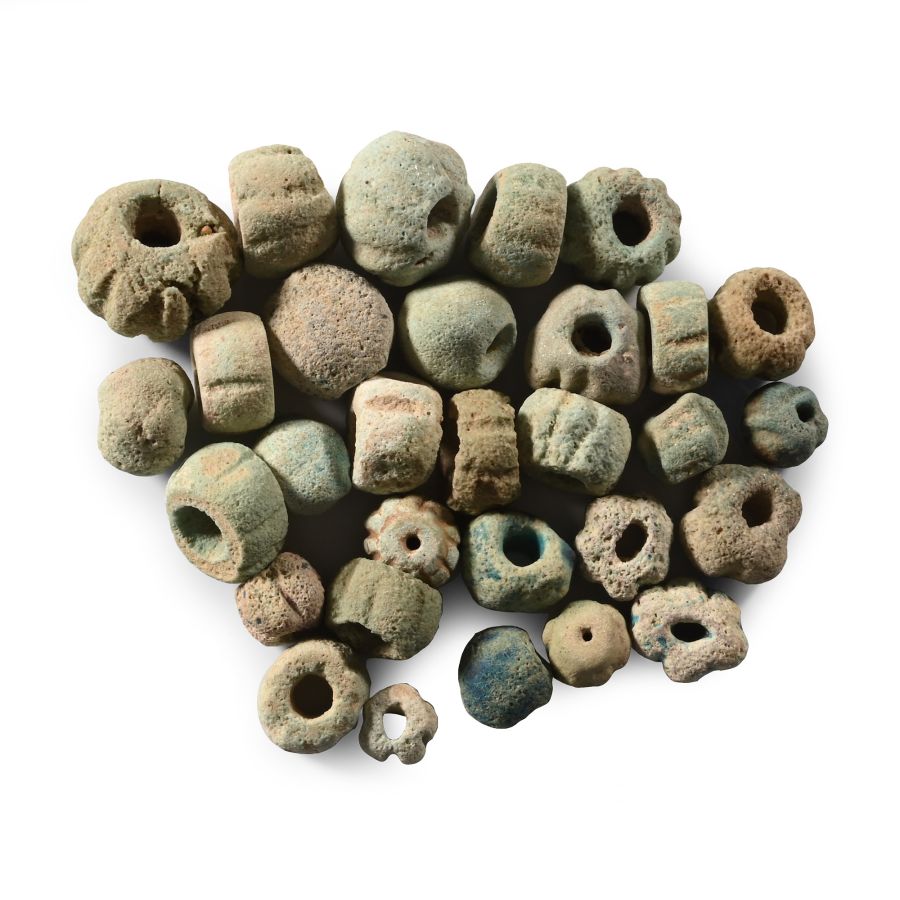
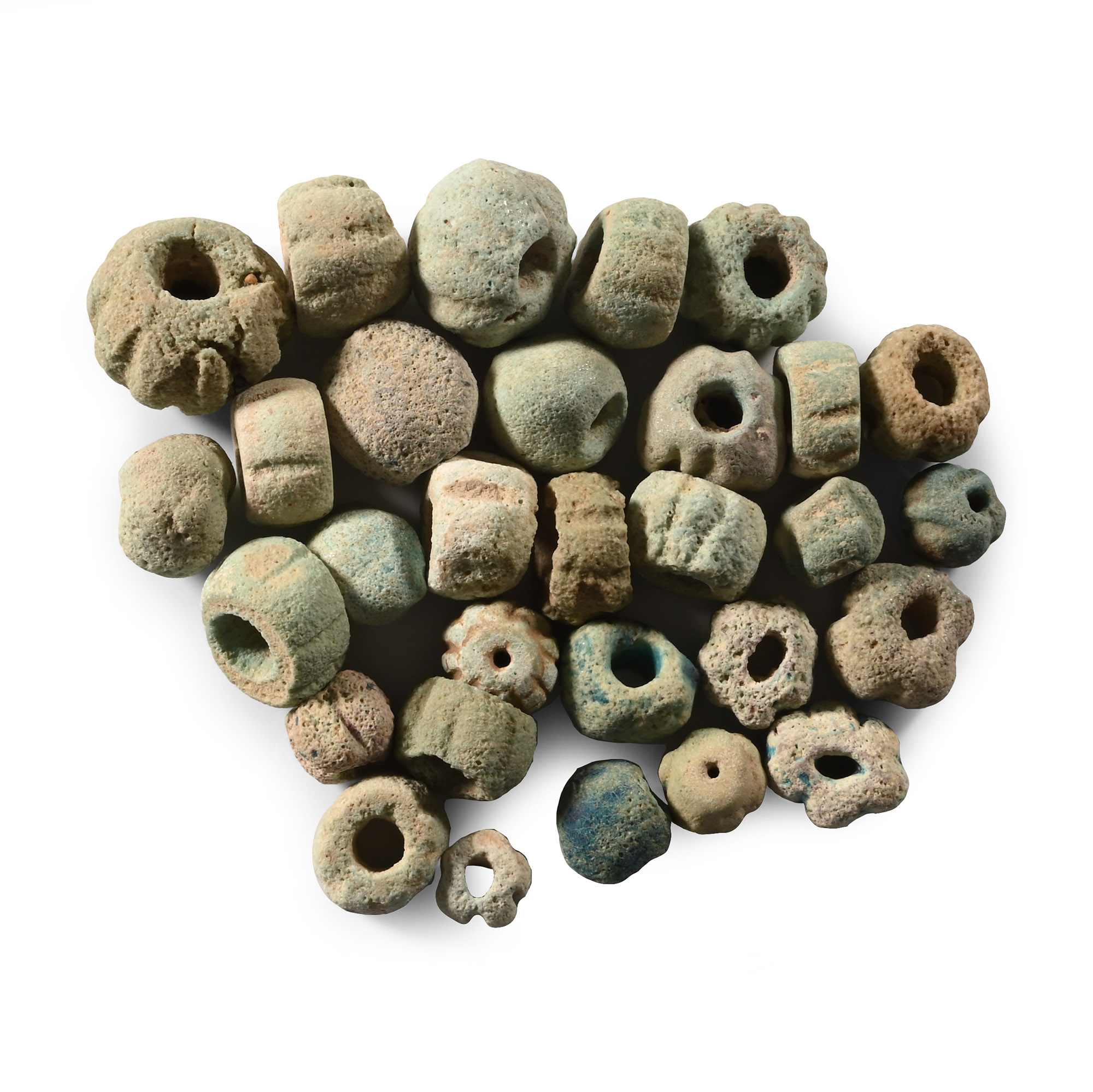
Romano-Egyptian Faience Melon Bead Collection
2ND-1ST CENTURY B.C.
1/4 - 3/4 in. (42 grams total, 8-18 mm).
Comprising thirty green and blue beads in various sizes. [30, No Reserve]
ProvenanceEx H. Norry collection, Milton Keynes, UK, 1980s-1990s.
This lot is accompanied by an illustrated lot declaration signed by the Head of the Antiquities Department, Dr Raffaele D'Amato.
Cf. Berlev, O. and Hodjash, S., Catalogue of Monuments of Ancient Egypt: From the Museums of the Russian Federation, Ukraine, Bielorussia, Caucasus, Middle Asia and the Baltic States, Orbis Biblicus et Orientalis 17, Fribourg/Göttingen, 1998, pl. 196, XVII. 265-361, for comparable examples.
CONDITIONTimeLine Auctions follows a vetting process to ensure the authenticity and legality of all items, reinforcing our commitment to integrity and responsible trading. Each antiquity, antique, and coin lot undergoes thorough examination by a vetting committee of at least ten external specialists, professional trade association members, scientists, and archaeologists: Our Vetting Process
AUCTIONS:
TimeLine is a leading auction house specialising in antiquities, ancient art, collectables, natural history, coins, medals, and books. Our auctions offer museums, collectors, historians, and enthusiasts the opportunity to acquire unique and historically significant pieces.
-
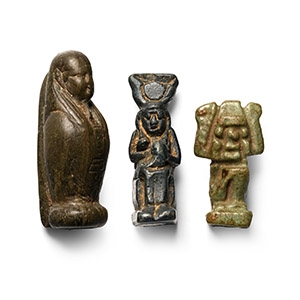
Egyptian Stone and Faience Amulet Group
Late Period-Roman Period, circa 664 B.C.-100 A.D.Sold for (Inc. bp): £572
Comprising: a seated figure of Isis suckling infant Horus on her lap, the goddess crowned with large cow horns flanking a solar disc, pierced behind the head; a mummiform Osiris-Canopus amulet wearing a nemes headdress and plain dorsal pillar, a winged scarab with solar disc above at the base of the figure; a kneeling Shu amulet, his arms raised above his head holding a large solar disc, pierced through the dorsal pillar. 6.47 grams total, 18-25 mm
Ex Prof. Dr Emil Vogt (1906-1974), The Former Director of the Swiss National Museum, Zürich, in his collection before 1970. with Galerie Rhéa, Zurich, Switzerland. This lot is accompanied by an illustrated lot declaration signed by the Head of the Antiquities Department, Dr Raffaele D'Amato. -
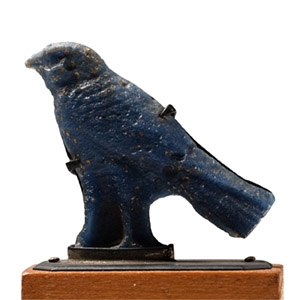
Egyptian Blue Glass Bird Inlay
Ptolemaic Period, circa 332-30 B.C.Sold for (Inc. bp): £624
Modelled in the half-round with low-relief hatched detailing; perching on a D-section base; mounted on a silver support and a wooden display stand. 18 grams total, 55 mm including stand
with Jean-Phillipe Mariaud de Serres, Paris, France. Private collection, London, UK, acquired from the above in 1992. This lot is accompanied by an illustrated lot declaration signed by the Head of the Antiquities Department, Dr Raffaele D'Amato.
The falcon inlay possibly symbolises Horus, the god of the sky, war, and protection. Horus was one of the most significant and widely worshipped gods in ancient Egyptian mythology. His importance spans multiple facets of Egyptian religion, including kingship, protection, the sky, and the sun. Depicted in various human and animal forms, Horus played a vital role in Egyptian cosmology, especially as the protector of the Pharaoh and as a representation of divine authority. -
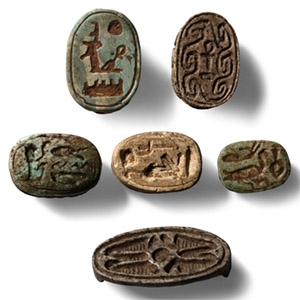
Egyptian Mixed Scarab Collection
2nd-1st millennium B.C.Sold for (Inc. bp): £585
Comprising (from left to right, top to bottom): 1) a scarab with an oval border containing the throne name of the 19th Dynasty pharaoh, Seti I (Men-Maat-Re); 2) a scarab with an oval outer border containing a continuous oblong scroll border framing a neb and ankh symbol; 3) a scarab with an oval border containing a seated adorant before a sa, water, and neb symbol; 4) a scarab with an oval border containing the throne name of the 19th Dynasty pharaoh, Ramesses II (User-Maat-Re), atop a neb sign; 5) a scarab with two signs, possibly representing the word for ‘bread’ above a goose, with a beer jar in front; 6) and a scaraboid with a stretched oval border containing mirrored pairs of rearing cobras surrounding a central sun disc. 18.64 grams total, 14-27 mm
From the collection of a gentleman, acquired on the London art market in the 1990s. This lot is accompanied by an illustrated lot declaration signed by the Head of the Antiquities Department, Dr Raffaele D'Amato.
