
Loading, please wait...
_900x900.jpg "Romano-Egyptian Bronze Frog and Turtle Collection")
_200x200.jpg "Romano-Egyptian Bronze Frog and Turtle Collection")
.jpg "Romano-Egyptian Bronze Frog and Turtle Collection")
LOT 0132
Romano-Egyptian Bronze Frog and Turtle Collection
ROMAN PERIOD, 30 B.C.-323 A.D.
5/8 - 1 3/8 in. (127 grams total, 16-34 mm).
Comprising five frogs in different styles, including one example in relief on a square base; two turtles with simple shell detailing. [7]
Provenance‘The Ancient Menagerie Collection’ formerly the property of a Cambridgeshire lady, collected since the 1990s and acquired from auctions and dealers throughout Europe and the USA, now ex London collection.
CONDITIONTimeLine Auctions follows a vetting process to ensure the authenticity and legality of all items, reinforcing our commitment to integrity and responsible trading. Each antiquity, antique, and coin lot undergoes thorough examination by a vetting committee of at least ten external specialists, professional trade association members, scientists, and archaeologists: Our Vetting Process
AUCTIONS:
TimeLine is a leading auction house specialising in antiquities, ancient art, collectables, natural history, coins, medals, and books. Our auctions offer museums, collectors, historians, and enthusiasts the opportunity to acquire unique and historically significant pieces.
LOT 0132
Romano-Egyptian Bronze Frog and Turtle Collection
Estimate £800 - 1,000€930 - 1,160 (for guidance only)$1,080 - 1,350 (for guidance only)
-
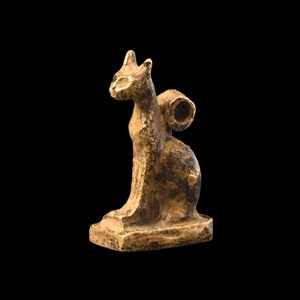
Egyptian Gold Cat Amulet of the God Bastet
Late New Kingdom, 1070-900 B.C.Sold for (Inc. bp): £845
Modelled seated on an arch-shaped base, with simple facial detailing and suspension loop to the reverse. 0.52 grams, 8 mm
Ex French collection 1920s, Paris art market. -
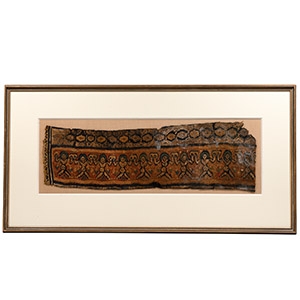
Large Framed Coptic Wool Garment Fragment with Dancing Nymphs
Circa 6th-7th century A.D.Sold for (Inc. bp): £520
Comprising a series of nude female figures on red background, probably maenads or nymphs, dancing to the sounds of cymbals held in their outstretched hands, each wearing a green proploma; wide band of geometric decoration above; mounted in a custom-made glazed frame. 2.1 kg total, 71 x 36 cm including frame
Ex Dutch collection, 1960s. UK collection 2018.
The band is probably the terminal part of a large wall carpet. The warp material is raw natural twisted wool in one strand, with weft in linen and raw wool in red, orange, ochre yellow, blue green, olive green, blue. The motif still echoes themes of the pagan world, despite being made in the Christian Roman Empire. -
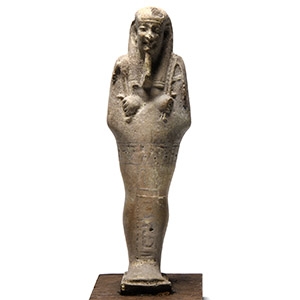
Large Egyptian Glazed Hieroglyphic Shabti
Late Period, 30th Dynasty, 380-343 B.C.Sold for (Inc. bp): £845
Modelled mummiform, arms crossed over the chest holding crook and flail, with a blank pillar to reverse; hieroglyphs to the front of the body; remains of glaze; mounted on a wooden display base; repaired. 191 grams total, 17 cm high including stand
Gifted by Herbert Parsons (1870-1940) to his grandson, James Gibson (1926-2013). Inherited by the vendor and her brother, from their grandfather James Gibson.
