
Loading, please wait...
LOT 0759
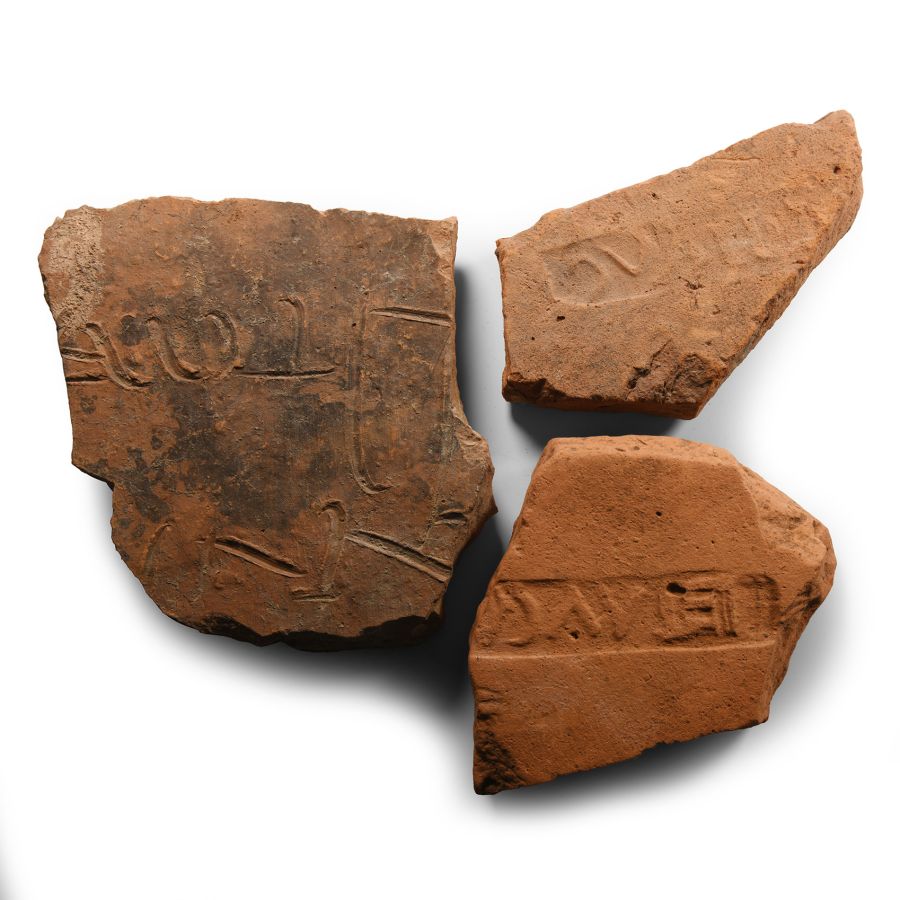
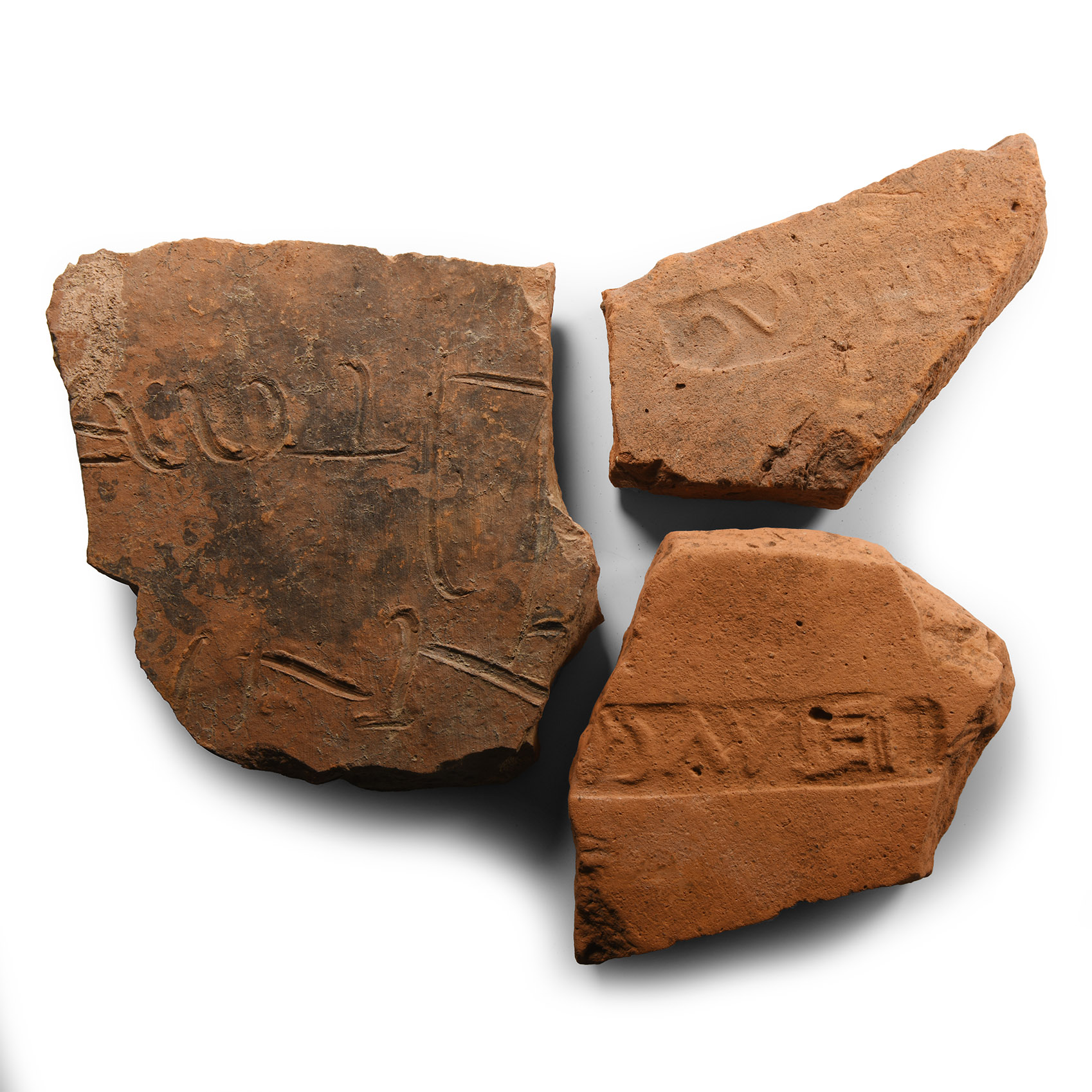
Romano-British Legionary Terracotta Tile Fragment Group
1ST-4TH CENTURY A.D.
5 1/8 - 6 in. (1.46 kg total, 13-15.4 cm).
Group of three terracotta fragments with impressed stamps '[..]NVAC', 'LEG.AVG' and one marked freehand '[..}LITOF[..]'. [3, No Reserve]
ProvenanceFound UK.
From the collection of a late East Anglian teacher and antiquarian who retired to the Isle of Wight in Hampshire, UK.
He amassed a large collection of objects between the 1960s-1980s.
Cf. Warry, P., ‘Legionary Tile Production in Britain’ in Britannia, volume 41, November 2010, pp.127-147, fig.3, p.133, for similar tiles; for the history of the Legio II Augusta see D'Amato, R., La grande storia delle legioni romane (The great history of the Roman legions), Roma, 2023, pp.156-160.
FootnotesThe bricks belonged to the famous Legio II Augusta, (Legio II Gallica Augusta Sabina Britannica Felix) which since the 43 A.D. until the 5th century A.D. were linked to Britain. Its headquarters were at Isca Augusta or Isca Silurum (Newport in South Wales) and in the Late Empire at Rutupiae (Richborough). Traces of this legion were still found in Sub-Roman Britain and Sub-Roman Gallia in 5th-6th centuries A.D.
CONDITIONTimeLine Auctions follows a vetting process to ensure the authenticity and legality of all items, reinforcing our commitment to integrity and responsible trading. Each antiquity, antique, and coin lot undergoes thorough examination by a vetting committee of at least ten external specialists, professional trade association members, scientists, and archaeologists: Our Vetting Process
AUCTIONS:
TimeLine is a leading auction house specialising in antiquities, ancient art, collectables, natural history, coins, medals, and books. Our auctions offer museums, collectors, historians, and enthusiasts the opportunity to acquire unique and historically significant pieces.
LOT 0759
Romano-British Legionary Terracotta Tile Fragment Group
Sold for (Inc. bp): £247
-
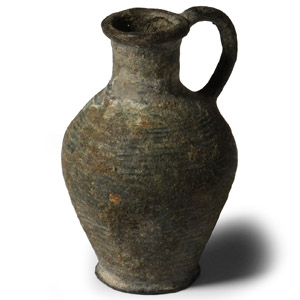
Roman Bronze Miniature Flagon
2nd-3rd century A.D.Sold for (Inc. bp): £91
With piriform body, short neck, everted rim and strap handle, circumferential bands to the body. 10.9 grams, 42 mm
Acquired from Den of Antiquity, Cambridgeshire, UK, 2010. Ian Wilkinson collection, Nottinghamshire, UK.
The small size of this bronze container suggests that it was intended as a toilette object, or as an oil vessel for athletes, generally associated with a strigil. Its could also have been used as a balsamarium. -
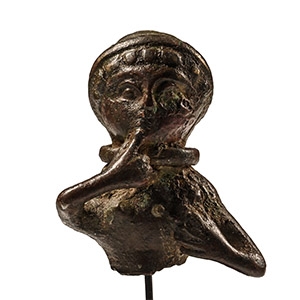
Eastern Roman Bronze Female Bust
1st century B.C.-1st century A.D.Sold for (Inc. bp): £208
Hollow-formed figurine fragment depicting a bare-chested female with a tight-fitting cap placed over her hair and row of curls escaping from beneath the brim, broad forehead above lentoid eyes and narrow nose, small pursed mouth; integral swag of beads to the upper chest above the conical breasts, left arm bent and hand clutching the left breast, right arm raised and forefinger placed on the chin; separate round-section ring added to the neck; mounted on a custom-made display stand. 195 grams total, 11.2 cm including stand
From a collection acquired on the UK art market from various auction houses and collections mostly before 2000. From an important Cambridgeshire estate; thence by descent. -
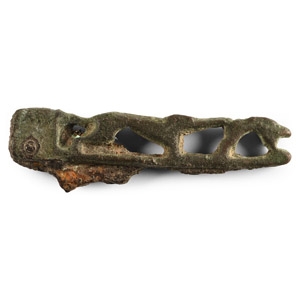
Roman Bronze Folding Knife Handle with Hare and Hound
Circa 2nd-3rd century A.D.Sold for (Inc. bp): £104
Openwork rectangular panel with reserved hare-and-hound motif, remains of ferrous blade below. 19.1 grams, 66 mm
Found Wiltshire, UK, before 1974.
