
Loading, please wait...
LOT 0745
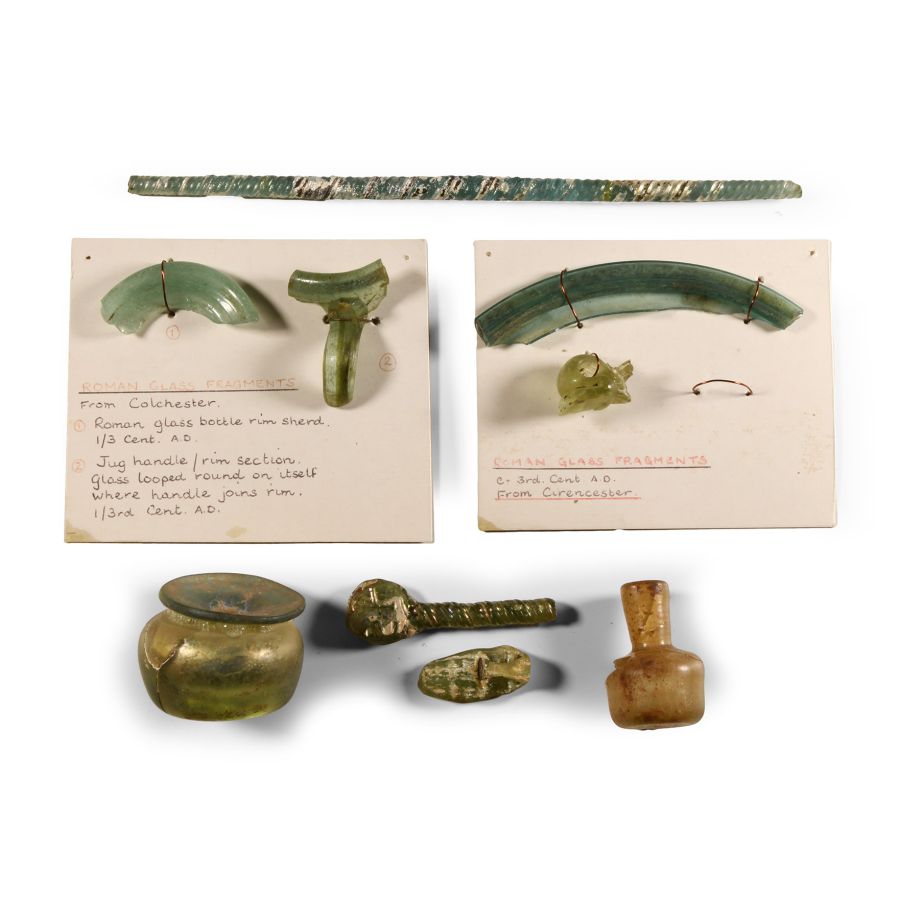
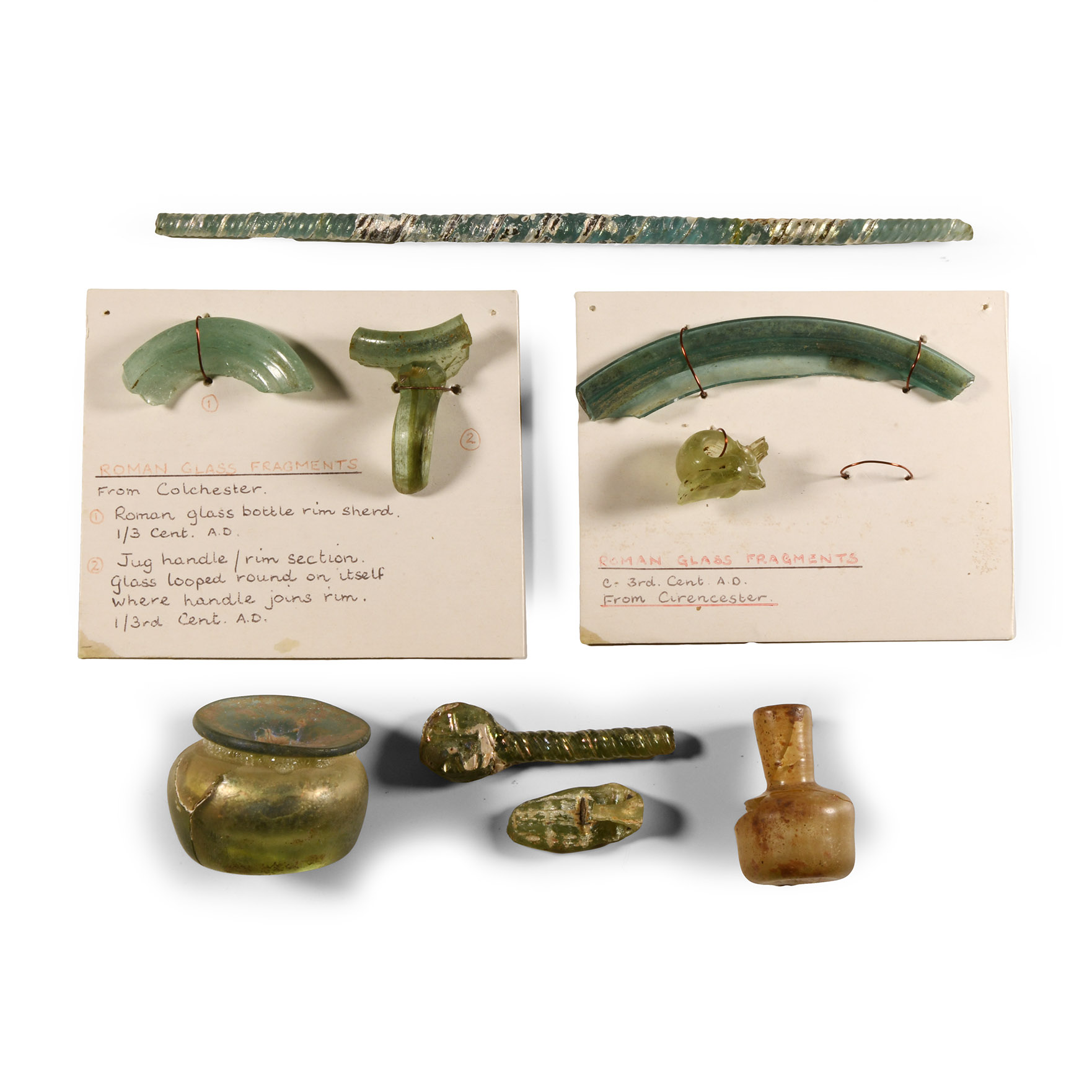
Romano-British 'Colchester and Cirencester' Glass Fragment Collection
1ST-4TH CENTURY A.D.
3/4 - 7 3/8 in. (112 grams total, 2-18.7 cm).
Including a twisted rod with iridescent surface, squat jar with broad rim, group of glass fragments from Colchester and Cirencester mounted on display cards, and other items. [9, No Reserve]
ProvenanceFrom the collection of a late East Anglian teacher and antiquarian who retired to the Isle of Wight in Hampshire, UK.
He amassed a large collection of objects between the 1960s-1980s.
TimeLine Auctions follows a vetting process to ensure the authenticity and legality of all items, reinforcing our commitment to integrity and responsible trading. Each antiquity, antique, and coin lot undergoes thorough examination by a vetting committee of at least ten external specialists, professional trade association members, scientists, and archaeologists: Our Vetting Process
AUCTIONS:
TimeLine is a leading auction house specialising in antiquities, ancient art, collectables, natural history, coins, medals, and books. Our auctions offer museums, collectors, historians, and enthusiasts the opportunity to acquire unique and historically significant pieces.
LOT 0745
Romano-British 'Colchester and Cirencester' Glass Fragment Collection
Sold for (Inc. bp): £169
-
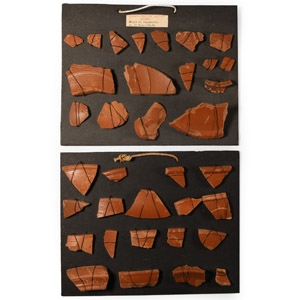
Romano-British 'Hampshire' Samian Ware Sherd Collection on Display Cards
Late 1st century B.C.-early 1st century A.D.Sold for (Inc. bp): £59
Mixed group of decorated Samian ware fragments mounted on card display boards, one with old typed label: 'COARSE BEAD RIM POTTERY SHERDS. / Found in Hampshire. / c. 25 B.C.-25A.D.'. 534 grams total, 25.5 x 20.5 cm each
Found Hampshire UK. From the collection of a late East Anglian teacher and antiquarian who retired to the Isle of Wight in Hampshire, UK. He amassed a large collection of objects between the 1960s-1980s. -
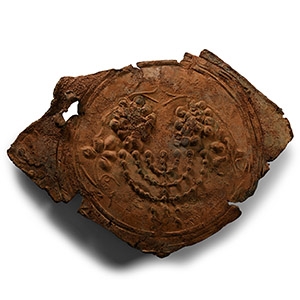
Roman Lead Sarcophagus Fragment with Menorah
2nd-3rd century A.D.Sold for (Inc. bp): £2,340
Irregular fragment with raised concentric rings, low-relief wreath and raised bulbs forming a stem with seven arms. 1.36 kg, 32.5 cm
Acquired on the German art market, 1989-1995. with The Museum Gallery, 19 Bury Place, London, WC1, UK, 1998-2003. Property of a London based academic, 2003-present. This lot has been checked against the Interpol Database of stolen works of art and is accompanied by a search certificate number no.12097-214786.
This fragment of a sarcophagus front is probably a remnant of a Jewish sarcophagus from the Roman period. It belongs to a style of sarcophagi made in the Levant, often decorated with dolphins, sphinxes and other symbols of the hereafter. -
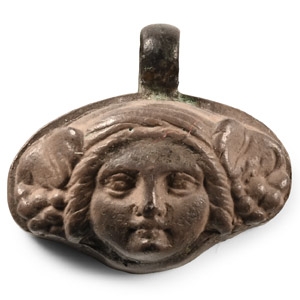
Roman Silver Dionysus Pendant
1st-3rd century A.D.Sold for (Inc. bp): £364
Ellipsoid pendant, hollow to the reverse with high-relief mask of Dionysus flanked by vine leaves and bunches of grapes. 6.2 grams, 23 mm
From the glyptic collection of Mr X; thence by descent. Acquired Hotel des Ventes, Drouot, Eve SVV, Paris, France, 28 June 2017, no.147 (Part). Property of a French collector.
