
Loading, please wait...
_900x900.jpg "Romano-British Bronze Chariot Terret Ring")
_200x200.jpg "Romano-British Bronze Chariot Terret Ring")
.jpg "Romano-British Bronze Chariot Terret Ring")
LOT 0611
Romano-British Bronze Chariot Terret Ring
CIRCA 1ST CENTURY A.D.
2 3/4 in. (76.36 grams, 70.36 mm overall, 21.92 mm internal diameter (approximate size British V, USA 10 1/2, Europe 23.77, Japan 22)).
Comprising a substantial ring mounted on a short neck with tiered collars and facetted flared flange below; three radiating carinated knops, loop to the underside.
ProvenanceFound Thetford, Norfolk.
From an East Anglian private collection.
Cf. Megaw, R.& V., Celtic Art. From its Beginnings to the Book of Kells, London, 1989, item 225, for type.
CONDITIONTimeLine Auctions follows a vetting process to ensure the authenticity and legality of all items, reinforcing our commitment to integrity and responsible trading. Each antiquity, antique, and coin lot undergoes thorough examination by a vetting committee of at least ten external specialists, professional trade association members, scientists, and archaeologists: Our Vetting Process
AUCTIONS:
TimeLine is a leading auction house specialising in antiquities, ancient art, collectables, natural history, coins, medals, and books. Our auctions offer museums, collectors, historians, and enthusiasts the opportunity to acquire unique and historically significant pieces.
-
.jpg)
Roman Bronze Medical Implement with Razor
1st-4th century A.D.Sold for (Inc. bp): £182
Hexagonal-section handle with scooped blade at one end, lentoid-section probe at the other. 11.7 grams, 14.1 cm
Ex German art market, 2000s. Acquired from an EU collector living in London. From the collection of Surrey, UK, gentleman. -
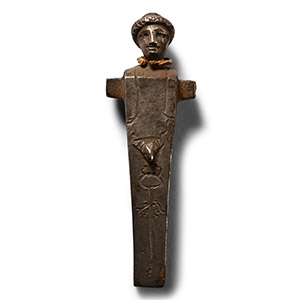
Roman Silver Miniature Herm
1st-3rd century A.D.Estimate: £2,500 - 3,500 (‡+bp*)
Opening Bid: £1,000
Comprising a square-section tapering body with lateral stub arms; head of Mercury (Greek Hermes) above with applied twisted gold collar, low-relief shoulder panels, genitals modelled in the round, low-relief horned figure below. 27 grams, 52 mm
Acquired in the mid 1980s-1990s. From the family collection of Mr S.A., Switzerland, thence by descent. Private collection since the late 1990s. This lot has been checked against the Interpol Database of stolen works of art and is accompanied by a search certificate number no.12103-218207.
This object, was likely votive and perhaps belonged to a small domestic altar of the Roman imperial era, reproduced in miniature size a Hermaic pillar. These were terminals made of stone or wood which were often placed on the roads, near crossings; they served to indicate the right path and therefore were supposed to protect travellers when traveling. In Roman times, these pillars were often topped with busts or portraits and were also found in the gardens of wealthy homes; gods (Hermes and Bacchus in particular) or philosophers were the subjects thus represented. -
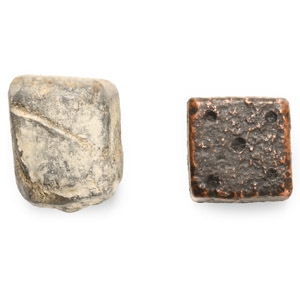
Roman 'Yorkshire' Bronze and Lead Gaming Dice Group
2nd-4th century A.D.Sold for (Inc. bp): £78
Comprising one cuboid dice with markings disposed 1:6, 2:5, 3:4; one rectangular block with sprue to one end, surface abraded. 36.9 grams total, 12-16 mm
Found whilst searching with a metal detector in Yorkshire, UK.
