
Loading, please wait...
_900x900.jpg "Romano-British Bronze Adlocutio Type Repousse Brooch")
_200x200.jpg "Romano-British Bronze Adlocutio Type Repousse Brooch")
.jpg "Romano-British Bronze Adlocutio Type Repousse Brooch")
LOT 0075
Romano-British Bronze Adlocutio Type Repousse Brooch
2ND CENTURY A.D.
1 1/4 in. (12.9 grams, 33 mm).
Imitating Hadrian's sestertius adlocutio, the emperor with a companion (or Castor and Pollux) on horseback, one of the horsemen holding a round shield; arrayed legions in front of them wearing crested helmets, raised spears and quadrangular shields; legionary eagle in the foreground; the scene enclosed within a rope border; pin lugs and catchplate to the reverse.
ProvenanceFrom a Cambridgeshire, UK, collection, 1990s.
This brooch is an extreme rarity and is believed to be the finest known example.
Accompanied by an academic report by Dr Raffaele D'Amato.
This lot has been checked against the Interpol Database of stolen works of art and is accompanied by search certificate number no.11747-202502.
Cf. Hattatt, R., Ancient and Romano-British Brooches, Sherborne, 1982, p.147, no.140; for the Hadrian’s coin see Mattingly, Roman Coins from the earliest times to the fall of the Western Empire, London, 1977, pl.XXXIX, 25 (BM inventory no.1672).
FootnotesThese brooches were a mystery until one was excavated at Wiggonholt, Sussex, together with three other damaged specimens now in the Devizes Museum, all from Wiltshire (more precisely Cold Kitchen Hill). The image of the original coin was slightly modified. The local craftsman improved the coin type making his brooch more interesting, transforming the Emperor Hadrian on horseback into two cavalrymen, probably the sacred Dioscuri, while the Roman Aquila, symbol of the legions, was taken from the top of the signa and placed in the foreground.
CONDITIONTimeLine Auctions follows a vetting process to ensure the authenticity and legality of all items, reinforcing our commitment to integrity and responsible trading. Each antiquity, antique, and coin lot undergoes thorough examination by a vetting committee of at least ten external specialists, professional trade association members, scientists, and archaeologists: Our Vetting Process
AUCTIONS:
TimeLine is a leading auction house specialising in antiquities, ancient art, collectables, natural history, coins, medals, and books. Our auctions offer museums, collectors, historians, and enthusiasts the opportunity to acquire unique and historically significant pieces.
-
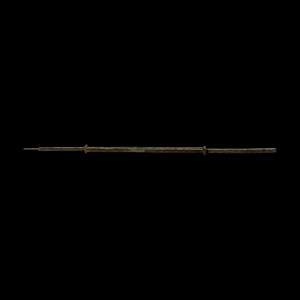
Roman Bronze Extendable Table Leg
2nd-3rd century A.D.Sold for (Inc. bp): £130
Composed of two rectangular-section bars with square-sockets. 2 kg total, 1.07 m
Acquired 1990s-early 2000s. East Anglian private collection.
These bars were one of the four supports of a folding table with a height-adjustable frame, often surmounted by busts of divinities. These folding supports for tables, bracers and cauldrons are known finds from important excavations in the Roman world, like Pompeii. The purpose of such folding stands varied; during a meal they were placed between the triclinium beds with bowls and plates hung to the hooks at the back of the holders. -
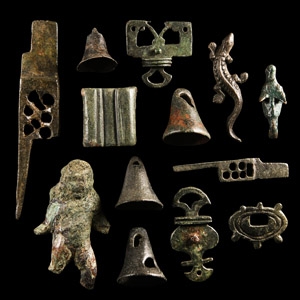
Bronze Age to Medieval Bronze Artefact Group
1st-19th century A.D.Sold for (Inc. bp): £124
Comprising: lock bolts; human and animal figures; bells; decorative fittings and other items. 150 grams total, 16-81 mm
Acquired on the German art market around 2000. From the collection of a Surrey, UK, gentleman. -
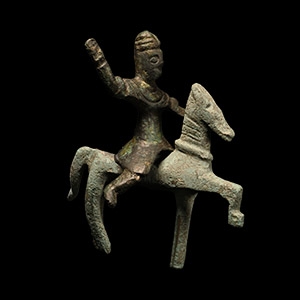
Roman Bronze Horse and Rider
3rd-4th century A.D.Sold for (Inc. bp): £176
Each figure modelled separately in the round; the horse standing with one foreleg raised at a right angle, simple stylised head detailing; the rider modelled seated with one leg either side of the horse, one arm extended above the head, the other held forwards, stylised facial detailing. 35 grams total, 39-45 mm
Acquired on the EU art market around 2000. From the collection of North American gentleman.
