
Loading, please wait...
LOT 0765
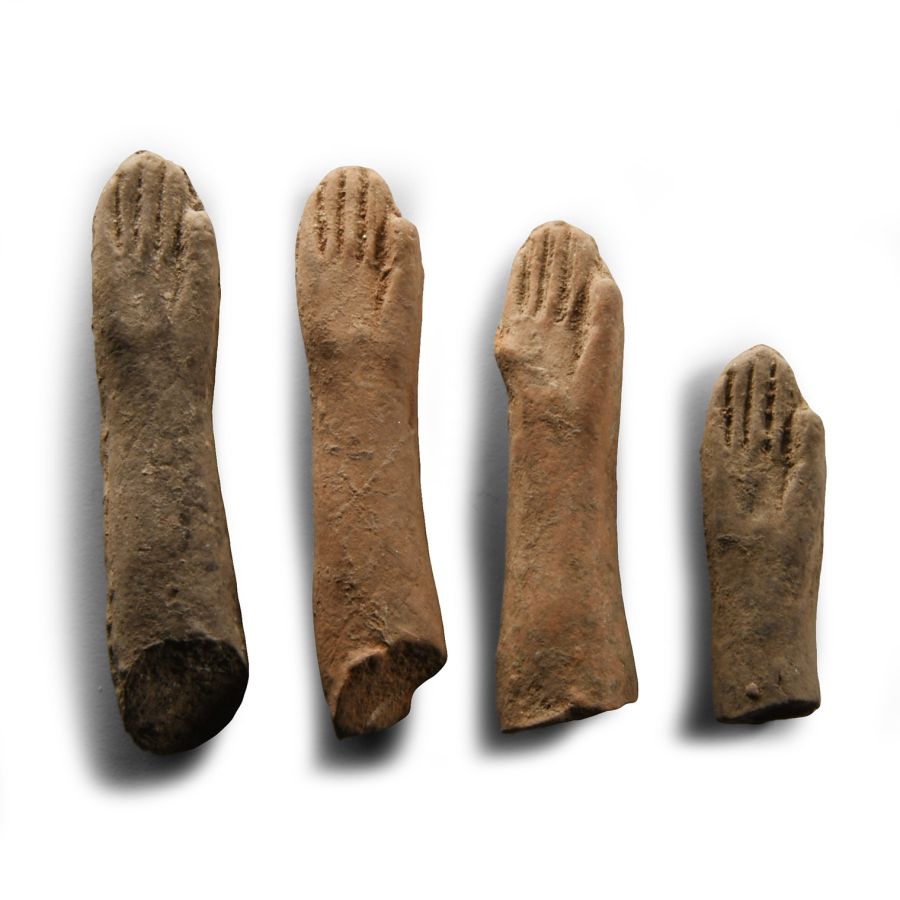
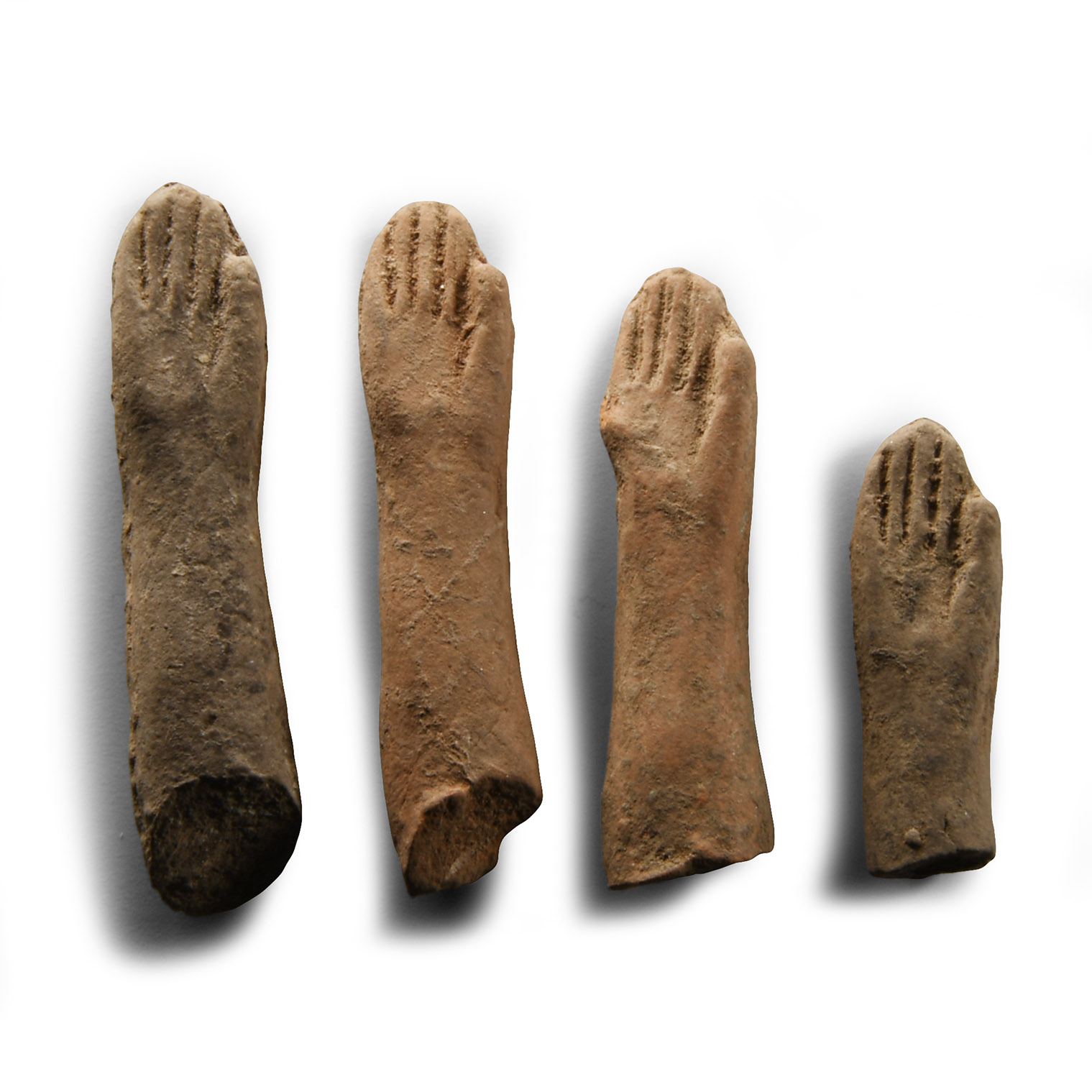
Roman Votive Terracotta Hand Group
CIRCA 1ST CENTURY A.D.
1 1/4 - 2 1/8 in. (23 grams total, 34-53 mm).
Each moulded with finger detailing to one face; or from children's dolls. [4]
ProvenanceEx German art market, 2000s.
Acquired from an EU collector living in London.
From the collection of Surrey, UK, gentleman.
TimeLine Auctions follows a vetting process to ensure the authenticity and legality of all items, reinforcing our commitment to integrity and responsible trading. Each antiquity, antique, and coin lot undergoes thorough examination by a vetting committee of at least ten external specialists, professional trade association members, scientists, and archaeologists: Our Vetting Process
AUCTIONS:
TimeLine is a leading auction house specialising in antiquities, ancient art, collectables, natural history, coins, medals, and books. Our auctions offer museums, collectors, historians, and enthusiasts the opportunity to acquire unique and historically significant pieces.
-
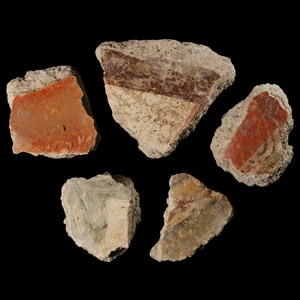
Roman Fresco Wall Plaster Collection
1st century B.C.Sold for (Inc. bp): £111
Second style, painted in red, blue and cream and decorated in contrasting colours. 631 grams total, 6.3-10.5 cm
Acquired in the 19th century. Ex Jeger collection, Switzerland.
These small fragments, with analogies with the fragments from Pompeii, seem to belong to the second style of Roman painting, where several simpler walls had an entirely yellow socle or a yellow socle with a darker main zone (more common in the middle phase of the style). -
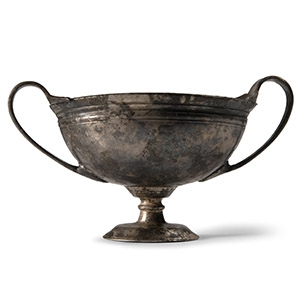
Roman Silver Kantharos Wine Cup
2nd century B.C.-1st century A.D.Estimate: £3,500 - 4,500 (+bp*)
Opening Bid: £1,850
With deep spherical body supported on a round stand; incised with a band around the inner surface and concentric circles on the outer body; two looped high handles, one with stipple engraved monogram on the upper side. 156 grams, 14 cm wide
Ex Mansees collection, formed 1950s-early 1990s. From a large American collection formed in Chicago, Illinois, USA, in 1995. From a European collection. This lot has been checked against the Interpol Database of stolen works of art and is accompanied by search certificate no.11627-197618. -
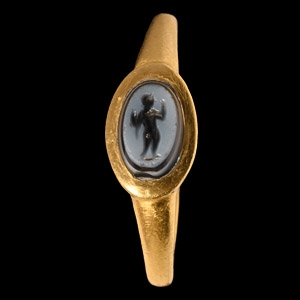
Roman Gold Ring with Apollo Gemstone
2nd-3rd century A.D.Estimate: £2,000 - 3,000 (+bp*)
Opening Bid: £1,100
With a solid ellipsoid hoop expanding at the shoulders from the mid 3rd century, with oval bezel set with a blue nicolo gemstone engraved with the figure of standing crowned god Apollo, depicted nude and holding a staff (or lyre?) in his raised right hand, gazing towards his raised left hand. 4.49 grams, 26.13 mm overall, 21.70 mm internal diameter (approximate size British L 1/2, USA 6, Europe 11.87, Japan 11)
From the private collection of the late A.B., London, UK; acquired before 1989. Accompanied by an academic report by Dr Raffaele D’Amato. This lot has been checked against the Interpol Database of stolen works of art and is accompanied by a search certificate number no.12005-213036.
The god’s body is depicted in three-quarter view, whereas the head is in full profile. The casual posture of the figure on the gemstone is taken from the common iconography of the god. Apollo is frequently portrayed in this fashion, although often leaning against a small column.
