Loading, please wait...

Roman Translucent Glass Jar with Gallery Roman Translucent Glass Jar with Gallery Roman Translucent Glass Jar with Gallery
Use mousewheel to zoom in and out, click to enlarge
Details

LOT 0162

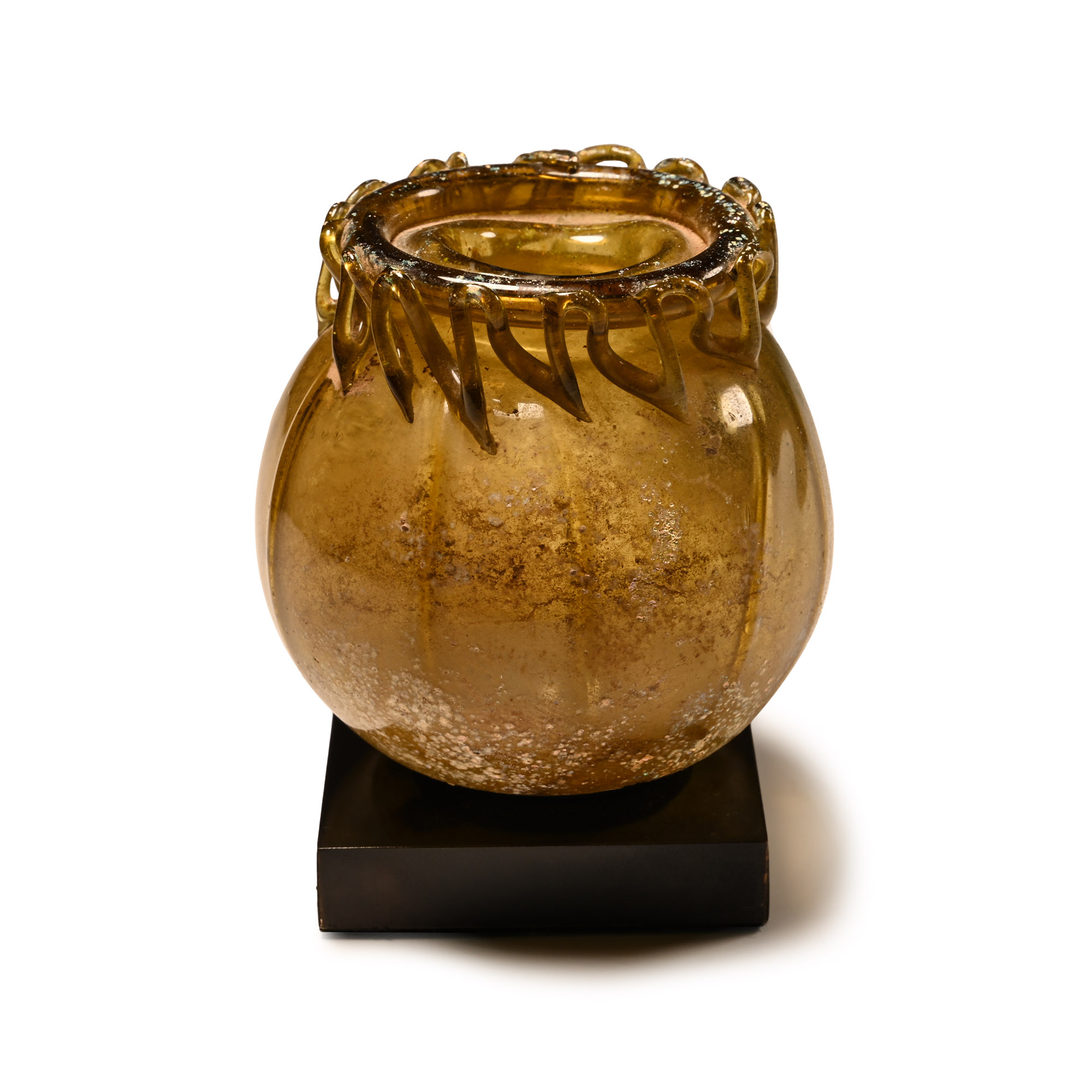
Roman Translucent Glass Jar with Gallery

3RD-4TH CENTURY A.D.

3 in. (3 3/8 in.) (46 grams, 74 mm wide (125 grams, 85 mm high including stand)).

Globular in profile with wide double-stepped rolled rim, applied wavy line trails forming a gallery from rim to body, pinched diagonal ribs to outer face and dimple to the underside; supplied with a custom-made stand.

Provenance

From the glass collection of a London gentleman, UK, 1990s.

Literature

Cf. The Metropolitan Museum, accession number 74.51.197, for similar.

CONDITION
VETTING:

TimeLine Auctions follows a vetting process to ensure the authenticity and legality of all items, reinforcing our commitment to integrity and responsible trading. Each antiquity, antique, and coin lot undergoes thorough examination by a vetting committee of at least ten external specialists, professional trade association members, scientists, and archaeologists: Our Vetting Process


AUCTIONS:

TimeLine is a leading auction house specialising in antiquities, ancient art, collectables, natural history, coins, medals, and books. Our auctions offer museums, collectors, historians, and enthusiasts the opportunity to acquire unique and historically significant pieces.

Live Bidding

LOT 0162

Roman Translucent Glass Jar with Gallery

Sold for (Inc. bp): £546

Print page

RELATED LOTS
  • Roman Marble Draped Female Torso
    Roman Marble Draped Female Torso
    2nd-3rd century A.D.

    Sold for (Inc. bp): £12,350

    Carved in high-relief, a high-status female wearing a palla with a loosely draped stola draped from the left shoulder and arm and drawn across the hips; the left forearm resting on the head of a figure of Venus on a socle base, socket to accept separately carved left hand (absent); mounting sockets to neck and right hip; plain to the reverse; mounted on a custom-made stand. 23 kg total, 55.5 cm including stand


    Private collection, England. Accompanied by an academic report by Dr Raffaele D'Amato. This lot has been checked against the Interpol Database of stolen works of art and is accompanied by search certificate number no.12228-215645.

    Lot Details

  • Etruscan Bronze Robed Figure
    Etruscan Bronze Robed Figure
    3rd-2nd century B.C.

    Estimate: £1,000 - 1,400 (‡+bp*)

    Opening Bid: £500

    Female with hair drawn up in a chignon, palla wrapped tightly around the upper body hiding the right arm bent with the hand at the shoulder, lower hem of robe flared; fixing lug to underside. 86 grams, 71 mm


    Acquired in the mid 1980s-1990s. Private collection, Switzerland, thence by descent. Private collection, since the late 1990s.

    This is a figurine of a deity of difficult interpretation representing an ex-voto. This typology is widespread in the votive offerings of Etrusco-Roman sanctuaries, and by analogy with various statuettes could represent Ceres or Pomona.

    Lot Details

  • Roman Bronze Musical Flute
    Roman Bronze Musical Flute
    Circa 2nd-3rd century A.D.

    Sold for (Inc. bp): £3,900

    An extremely rare aulos or tibia with round-section body, six circular holes to one side and a D-shaped hole to the reverse. 87 grams, 23 cm

    Fine condition. Extremely rare.

    From the late Alison Barker collection, a retired London barrister; from her collection formed early 1960s-1990s. Accompanied by an academic report by Dr Raffaele D'Amato. This lot has been checked against the Interpol Database of stolen works of art and is accompanied by search certificate number no.11055-184396.

    The flute was used for religious ceremonies and for entertainment. The pyrrhic, a war dance of Doric origin, was a rapid dance to the double flute, and made to resemble an action in battle.

    Lot Details

Stay up-to-date with the latest from TimeLine Auctions by joining our mailing list