
Loading, please wait...
_900x900.jpg "Roman to Post Medieval Artefact Group")
_200x200.jpg "Roman to Post Medieval Artefact Group")
.jpg "Roman to Post Medieval Artefact Group")
LOT 2023
Roman to Post Medieval Artefact Group
CIRCA 2ND-19TH CENTURY A.D.
3/4 - 3 1/2 in. (24 grams total, 18-88 mm).
Including a Trajan Denarius (98-117 AD), medieval buckle loop and other items. [5, No Reserve]
ProvenanceFound Yorkshire, UK, before 1991.
LiteratureFor the Trajan denarius see Seaby, H.A., Roman Silver Coins, volume II, Tiberius to Commodus London, 2004, nos.63ff., p.84.
FootnotesThe Trajan (AD 98-117) silver Denarius should be from the mint of Rome (A.D. 100). It shows on the obverse the inscription IMP CAES NERVA TRAIAN AVG GERM, and laureate bust of Trajan facing right.
CONDITIONTimeLine Auctions follows a vetting process to ensure the authenticity and legality of all items, reinforcing our commitment to integrity and responsible trading. Each antiquity, antique, and coin lot undergoes thorough examination by a vetting committee of at least ten external specialists, professional trade association members, scientists, and archaeologists: Our Vetting Process
AUCTIONS:
TimeLine is a leading auction house specialising in antiquities, ancient art, collectables, natural history, coins, medals, and books. Our auctions offer museums, collectors, historians, and enthusiasts the opportunity to acquire unique and historically significant pieces.
-
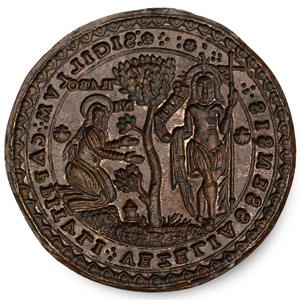
Bronze Seal Matrix of Vezelay with Christ and Mary
18th-19th century A.D.Sold for (Inc. bp): £234
A reproduction of a Medieval seal discoid in plan with flange handle to reverse; central incuse design of facing Christ in loincloth, nimbate and holding a processional cross with legend 'MARIA', beside a tree with kneeling nimbate Mary, her hands extended and legend 'RABONI' above; scallop motifs in the field, outer band of egg-and-dart moulding; legend to inner band ' ·:· SIGILLVM ·:· CAPPITULI ·:· VEZELIASSENSIS' (chief seal of Vézelay [in Burgundy, France]). 54.2 grams, 61 mm
Private collection, UK.
The reference is to the incident in John v.20 where Jesus said to his mother, “Mary” and she turned toward him and cried out “Rabboni!” (which means “Teacher”). -
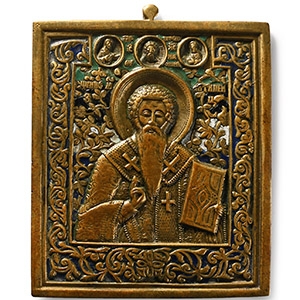
Russian Orthodox Enamelled Bronze Travel Icon with Saint Antipas of Pergamum
19th century A.D.Estimate: £300 - 400 (+bp*)
Opening Bid: £150
Representing Saint Antipas with a Gospel in his left hand and making the gesture of blessing with his right, dressed as a bishop, with sticharion, covered by omophorion, and surmounted by an epitrachelion; the Mandylion at the centre above the saint, Saint Mary on the left panel and Jesus on the right; Old Slavic inscription around the figures: 'ΙC ΧΡ' (Jesus Christ); 'ΜΡ ϴΥ'(Mother of God); Saint Antipas of Pergamum (Св Анти́па Перга́мский). 238 grams, 11.3 cm
Acquired from Chris Martin-Zakheim, Iconastas, 5 Piccadilly Arcade, London SW1. From the private collection of a West London, UK, gentleman, formed since the early 2000s.
The icon features meticulous craftsmanship typical of Orthodox iconography. Saint Antipas was popularly held to be a healer of tooth problems. He was martyred by burning in a brazen bull-shaped altar under the Emperors Nero or Domitian. -
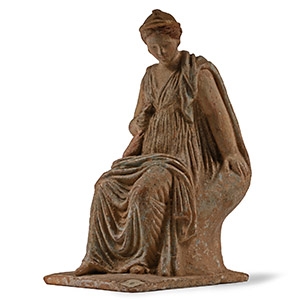
Hellenistic Style Terracotta Figurine
19th century A.D.Sold for (Inc. bp): £780
Modelled in the round on a rectangular base, seated female wearing a crested cap, peplos dress and palla holding a coin-purse to her midriff, collector's reference 'ABLT' to underside. 157 grams, 11.6 cm
Ex Louis-Gabriel Bellon (c.1819-1899), France. Private collection, Europe. Accompanied by a copy of French passport no.111342 dated 6 July 2009.
