
Loading, please wait...
_900x900.jpg "Roman 'The Wakefield' Bronze Founding of Rome Commemorative Military Phalera")
_200x200.jpg "Roman 'The Wakefield' Bronze Founding of Rome Commemorative Military Phalera")
.jpg "Roman 'The Wakefield' Bronze Founding of Rome Commemorative Military Phalera")
LOT 0898
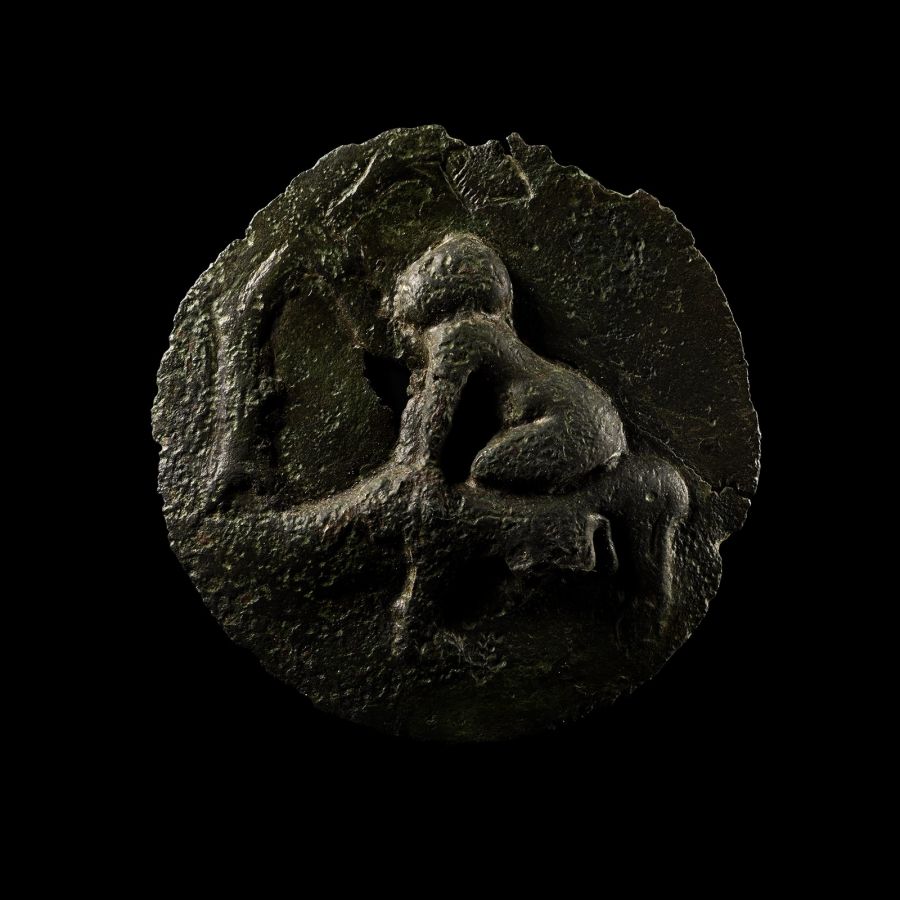
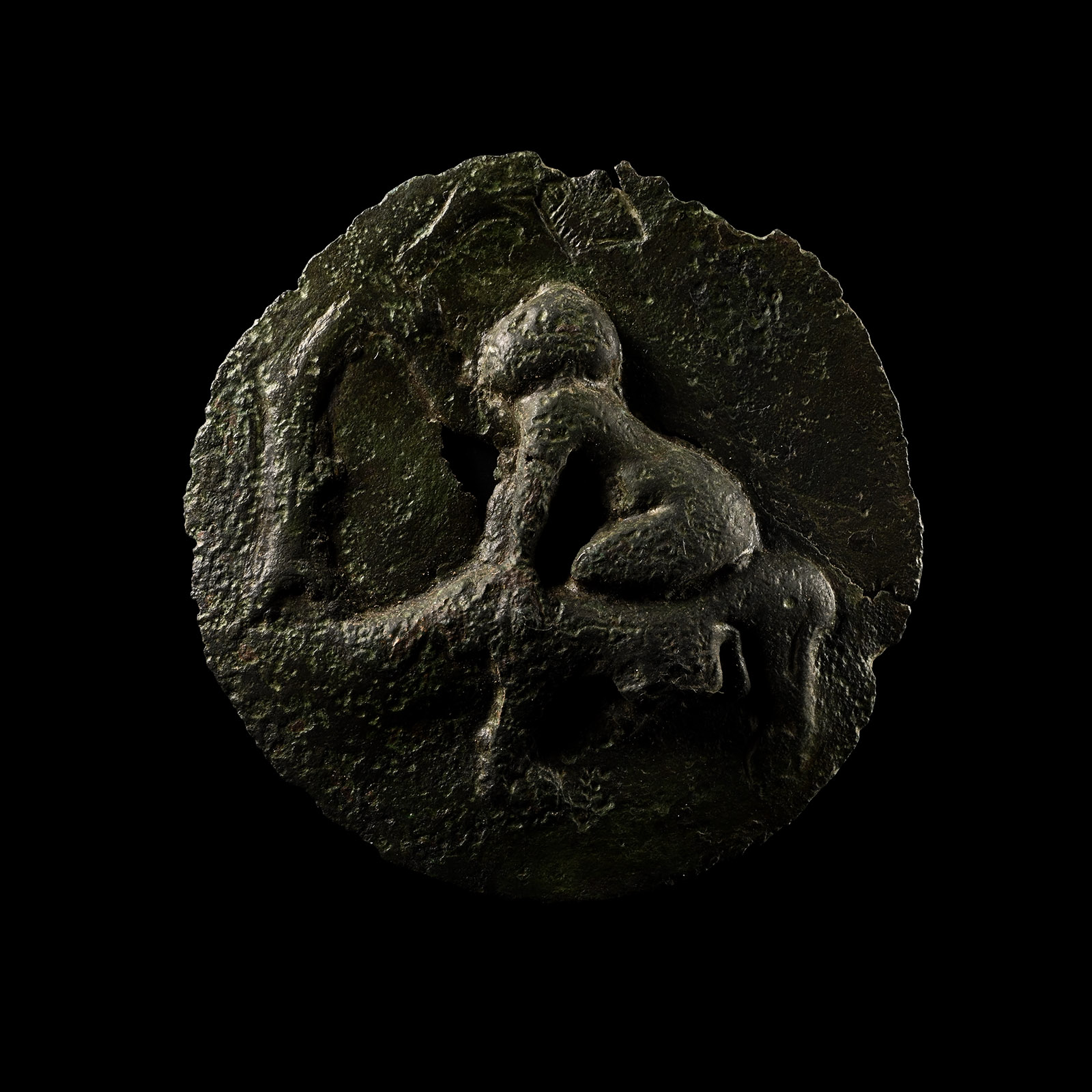
Roman 'The Wakefield' Bronze Founding of Rome Commemorative Military Phalera
1ST CENTURY B.C.-1ST CENTURY A.D.
2 3/8 in. (39 grams, 62 mm).
With high-relief image depicting a she-wolf in profile advancing beneath a tree, with an infant or boy (Romulus?) on its back, nude and looking up towards the tree.
ProvenanceBelieved to have been found in Wakefield, UK, in the 1960s.
From the Roman 'Invasion Period' private collection of Brian Riley, Wakefield, UK, 1960s-2007.
Acquired from Brian Riley, Yorkshire, UK, circa 2007.
Property of a Stowmarket, UK, gentleman.
Accompanied by an academic report by Dr Raffaele D’Amato.
Cf. Maxfield, V.A., The military decorations of the Roman Army, Los Angeles, 1981; D’Amato, R., Sumner G., Arms and Armour of the Imperial Roman Soldier: From Marius to Commodus, 112 BC-AD 192, London, 2009; cf. also a phalera in the Getty Museum collection, accession no.81.AM.87.2 (Hellenistic-Parthian phalera representing a lion attacking a stag).
FootnotesMilitary phalerae usually depicted heads of the gods, spirits of the underworld, birds and lions. The higher officers in the Roman army had the custom of wearing a rich suite of phalerae with its straps directly attached to leather garments or doublets, worn over their armour. These decorations were awarded in sets, commonly of nine, although sources confirm that this was not an always the case.
CONDITIONTimeLine Auctions follows a vetting process to ensure the authenticity and legality of all items, reinforcing our commitment to integrity and responsible trading. Each antiquity, antique, and coin lot undergoes thorough examination by a vetting committee of at least ten external specialists, professional trade association members, scientists, and archaeologists: Our Vetting Process
AUCTIONS:
TimeLine is a leading auction house specialising in antiquities, ancient art, collectables, natural history, coins, medals, and books. Our auctions offer museums, collectors, historians, and enthusiasts the opportunity to acquire unique and historically significant pieces.
LOT 0898
Roman 'The Wakefield' Bronze Founding of Rome Commemorative Military Phalera
Estimate £800 - 1,000€930 - 1,160 (for guidance only)$1,080 - 1,350 (for guidance only)
-
Roman Silver Phalera with Medusa
1st-2nd century A.D.Sold for (Inc. bp): £936
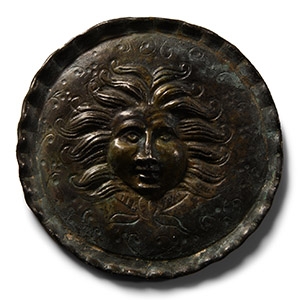
Discoid with fluted rim, central raised gorgoneion within scrolled tendrils. 13.8 grams, 59 mm
Ex German art market, 2000s. Acquired from an EU collector living in London. From the collection of Surrey, UK, gentleman.
Military phalerae with representations of Medusa or the Gorgoneion were popular among the Roman army. They decorated horse harnesses and officers' armour. They were also used as appliqués for scabbards, caskets, or other items in military use. Our phalera is classical in style, recalling the style of the Gorgoneia of the Nemi's ship, and it could also have been used as decorative item for furniture. -
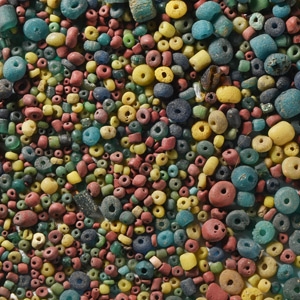
Roman and Other Mixed Glass Bead Group
1st-4th century A.D. and laterSold for (Inc. bp): £91
Including spherical, annular and other types including some 'trade wind beads'. 140 grams total, 1-9 mm
From the private collection of the late Mrs Belinda Ellison, a long time member of the Egyptian Exploration Society, c.1940-2020. -
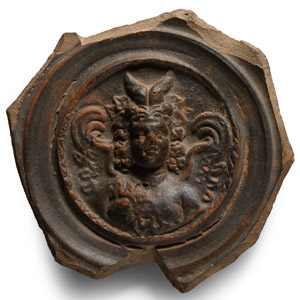
Roman Decorated Terracotta Fragment
1st-4th century A.D.Sold for (Inc. bp): £104
Base from a cup or bowl with winged bust of Dionysus modelled in the half-round with goat-horns above the head, scrolled lateral wings, vine tendrils to the chest and hair. 54 grams, 76 mm
From a Cambridgeshire, UK, collection, 1990s.
