
Loading, please wait...
LOT 0897
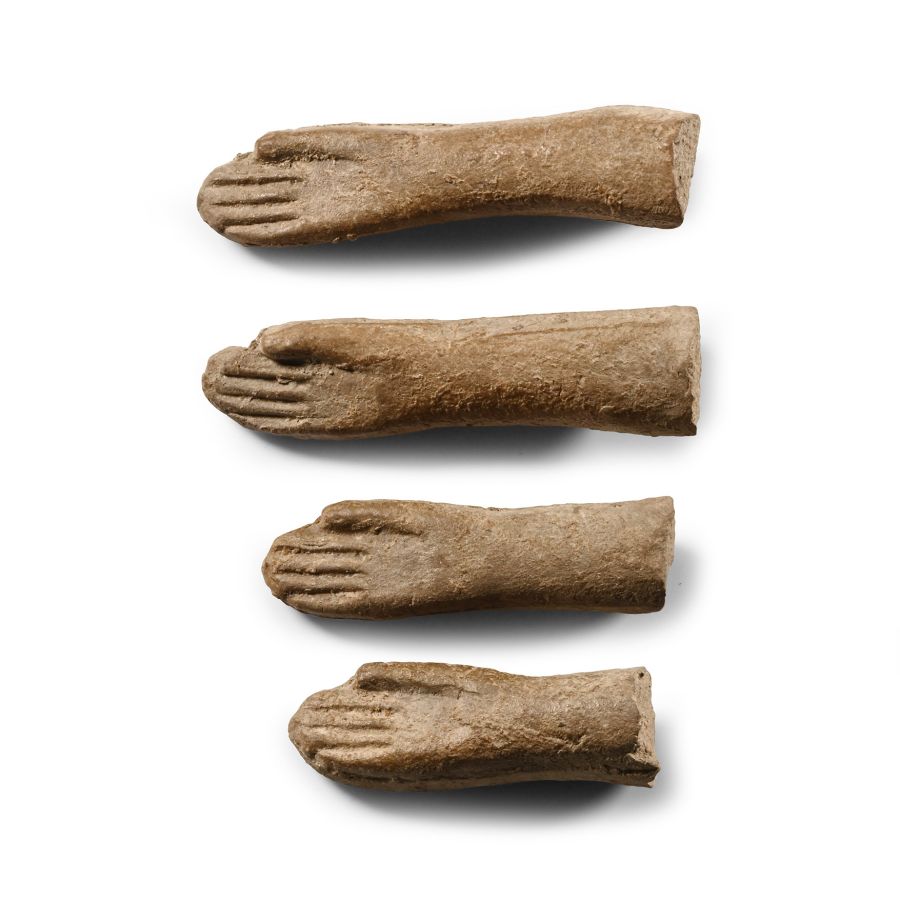
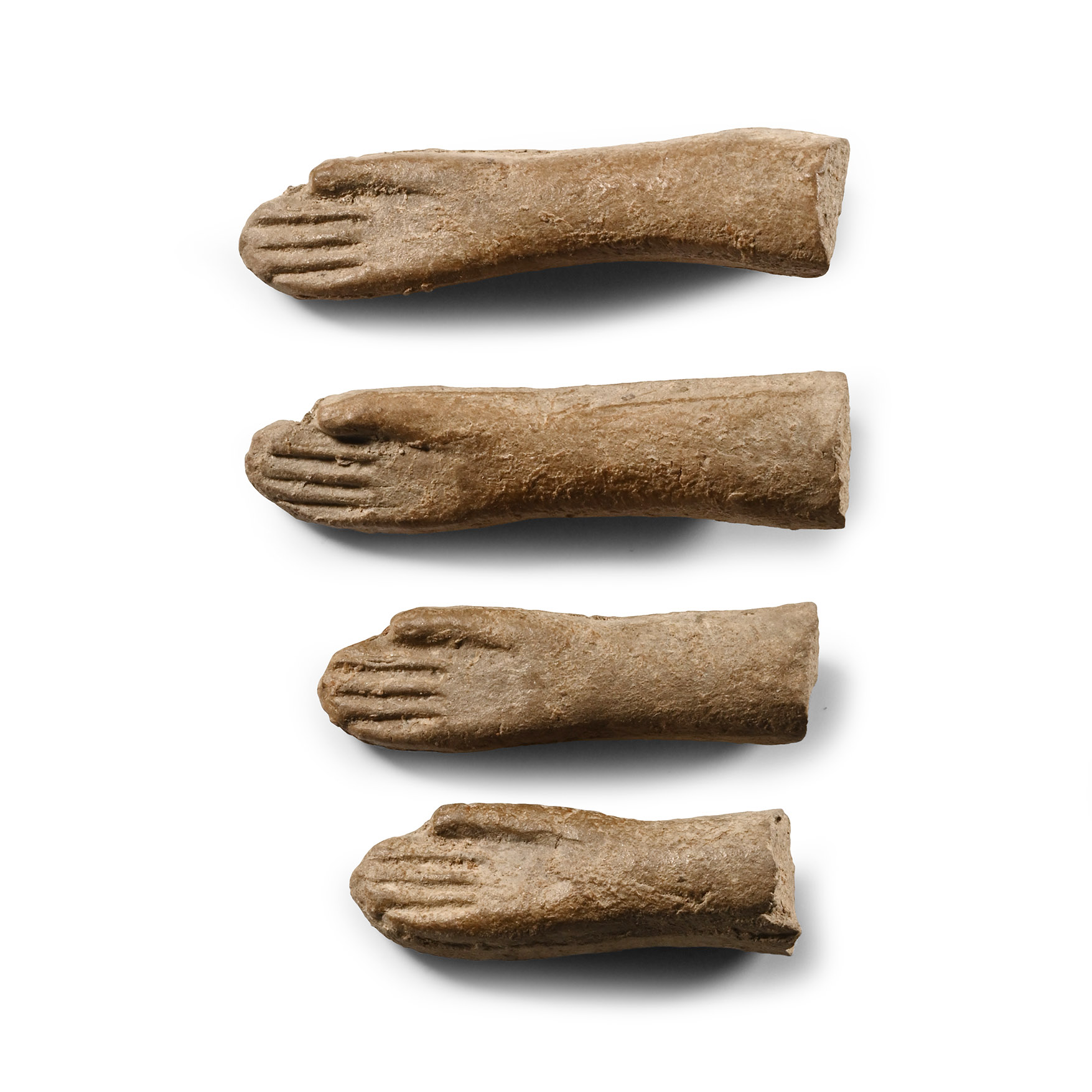
Roman Terracotta Votive Arm Group
1ST-3RD CENTURY A.D.
1 1/4 - 1 3/4 in. (17.2 grams total, 33-45 mm).
Comprising four lower arms with extended fingers. [4, No Reserve]
ProvenanceEx German art market, 2000s.
Acquired from an EU collector living in London.
From the collection of Surrey, UK, gentleman.
TimeLine Auctions follows a vetting process to ensure the authenticity and legality of all items, reinforcing our commitment to integrity and responsible trading. Each antiquity, antique, and coin lot undergoes thorough examination by a vetting committee of at least ten external specialists, professional trade association members, scientists, and archaeologists: Our Vetting Process
AUCTIONS:
TimeLine is a leading auction house specialising in antiquities, ancient art, collectables, natural history, coins, medals, and books. Our auctions offer museums, collectors, historians, and enthusiasts the opportunity to acquire unique and historically significant pieces.
-
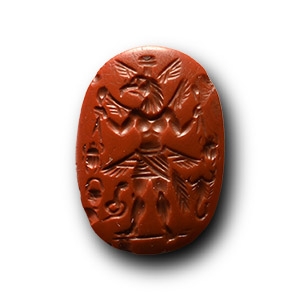
Late Roman Gnostic Carnelian Gemstone
4th-7th century A.D.Sold for (Inc. bp): £1,235
Bifacial ellipsoid insert with lip to one face; obverse depicting a kilted figure with avian head and with wings on his head, shoulders and hips holding symbols and flanked by a scorpion, scarab, serpent and other items; reverse with lion-headed serpent, surrounding enigmatic legend 'XAYMNOMNABMXMXIM'; supplied with a museum-quality impression of each face. 1.92 grams, 22 mm
From the property of late Mr SM, London, UK, 1969-1999. -
.jpg)
Roman Bronze Statuette of Athena
2nd-3rd century A.D.Sold for (Inc. bp): £3,640
Standing erect in contrapposto pose, wearing a floor-length himation and with the gorgoneion medallion on her chest; Corinthian helmet on her head tilted backwards to reveal her face; right arm raised and bent with open hand to accept a spear-shaft; mounted on a custom-made display stand. 279 grams total, 13 cm including stand
From a collection acquired on the UK art market from various auction houses and collections mostly before 2000. From an important Cambridgeshire estate; thence by descent.
The figure is a hybrid based on representation of Roman Minerva, closely associated with Greek Athena. The missing attributes are the spear and the shield, according to the type of Minerva of Firenze (Reinach, 1930, p.278). -
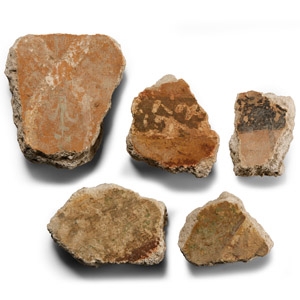
Roman Fresco Wall Plaster Collection
1st century A.D.Sold for (Inc. bp): £111
Fragments of wall plaster with rendered surface painted red with white detailing to the edge; impression of timber laths to the reverse. 598 grams total, 66-98 mm
Acquired in the 19th century. Ex Jeger collection, Switzerland.
These small fragments seem to belong to the second style of Roman painting, red panels representing highlight and shadow, decorated with vegetal interlaces. Some panels were probably framed by a red grenade fillet. A fragment shows alternate blue and red colour over a cream background, maybe pertinent to a socle.
