
Loading, please wait...
LOT 0675
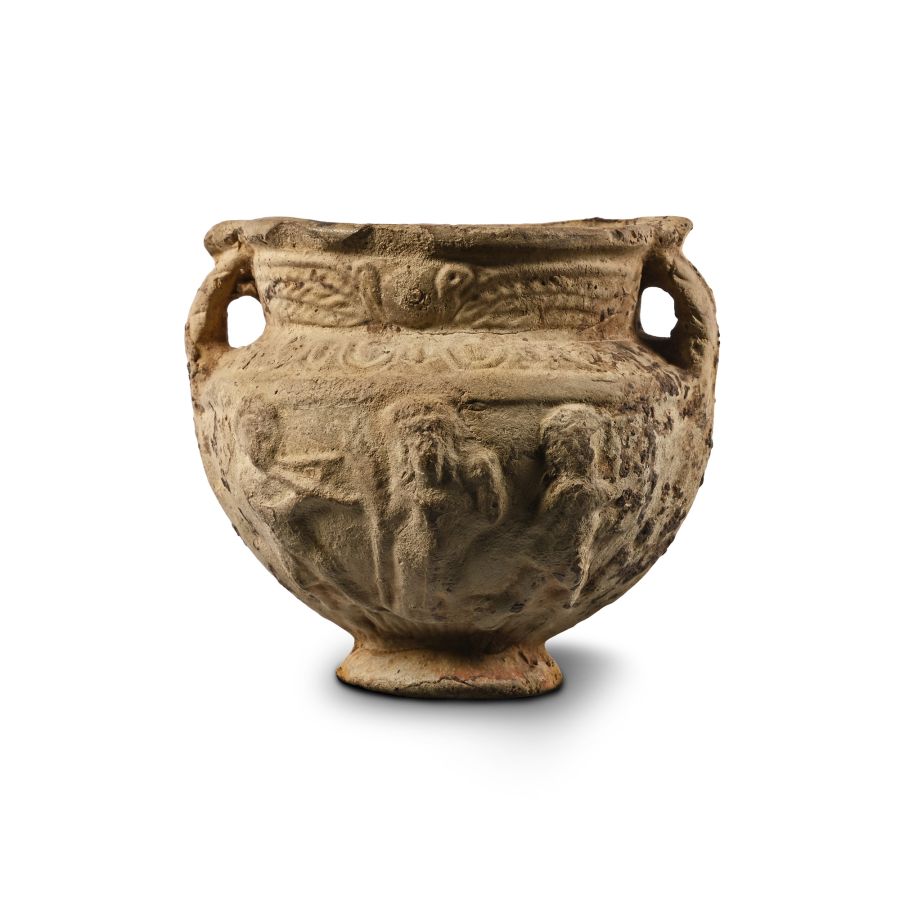
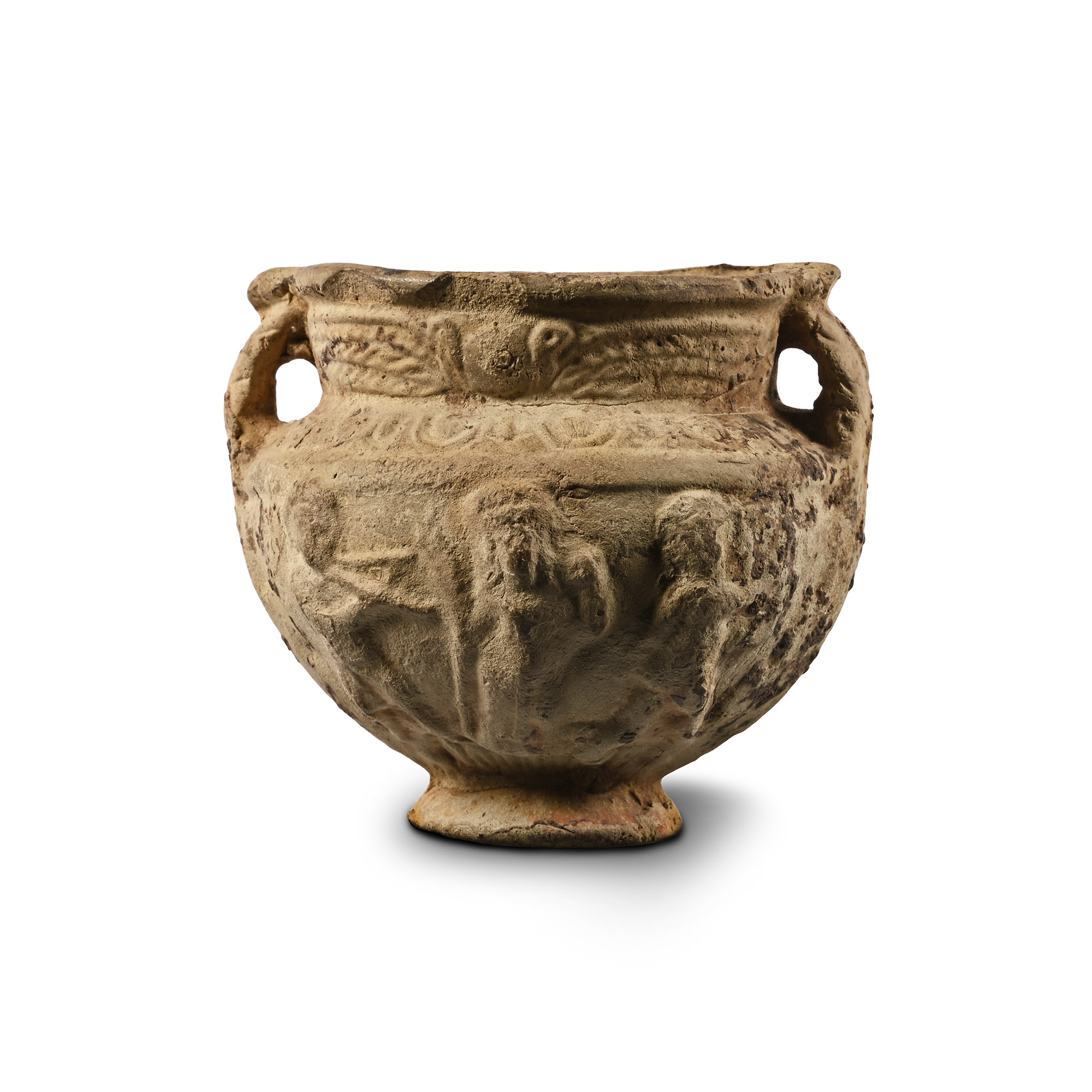
Roman Terracotta Vessel with Processions of Musicians
1ST CENTURY B.C.-1ST CENTURY A.D.
3 1/4 in. (90 grams, 82 mm).
With moulded relief decoration depicting scenes of dance and music, probably a Bacchic procession, one side with a woman playing an epigonion or psaltery, flanked by two nude dancing men; the other side with a nude woman holding a palm branch and surrounded by two men playing a double flute and a cithara. [No Reserve]
ProvenanceAcquired prior to 1971.
Ex Fridolin (1903-1969) and Halina (1907-1989) Schwitter-Lagutt collection, Basel, Switzerland.
with Christie's, London, UK, sale 21014, no.115 (part).
Accompanied by a copy of the Christie's listing and invoice.
Accompanied by an academic report by Dr Raffaele D’Amato.
This lot is accompanied by an illustrated lot declaration signed by the Head of the Antiquities Department, Dr Raffaele D'Amato.
Exhibited: On loan to the Antikenmuseum, Basel, Switzerland, 1971-2022.
LiteratureCf. Metropolitan Museum of Art, accession no. 1983.571.9, for a cup of similar shape; for the musical instruments see Museum of Ancient, Byzantine and Post-Byzantine Musical Instruments, Museum Exhibits, Thessaloniki, 1997, pp.33ff., 48ff., 77ff.
CONDITIONTimeLine Auctions follows a vetting process to ensure the authenticity and legality of all items, reinforcing our commitment to integrity and responsible trading. Each antiquity, antique, and coin lot undergoes thorough examination by a vetting committee of at least ten external specialists, professional trade association members, scientists, and archaeologists: Our Vetting Process
AUCTIONS:
TimeLine is a leading auction house specialising in antiquities, ancient art, collectables, natural history, coins, medals, and books. Our auctions offer museums, collectors, historians, and enthusiasts the opportunity to acquire unique and historically significant pieces.
-
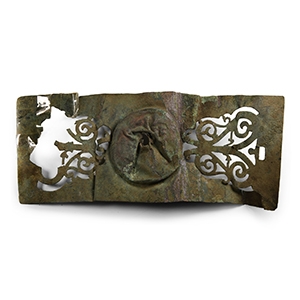
Large Roman Bronze Military Mount
2nd-3rd century A.D.Sold for (Inc. bp): £117
Composed of a central domed boss and openwork volutes to the sides; for a sword belt or a chariot, one corner separated. 69 grams, 14 cm wide
Good condition, very rare
Acquired 1960s-1990s. Late Alison Barker collection, a retired London barrister. This lot is accompanied by an illustrated lot declaration signed by the Head of the Antiquities Department, Dr Raffaele D'Amato.
In the 3rd century A.D. the sword (spatha) was mainly carried suspended from a broad baldric usually on the soldier’s left side. This sword’s shoulder belt, visible on many monuments related to the 3rd century, was composed from a leather strap, reinforced on the rims. The four specimens of Vimose provided valuable information about the shape of the baldric: one end was broad and finished in a straight edge, the other tapered to a narrow strip. They were decorated with silver disks (phalerae) of circa 6.4 cm of diameter, with rings on the reverse for fastening. These phalerae were of different shapes, styles and decorations: we can observe a range from simple copper-alloy discs to bronze openwork pieces fitted with a plate or an openwork disc showing elaborate figures. They were usually attached at about 29-30 cm from the wider and squared top of the baldric. One of the finial parts of the baldric was in fact very wide and ended with a straight edge, upon which could be placed a hinged rectangular openwork terminal plate (like our specimen), attached to a belt terminal pendant. The lack of holes for the attachment rivets in our specimen could also support the thesis that the piece is not for a baldric, but a mount for cart or chariot as some examples in a similar style found in Roman North Africa. -

Two Roman Sandstone Architectural Frieze Sections
Circa 1st century B.C.-1st century A.D.Sold for (Inc. bp): £6,435
Each rectangular with raised upper lip and a raised decorative frieze with rosettes and a bull's head (bucranium) separated by triple pilasters. 76.2 kg total, 76.5 cm each
with Georges Joseph Demotte (1877-1923) and Andrée Macé (1918-2000), Belgium and New York. Collection Demotte/Andrée Macé; Jean-Claude Renard Auction, Suresnes, 3 September 2013, no.87. with Galerie Chenel, Paris, 2021. This lot has been checked against the Interpol Database of stolen works of art and is accompanied by a search certificate number no.12624-236336. This lot has been cleared against the Art Loss Register database, and is accompanied by an illustrated lot declaration signed by the Head of the Antiquities Department, Dr Raffaele D'Amato.
In classical Rome bovine skulls decorated the friezes of entablatures. Often, they were positioned in the metopes of Doric entablatures, but also in Ionic and Corinthian friezes, sometimes connected by floral or drapery swags. The architectural term for these skulls is bucranium (pl. bucrania or bucranes), a word derived from the Latin bos, meaning ox or cow, and cranium, the Medieval Latin term for a skull. The skulls allude to the ancient Greek and Roman ceremonies of sacrifice. -
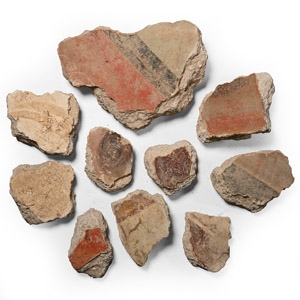
Roman Fresco Wall Plaster Collection
1st century A.D.Sold for (Inc. bp): £72
Fragments of wall plaster with rendered surface painted with mainly red, pale blue and white detailing; some with impression of timber laths to the reverse. 1.76 kg total, 6.5-17.5 cm
Acquired in the 19th century. Ex Jeger collection, Switzerland. UK gallery, early 2000s. This lot is accompanied by an illustrated lot declaration signed by the Head of the Antiquities Department, Dr Raffaele D'Amato.
These small fragments, for analogies with the fragments of Pompeii, seem to belong to the second style of Roman painting, red panels representing highlight and shadow, decorated with vegetal interlaces. Some panels were probably framed by a red grenade fillet. A fragment shows alternate blue and red colour over a cream background, maybe pertinent to a socle.
