
Loading, please wait...
LOT 0911
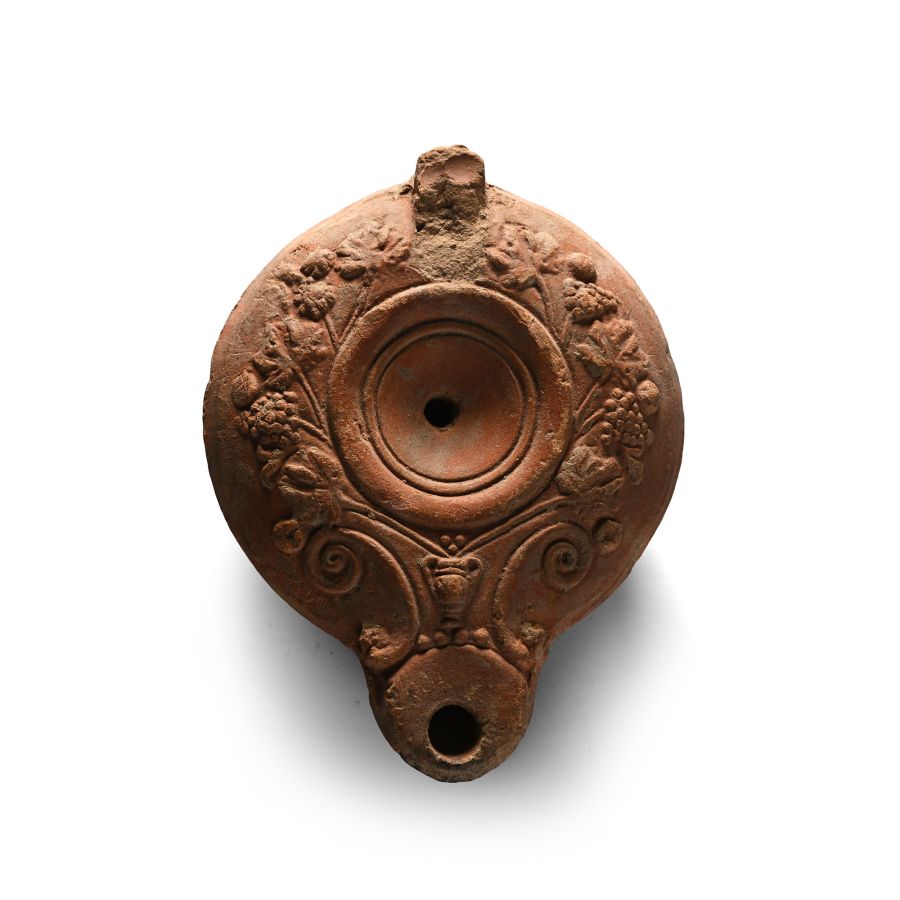
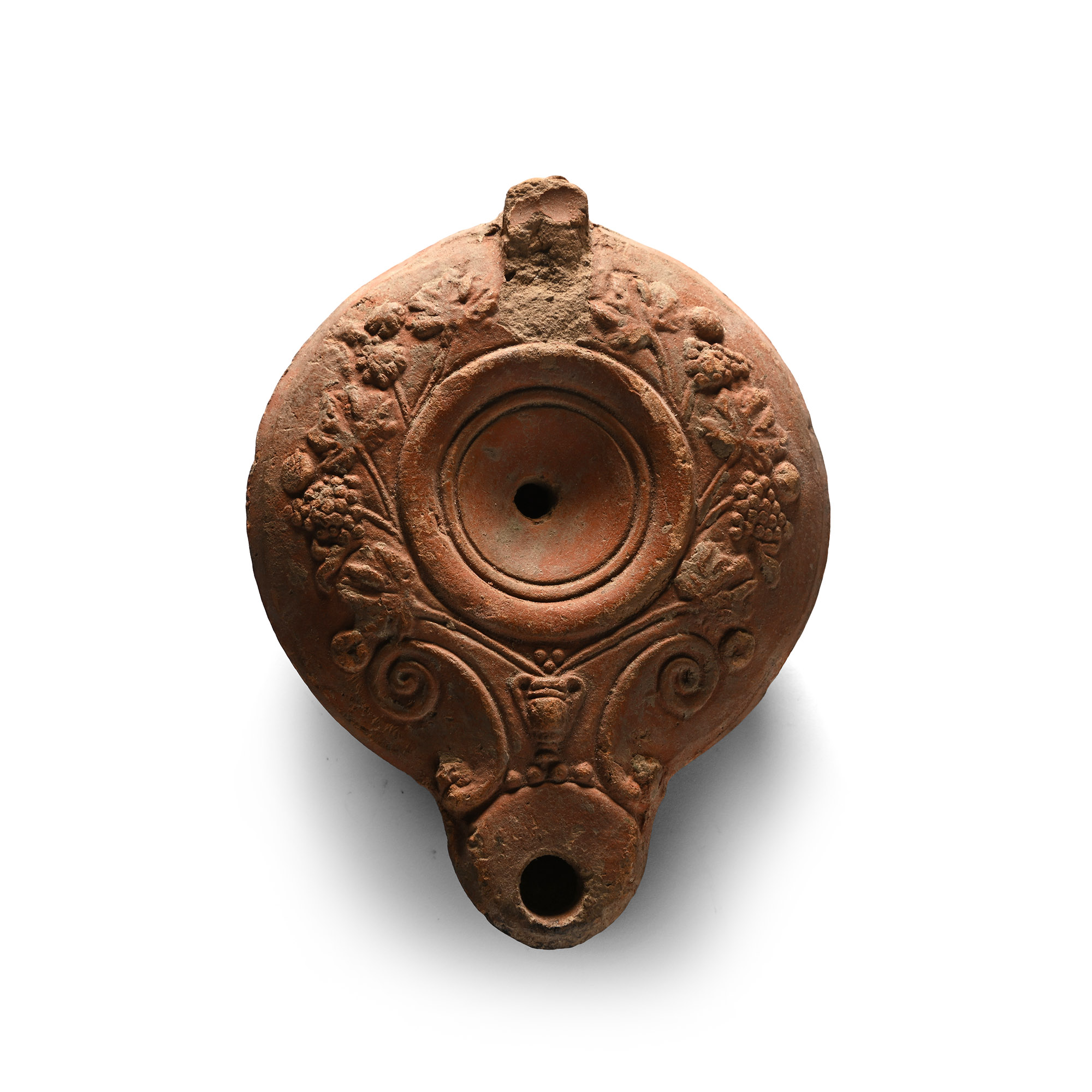
Roman Terracotta Oil Lamp with Grape Vines
1ST-2ND CENTURY A.D.
3 3/4 in. (58 grams, 94 mm).
Mould-made, the round handle absent, deep body, broad outward-sloping shoulder with grapes and vine decorations, separated from concave discus by two thin circular ridges with a groove between, central filling-hole, short round-tipped nozzle with two volutes on flat space between the discus edge and wick-hole, base marked by three circular grooves. [No Reserve]
ProvenanceFrom the collection of Mr W.A. Stewart, Director of School of Arts and Crafts, Cairo, 1919-1929.
Acquired Christie's, London, Antiquities, Works of Art and Important Renaissance Bronzes, Plaquettes and Limoges Enamels, 8 July 1981, no.126 (part).
From a private Wiltshire, UK, collection.
Accompanied by a copy of the relevant Christie's catalogue page.
Cf. Bussière, J., Lindros Wohl, B., Ancient Lamps in the J. Paul Getty Museum, Malibu, 2017, pp.381-382, and nos.522-523, for the type.
FootnotesThe lamp belongs to the Loeschke type VIII, eastern variants. These lamps appeared in the second half of the 1st century but were long-lived, for a number have been found in a 3rd century A.D. context in the necropolis of Beth Shearim. Whether this decor of typical double volutes was devised by lamp makers in Asia Minor or Attica, and who influenced whom, is not yet possible to determine. But it is worth signalling the use of this decor as anchored in the eastern part of the Mediterranean.
CONDITIONTimeLine Auctions follows a vetting process to ensure the authenticity and legality of all items, reinforcing our commitment to integrity and responsible trading. Each antiquity, antique, and coin lot undergoes thorough examination by a vetting committee of at least ten external specialists, professional trade association members, scientists, and archaeologists: Our Vetting Process
AUCTIONS:
TimeLine is a leading auction house specialising in antiquities, ancient art, collectables, natural history, coins, medals, and books. Our auctions offer museums, collectors, historians, and enthusiasts the opportunity to acquire unique and historically significant pieces.
-
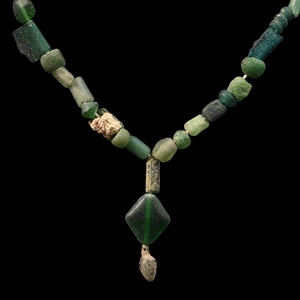
Roman Green Glass Bead Necklace String
1st-4th century A.D. and laterSold for (Inc. bp): £130
Restrung designer necklace string of tubular, oblate and other types with lozengiform centrepiece. 14.9 grams, 38 cm
London, UK, collection, 2000s. -
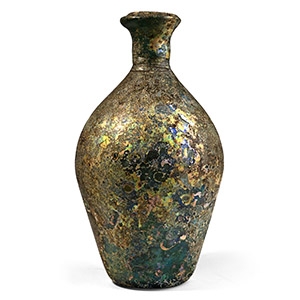
Large Eastern Roman Green Glass Bottle with Iridescence
2nd-3rd century A.D.Estimate: £2,500 - 3,500 (+bp*)
Opening Bid: £1,250
Piriform in profile with a narrow neck and flared mouth with a chamfered rim, dimple base. 945 grams, 29.5 cm high
From the Xavier Guerrand-Hermès private collection. with Artcurial, Paris, 25 March 2014, no.39. Private collection, London, UK. This lot has been checked against the Interpol Database of stolen works of art and is accompanied by search certificate number no.12959-245241.
On ancient glass, iridescence is the soft play of colour that develops as the surface ages and becomes silica-rich. Minute layers form over time and break light into shifting blues, greens and golds. It is not a modern finish but something time has drawn out of the material itself, so the pattern and palette are unique to each piece. Collectors prize good, stable iridescence because it lifts the form: ribs read more crisply, profiles glow, and simple vessels take on depth and movement. Museums now tend to preserve these surfaces rather than polish them away, recognising both their beauty and what they tell us about an object’s long life (though it is not, by itself, a dating test). For display, iridescent glass performs brilliantly under gentle, directional light, where the colours “turn” as the vessel is moved. Well-preserved, even iridescence of this quality is not common and adds materially to the presence and desirability of the piece. -
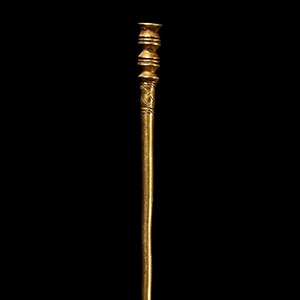
Roman Decorated Gold Dress Pin
1st-4th century A.D.Estimate: £700 - 900 (‡+bp*)
Opening Bid: £350
Slender body with balustered finial, a band of hatched herringbone decoration beneath the finial. 2.74 grams, 72 mm
Ex 'Neuburg' Collection, Germany, 1970. with Gorny & Mosch, Munich, Germany. with Galerie Rhéa, Zurich, Switzerland.
