
Loading, please wait...
LOT 0769
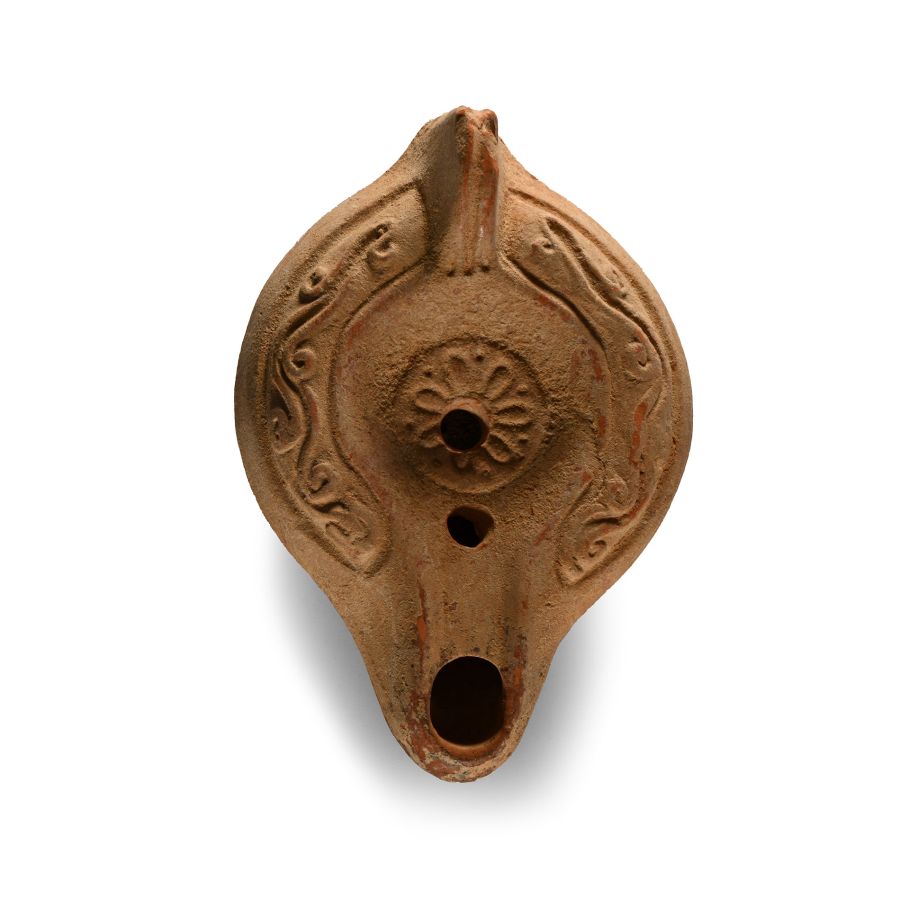
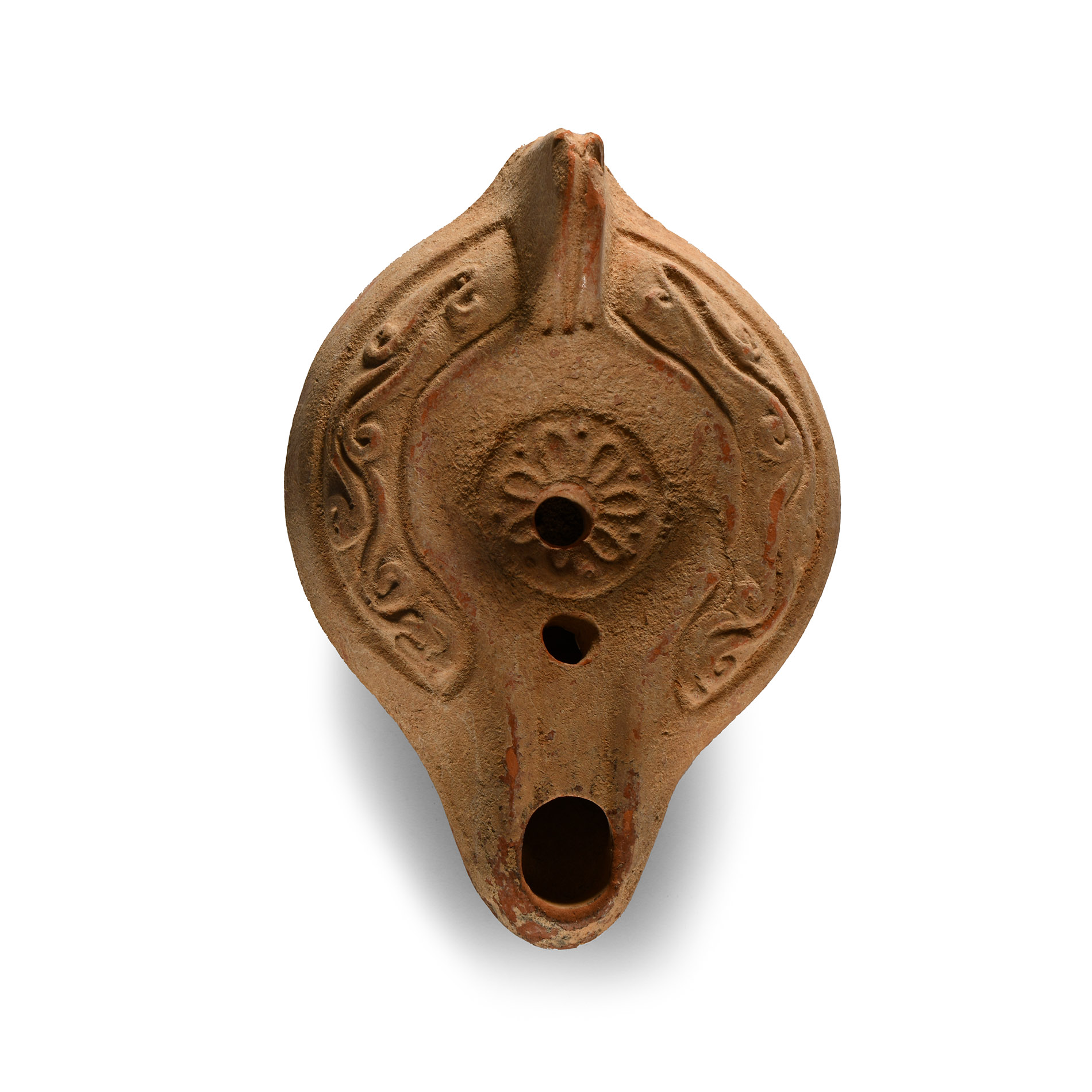
Roman Terracotta Oil Lamp with Floral Motif
5TH CENTURY A.D.
4 1/2 in. (173 grams, 11.5 cm).
Grooved lug handle to rear, discus with two filling holes and a central rosette motif, foliate border to the shoulder; low basal ring and maker's mark 'E'.
ProvenanceAcquired on the European art market, 1980s.
English private collection.
Cf. Bussière, J., Lindros Wohl, B., Ancient Lamps in the J. Paul Getty Museum, Malibu, 2017, no.526, for the type (late lamps from Asia Minor).
FootnotesMany lamps of this category (late lamps of Asia Minor types, sometimes just called 'late Ephesian lamps' but diffused in all of the Roman Levant) were discovered in the Seven Sleepers Cemetery at Ephesus. These lamp types have either a circular or an oval elongated body that is sharply carinated, with protruding nozzle. The shoulders are outward sloping and offer a variety of characteristic decorations in both relief and sunken patterns: rows of globules, slanted radiating grooves, ovolos, vine-tendrils and grapes, tongues or petals, and concentric rings.
CONDITIONTimeLine Auctions follows a vetting process to ensure the authenticity and legality of all items, reinforcing our commitment to integrity and responsible trading. Each antiquity, antique, and coin lot undergoes thorough examination by a vetting committee of at least ten external specialists, professional trade association members, scientists, and archaeologists: Our Vetting Process
AUCTIONS:
TimeLine is a leading auction house specialising in antiquities, ancient art, collectables, natural history, coins, medals, and books. Our auctions offer museums, collectors, historians, and enthusiasts the opportunity to acquire unique and historically significant pieces.
-
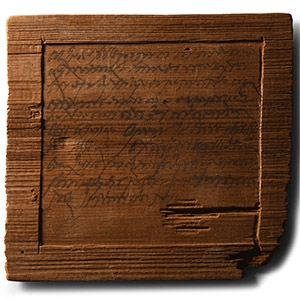
Roman Inked Wooden Tablet for a Contract Between Bassus and Neronianus
4th century A.D.Sold for (Inc. bp): £15,600
A reused tablet with a recessed panel on one side, the last tablet of a legal document which consisted of two (diptychon) or three tablets (triptychon); ten black inked lines of New Roman cursive script, the end of a record of a transaction in formulaic legal language, probably a sales contract, between the buyer (emptor) Bassus and a person called Neronianus; traces of text (perhaps in rustic capitals) to the reverse. 40 grams, 15.1 x 13.9 cm
From an important London collection since 1975. Accompanied by a collection of two 1970s photographs of the the tablet.
The contract follows standard Roman legal formulae. -
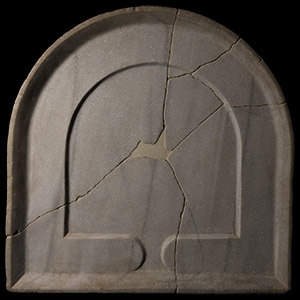
Large Late Roman Sigma-Shaped Marble Offering Table Top
Eastern Mediterranean, 4th-6th century A.D.Estimate: £10,000 - 14,000 (+bp*)
Opening Bid: £2,778
Semi-circular with raised and slightly everted edge, the top with a recessed area with a funnel-shaped outlet; for votive offerings within a church; restored. 84.5 kg including backplate, 91 cm wide
In general good condition, re-assembled.
Acquired in the late 1960s or early 1970s. Ex David Read collection. Accompanied by an academic report by Dr Raffaele D’Amato. This lot has been checked against the Interpol Database of stolen works of art and is accompanied by search certificate number no.12080-214035.
Marble tables such as the present example are called in archaeological terms sigma tables, in consideration of their resemblance to the Greek letter sigma. Sigma-shaped tables appeared in the banquet halls at the end of the 4th century and within Christian buildings from the following century. Most of the undecorated slabs were used as liturgical table tops for feasts to honour the deceased. This commemorative practice was known throughout the late Roman world in west and east, where it continued in the daily life of the citizens of the Eastern Roman Empire. In ecclesiastical settings, circular and sigma-shaped tables were used to collect offerings or for celebrating the agape, more generally as secondary furniture, while the rectangular form was preferred for use as an altar. -
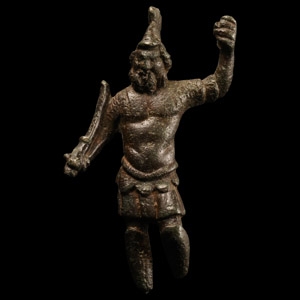
Roman Bronze Jupiter Dolichenus Statuette
Circa 2nd century A.D.Sold for (Inc. bp): £520
Modelled in the round standing wearing a crested helmet, muscle-cuirass with tunic beneath, short pteruges and greaves; left hand raised to hold a spear, right hand with gladius resting on the forearm. 36 grams, 62 mm
From a collection acquired on the UK art market from various auction houses and collections mostly before 2000. From an important Cambridgeshire estate; thence by descent.
The cult of Jupiter Dolichenus was a variant of worship of Zeus from Asia Minor whose mystery cult was widespread in the Roman Empire from the early 2nd to mid-3rd centuries A.D., especially in the military. The god is usually represented mounting a bull, with the double axe (labrys or bipennis) in his right raised hand, and dressed in the military attire of a Roman general.
