
Loading, please wait...
LOT 0884
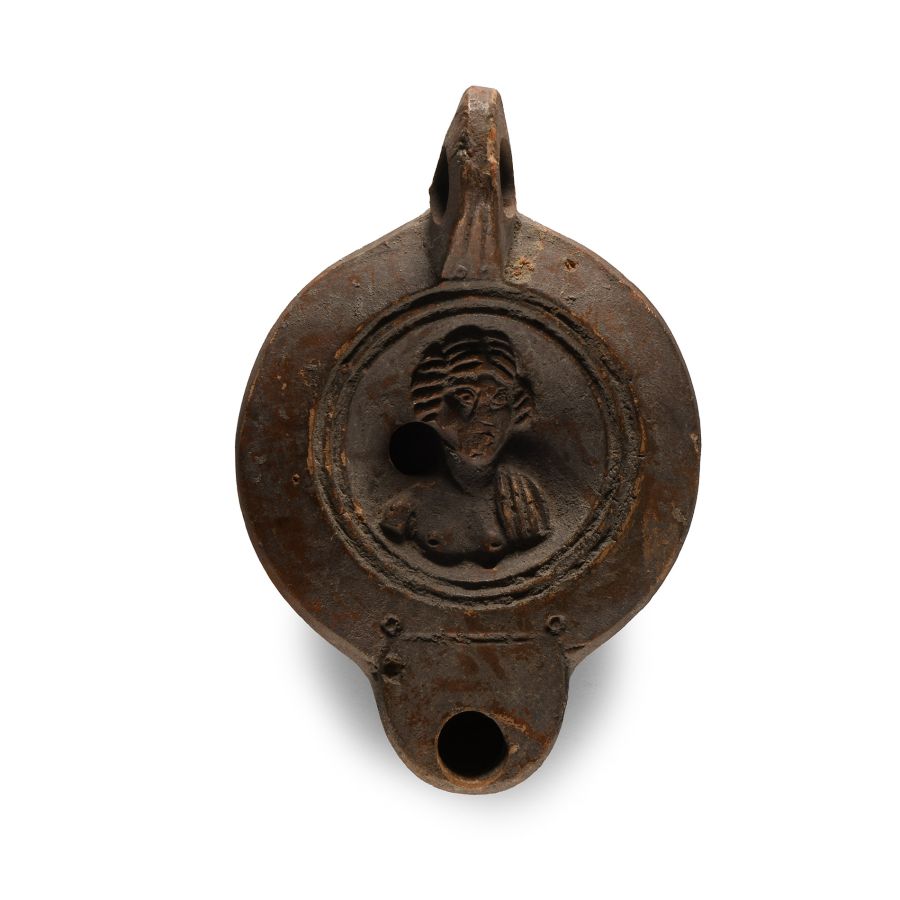
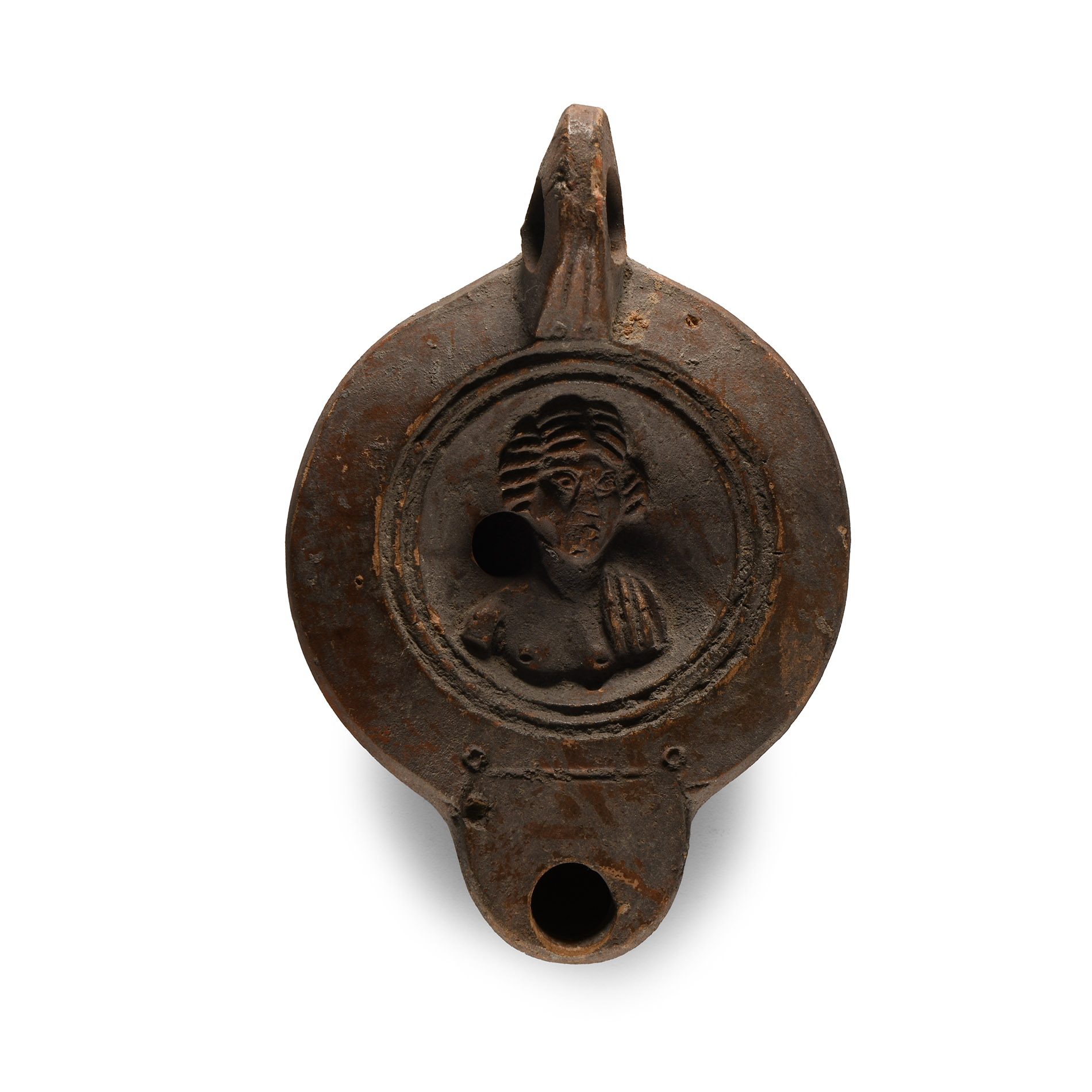
Roman Terracotta Oil Lamp with Facing Bust
120-200 A.D.
4 1/4 in. (67 grams, 10.7 cm).
Ribbed loop handle to the rear, discus with a nude bust of a young woman, a garment folded over her left shoulder; the base with maker's mark 'MNOVIVSI', for M. Novius Iustus.
ProvenanceAcquired on the European art market, 1980s.
English private collection.
See The Getty Museum, inv.no.83.AQ.377.205, for similar discus motif by a different maker in Bussière, J., Lindros Wohl, B., Ancient Lamps in the J. Paul Getty Museum, Malibu, 2017, no.292, p.204, type Loeschcke VIII; Bussière form D II 1.
FootnotesThe discus decors of these lamps are various: Diana, Dioscuri, Sol and Luna, Africa, Lares, and griffin; portraits of Domitian, Hadrian, male head, bust of a young man, bust of a young woman (our specimen), bust of a bearded old man, fisherman, and an aulete; scorpion, boar, and lion with crocodile; etc. They were an African production and not less than seven workshops have been individuated: M N O V I V, M N O V I V S T (our example), M N O V I V S T I, I V N I A L E X I, C C O R V R S, E X F N A / LV C C E I O R V M.
CONDITIONTimeLine Auctions follows a vetting process to ensure the authenticity and legality of all items, reinforcing our commitment to integrity and responsible trading. Each antiquity, antique, and coin lot undergoes thorough examination by a vetting committee of at least ten external specialists, professional trade association members, scientists, and archaeologists: Our Vetting Process
AUCTIONS:
TimeLine is a leading auction house specialising in antiquities, ancient art, collectables, natural history, coins, medals, and books. Our auctions offer museums, collectors, historians, and enthusiasts the opportunity to acquire unique and historically significant pieces.
-
.jpg)
Roman Enamelled Bronze Brooch
1st-3rd century A.D.Sold for (Inc. bp): £1,170
With raised central boss and peripheral discs with red enamel alternating with openwork loops; the body with a double band of blue, white and red enamelling, separated by ropework bands; remains of pin hinge and catchplate to the reverse; accompanied by a custom-made display stand. 61 grams total, 56 mm including stand
From a private New Jersey collection, 1960-1985. with Artemis Gallery, Colorado, USA, 8 March 2016, no.45. Private American collection, New York, USA.
A similar brooch is preserved in the Colchester Museum, and similarly decorated brooch discs are visible in the British Museum and have been found in Chesterholm, Vindolanda and Chepstow. It is a Roman provincial type used by military personnel and their families. -
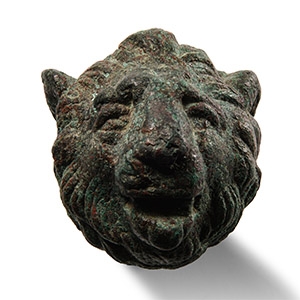
Roman Bronze Lion Head Finial
1st-2nd century A.D.Sold for (Inc. bp): £234
Hollow-formed on a tubular shank with raised rim, modelled with dense curls to the mane, mouth open and tongue protruding. 159 grams, 67 mm
Acquired in Europe in 1994. European private collection. -
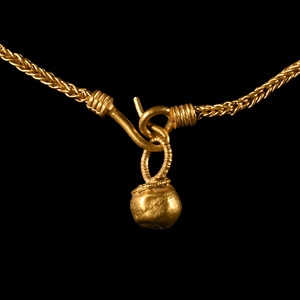
Roman Gold Chain with Ball Pendant
5th century A.D.Sold for (Inc. bp): £2,080
Trichinopoly chain with hook-and-eye closure, ball pendant with beaded wire collar. 15.02 grams, 36.5 cm long
From the collection of a Cambridgeshire lady, UK, 1990s.
The chain is composed of links in the form of pairs of broad, ribbed bands soldered together at a right angle. It is of fine loop-in-loop construction, terminating on one side in a ribbed cap with loops. The chain of ribbed loops placed at right angles is one of several popular varieties introduced in the late Roman period. The ball pendant was very common in Graeco-Roman times, substituted by Christian symbols during the late empire.
