
Loading, please wait...
LOT 0701
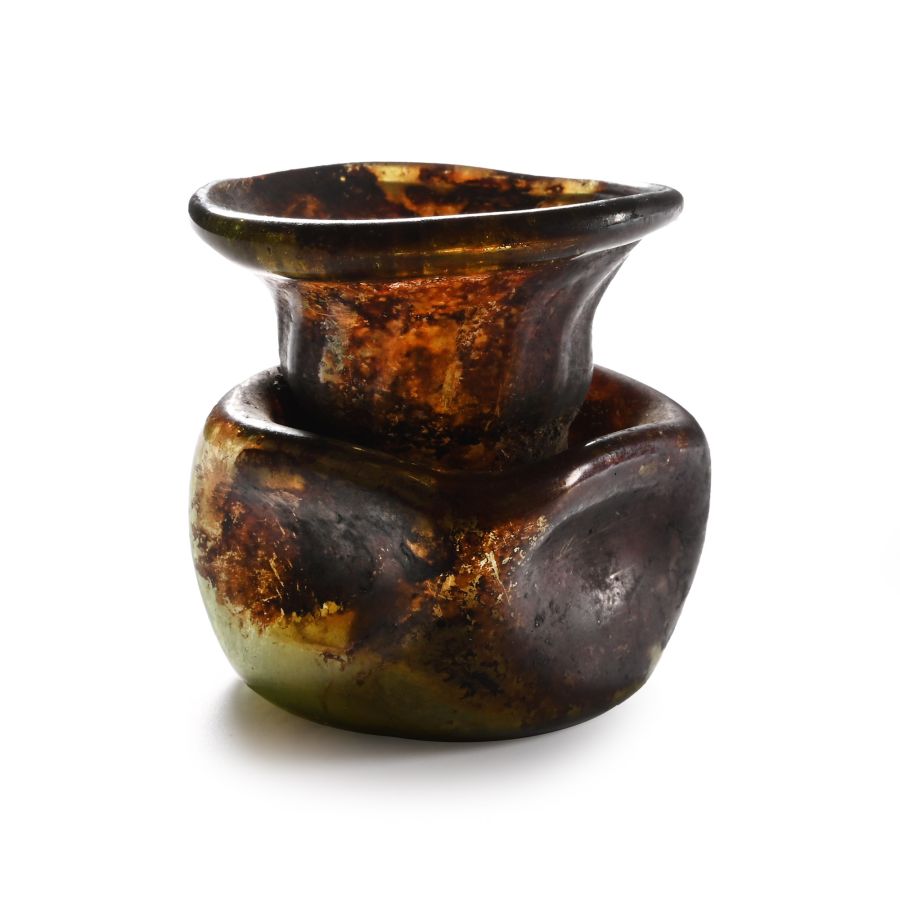
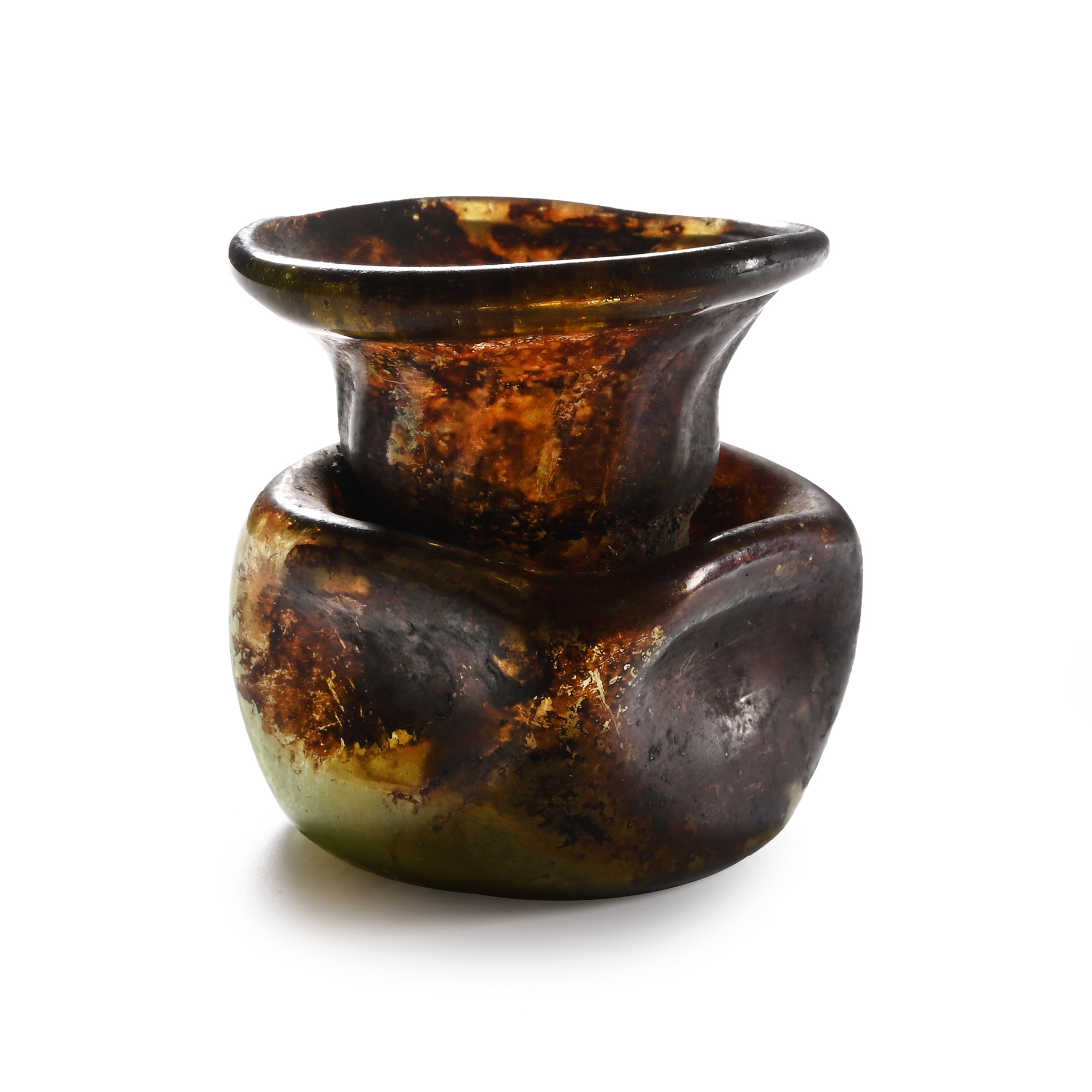
Roman Square Green Glass Flask
6TH-7TH CENTURY A.D.
2 in. (34.7 grams, 49 mm).
With dimple to the underside, squat square body and wide everted rim.
ProvenanceFrom an important London collection of glass, 1990s.
This lot is accompanied by an illustrated lot declaration signed by the Head of the Antiquities Department, Dr Raffaele D'Amato.
Cf. Whitehouse, D., Roman Glass in the Corning Museum of Glass, vol.2, New York, 2001, items 643-645, for type.
FootnotesThe object is certainly Late Roman in shape, although similar typologies did also exist in early Islamic glasswork. The bottle was probably blown into a flat mould to produce the ribs, then expanded and tooled to form the body.
CONDITIONTimeLine Auctions follows a vetting process to ensure the authenticity and legality of all items, reinforcing our commitment to integrity and responsible trading. Each antiquity, antique, and coin lot undergoes thorough examination by a vetting committee of at least ten external specialists, professional trade association members, scientists, and archaeologists: Our Vetting Process
AUCTIONS:
TimeLine is a leading auction house specialising in antiquities, ancient art, collectables, natural history, coins, medals, and books. Our auctions offer museums, collectors, historians, and enthusiasts the opportunity to acquire unique and historically significant pieces.
LOT 0701
Roman Square Green Glass Flask
Estimate £180 - 240€210 - 280 (for guidance only)$240 - 320 (for guidance only)
-
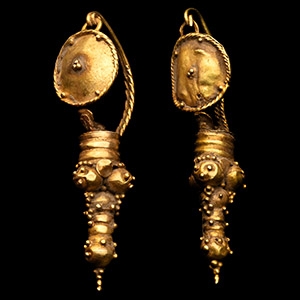
Roman Gold Earring with Matched Copy
2nd-3rd century A.D. and laterEstimate: £1,000 - 1,400 (+bp*)
Opening Bid: £550
Featuring a large central boss with and pendant decorated with fine granulation; discus decorated with a central cluster of granulation with four simple granules to the edges; boss framed with gentle ropework around the edges; hanging pendants with a cylindrical bead, and cluster of granulated hollow spheres; with another reproduction earring to make a pair. 7.25 grams total, 46 mm
Ex collection of a deceased Japanese gentleman, 1970-2010. -
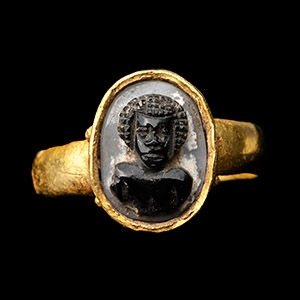
Roman Gold Ring with Onyx Nubian Bust Cameo
3rd century A.D.Estimate: £5,000 - 7,000 (+bp*)
Opening Bid: £2,250
With granules flanking an ellipsoid cell containing an onyx cameo facing bust of a Nubian with dressed hair executed in the half-round. 7.53 grams, 28.75 mm overall, 20.36 mm internal diameter (approximate size British V, USA 10 1/2, Europe 23.77, Japan 22).
Acquired 1970-1990. Ex property of a deceased lady. This lot has been checked against the Interpol Database of stolen works of art and is accompanied by search certificate number no.12954-246353. -
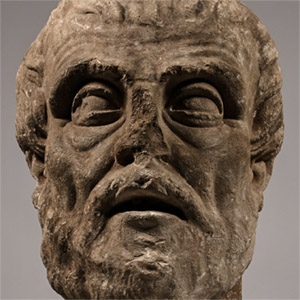
Monumental Roman Marble Head of a Greek Philosopher, Probably Diogenes
1st century B.C.-1st century A.D.Sold for (Inc. bp): £46,800
Carved in the round bust of a cynical, mature philosopher with short tousled hair and thick beard, exaggerated protruding eyes and gaunt facial features, the mouth modelled slightly open as if the subject is in pain; mounted on a custom-made stand. 47.6 kg total, 60 cm including stand
Private collection, Paris, 1980s. European private collection. Accompanied by a copy of French passport no.237041. Accompanied by an academic report by Professor Neritan Ceka. This lot has been checked against the Interpol Database of stolen works of art and is accompanied by a search certificate number no.12610-234690. This lot has been cleared against the Art Loss Register database, and is accompanied by an illustrated lot declaration signed by the Head of the Antiquities Department, Dr Raffaele D'Amato.
The portrait head was initially meant to be assembled on a statue. Chisel marks at the neck level indicate a relatively late separation of the head from the body, which must have been twice its natural size. The working of the back of the head suggests that the sculpture was exposed only to the front. The search for realistic traits brings this head close to the Hellenistic portraits of the 3rd and 2nd centuries BC, representing socially disadvantaged people of different ages and situations, such as fishermen and peasants, in the so-called genre sculptures. This presentation would be in contrast to the supernatural proportions of the portrait, which should have represented an elderly, publicly known person, poet, or philosopher, exhibited in his city of origin. In this respect, it would be more suited to the representation of a Cynical philosopher, in the model of Diogenes of Villa Albani. The almond-shaped eyes without drilled pupils, engraved eyes, and the absence of a deep drilling technique on hair date the portrait between the 1st century BC and the 1st century AD.
