
Loading, please wait...
LOT 0080
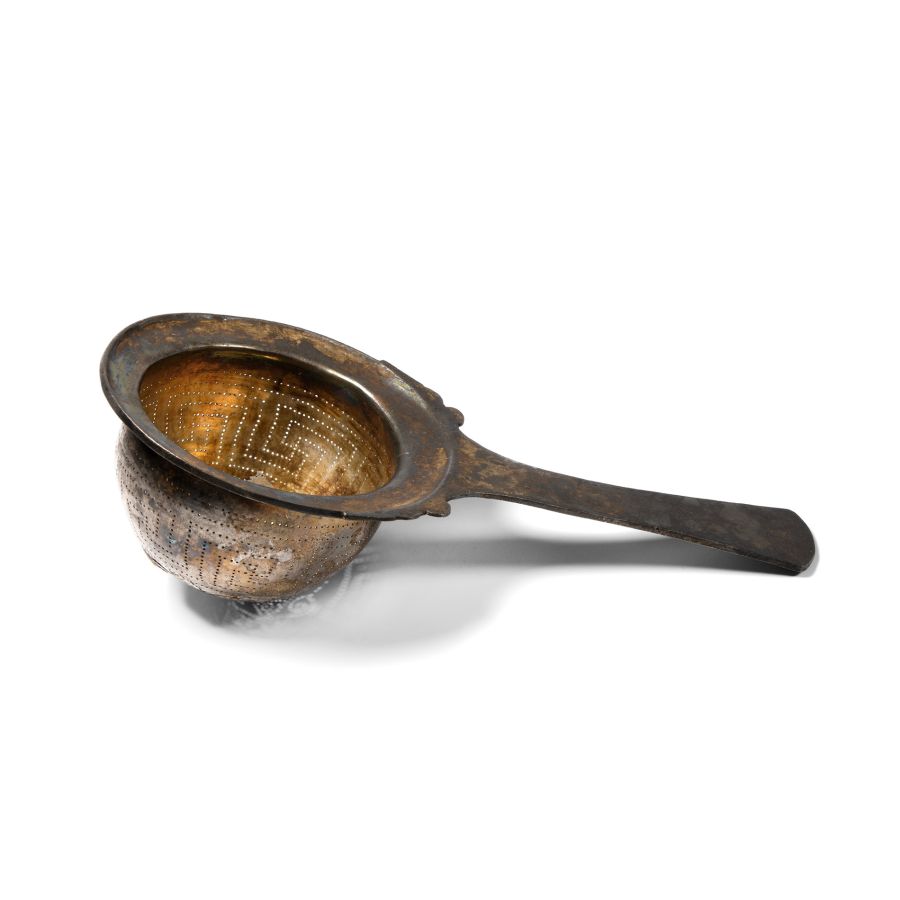
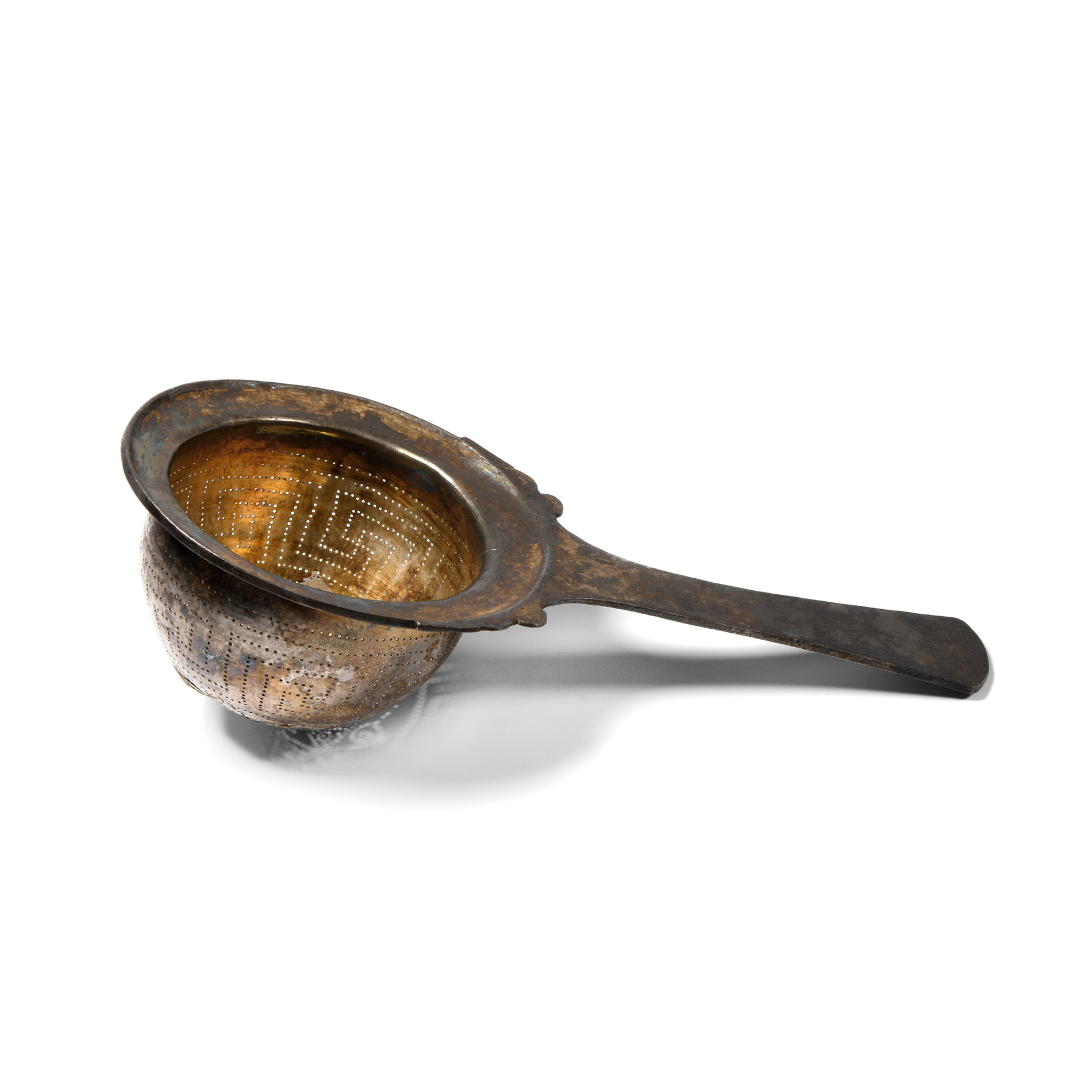
Roman Silver Wine Strainer
CIRCA 3RD CENTURY A.D.
6 7/8 in. (97 grams, 17.5 cm).
Of bulbous form, with a broad everted rim, integral scallops at the neck and splayed handle, perforated floral motif to centre of bowl, scrolling waves around and Greek key pattern above; hole to bowl.
ProvenanceAcquired 1990s-early 2000s.
East Anglian private collection.
This lot has been checked against the Interpol Database of stolen works of art and is accompanied by searcher certificate no. 200925.
Cf. Walters, H.B., Silver / Catalogue of the Silver Plate (Greek, Etruscan And Roman) in the British Museum, London, 1921, no.146, for a similar elaborately decorated silver strainer fastened to a silver funnel by a hinge in the British Museum, inventory no.1890,0923.6.
FootnotesRound-bowled strainers of various sizes occur in many late Roman hoards of domestic silver. They were used to strain the sediment from wine as it was poured into a drinking vessel. It is noteworthy that wine could have been a kind of gift from the Romans to the members of the foreign or provincial elite, often allies of the Roman leaders. Sets of bronze dishes (such as jars, scoops and strainers) along with glass horns (often with bronze fittings) and silver cups for drinking, usually placed in the so-called princely graves, confirm the wine consumption and indicate the area of its occurrence also outside the Empire.
CONDITIONTimeLine Auctions follows a vetting process to ensure the authenticity and legality of all items, reinforcing our commitment to integrity and responsible trading. Each antiquity, antique, and coin lot undergoes thorough examination by a vetting committee of at least ten external specialists, professional trade association members, scientists, and archaeologists: Our Vetting Process
AUCTIONS:
TimeLine is a leading auction house specialising in antiquities, ancient art, collectables, natural history, coins, medals, and books. Our auctions offer museums, collectors, historians, and enthusiasts the opportunity to acquire unique and historically significant pieces.
-
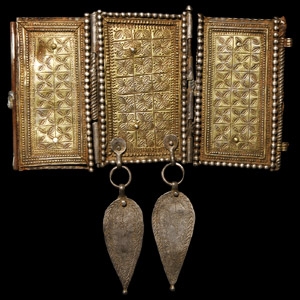
Roman Silver-Gilt Military Belt Plate Group for an Elite Imperial Officer
4th-5th century A.D.Sold for (Inc. bp): £4,160
Comprising three rectangular belt fittings: two with similar laurel leaf decoration and raised border, the third central plaque with two foliate pendants with punched decoration. 243 grams, 17 cm
Very fine, excellent condition
Acquired before the 1970s. Ex J.L. collection, Surrey, U.K., thence by descent.
Most precious military belts were reserved for soldiers belonging to Legiones Palatinae, i.e. the legions forming part of the imperial Comitatus, accompanying the emperor in his military expeditions. -
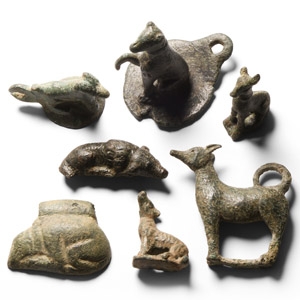
Roman Bronze Dog Collection
1st-4th century A.D.Estimate: £1,000 - 1,400 (+bp*)
Opening Bid: £556
Comprising dogs formed as pendants, lids, mounts and figurines, most displaying stylised or semi-naturalistic detailing and modelled in the round. 155 grams total, 25-40 mm
‘The Ancient Menagerie Collection’ formerly the property of a Cambridgeshire lady, collected since the 1990s and acquired from auctions and dealers throughout Europe and the USA, now ex London collection. -
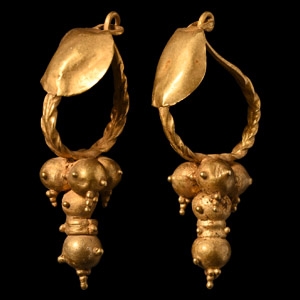
Roman Gold Boss Earrings
2nd-3rd century A.D.Sold for (Inc. bp): £650
Each composed of a central slender hoop flanked by a single strand of decoratively twisted filigree wire, domed plaque to upper body, granulated bulbs below. 3.84 grams total, 33 mm each
From the private collection of the late Mr S.M., London, UK, thence by descent.
