Loading, please wait...
Details
LOT 0928
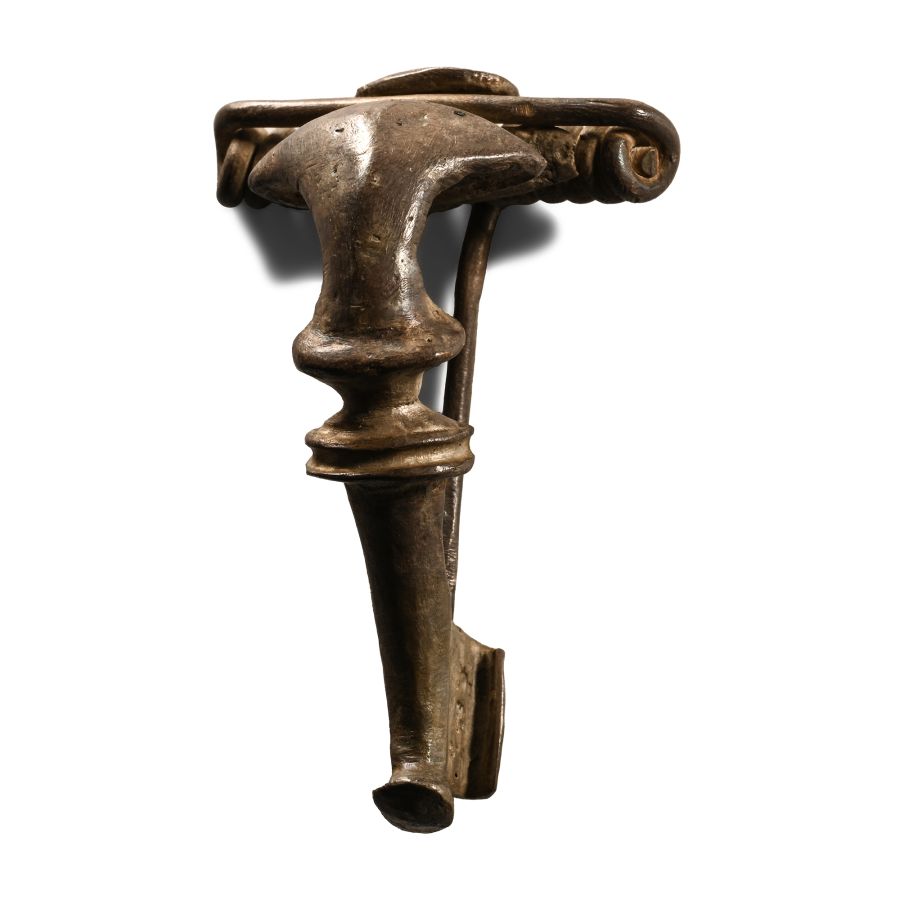
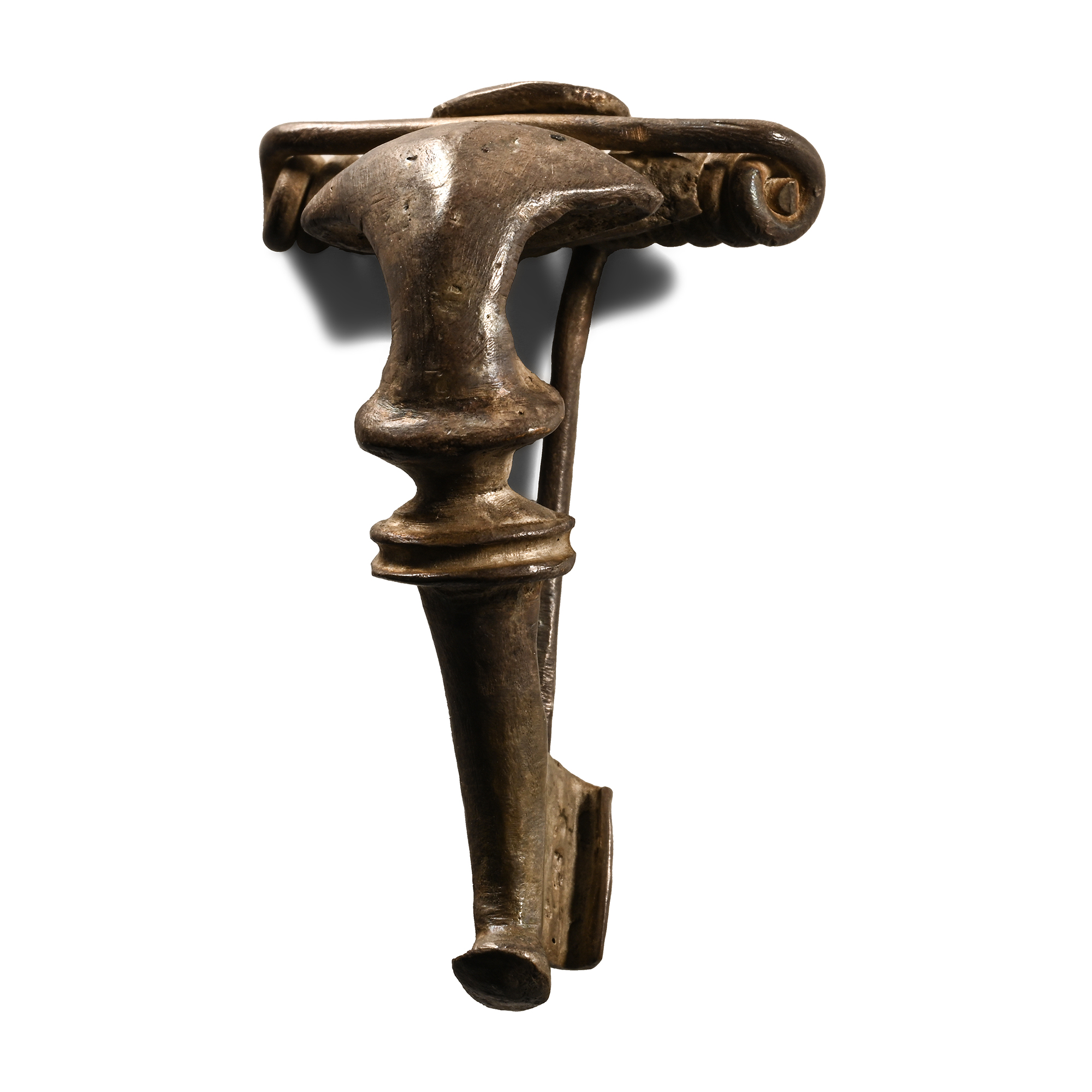
Roman Silver Trumpet Brooch
CIRCA 1ST-3RD CENTURY A.D.
2 3/8 in. (39 grams, 60 mm).
With chord, spring and pin, and trumpet-shaped headplate: D-section collars and a discoid finial at base of flared foot; articulated pin intact; catchplate projecting from the reverse of the lower bow, curving at the outer edge to house the pin. [No Reserve]
Provenance
Acquired in Munich, Germany, in the late 1980s.
Ex property of a Staffordshire, UK, gentleman.
Literature
Cf. Hattatt, R., Brooches of Antiquity, Oxford, 1987, item 1396.
CONDITIONVETTING:
TimeLine Auctions follows a vetting process to ensure the authenticity and legality of all items, reinforcing our commitment to integrity and responsible trading. Each antiquity, antique, and coin lot undergoes thorough examination by a vetting committee of at least ten external specialists, professional trade association members, scientists, and archaeologists: Our Vetting Process
AUCTIONS:
TimeLine is a leading auction house specialising in antiquities, ancient art, collectables, natural history, coins, medals, and books. Our auctions offer museums, collectors, historians, and enthusiasts the opportunity to acquire unique and historically significant pieces.
RELATED LOTS
-
Roman Silver Ring with Poseidon Gemstone
1st-2nd century A.D.Sold for (Inc. bp): £351
With elliptical cell, inset carnelian cabochon with intaglio figure of Poseidon standing naked, only covered by a cloak on his shoulders, holding a trident with left hand, and a net with a stylised dolphin(?) with the right hand; possibly a marriage. 4.97 grams, 26.02 mm overall, 18.30 mm internal diameter (approximate size British P, USA 7 1/2, Europe 16.23, Japan 15)
UK private collection formed before 2000. Ex North London, UK, gallery.
On issues of the Roman colonial coinage of Patras, the image of nude standing Poseidon holding a trident and dolphin is reproduced simultaneously with the most common representations of the god shown standing with one foot resting on a support (rock or dolphin). This type of standing nude Poseidon holding a trident in his left hand and a dolphin in his right is also pictured on the reverse of coins of Agion. -
Roman Erotic Leda and the Swan Terracotta Oil Lamp
Circa 1st-2nd century A.D.Sold for (Inc. bp): £572
With a long canal nozzle with volutes, discus with one filling hole and three concentric lines enclosing a central scene of Leda and the swan, softly rendered anatomical details and carefully modelled plumage; two old stickers to base. 74 grams, 11.7 cm
From the collection of Arno Jumpertz, Leverkusen, Germany, 1924-1984; much of the collection was exhibited at the Neus Museum, 1985. Accompanied by a previous catalogue information slip.
The lamp's style refers to the Loeschcke type I, a style popular during the Augustan and Imperial times. -
Roman Terracotta Oil Lamp with Head of Medusa
2nd century A.D.Sold for (Inc. bp): £221
Mould-made with convex shoulder separated from the concave discus by a narrow band of triangles and ovules, single groove around the discus, lower filling-hole, burn marks on the nozzle, flat undefined base, discus decorated with the head of Medusa within a laurel. 50 grams, 86 mm
Fine condition.
German collection formed since 1970. Acquired on the UK art market. Property of an Essex gentleman.
A Loeschcke VIII variant. The form and decoration suggest a Hadrianic date, at which time Medusa was one of the most popular subjects depicted on lamps. In ancient mythology, Medusa was one of three monstrous winged female creatures who had venomous snakes living in her hair. The story of Medusa is elaborated by the Roman poet Ovid in his Metamorphosis, which explains that Medusa was a beautiful woman until she had sex with Poseidon in Athena’s temple. Athena exacted punishment on Medusa, turning her into a monstrous creature with a glare that turned all who gazed into her eyes to stone. Medusa was eventually beheaded by the Greek hero Perseus, who used her head as a weapon which, even after being hewn from Medusa's body, could turn his enemies to stone. Perseus later presented Medusa's head to the goddess Athena, which she in turn weaponised, placing it on her shield. In classical antiquity, representations of the head of Medusa appeared in the apotropaic device known as the Gorgoneion, designed to ward-off evil and bad luck.