
Loading, please wait...
_900x900.jpg "Roman Silver Statuette Collection")
_200x200.jpg "Roman Silver Statuette Collection")
.jpg "Roman Silver Statuette Collection")
LOT 0931
Roman Silver Statuette Collection
2ND-3RD CENTURY A.D.
1 - 1 1/2 in. (24.5 grams total, 24-38 mm).
Modelled standing on polygonal bases, comprising: a male figure with full head of hair and beard, dressed in a floor-length robe and holding a patera; a male figure dressed in full-length robe, wearing a hat and holding a palm(?), one arm absent; a female figure standing in floor-length robes, possibly holding a cornucopia and rudder, suspension loop to reverse. [3, No Reserve]
ProvenanceAcquired in the late 1980s-early 1990s.
From an important North West London collection.
TimeLine Auctions follows a vetting process to ensure the authenticity and legality of all items, reinforcing our commitment to integrity and responsible trading. Each antiquity, antique, and coin lot undergoes thorough examination by a vetting committee of at least ten external specialists, professional trade association members, scientists, and archaeologists: Our Vetting Process
AUCTIONS:
TimeLine is a leading auction house specialising in antiquities, ancient art, collectables, natural history, coins, medals, and books. Our auctions offer museums, collectors, historians, and enthusiasts the opportunity to acquire unique and historically significant pieces.
-
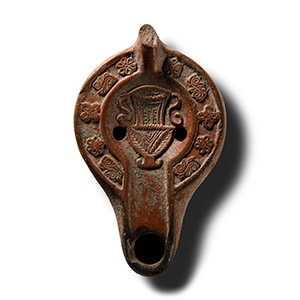
Roman Redware Oil Lamp with Amphora
North Africa, 5th century A.D.Sold for (Inc. bp): £286
With a lug handle and oval elongated body, two central filling-holes flanking the image of a kantharos, enclosed within a decorative shallow border on the shoulders with alternating floral S’s, concentric circles and quatrefoils; two thin concentric circles on the base with letter B in the middle, possibly the potter’s mark. 226 grams, 14.5 cm
From a collection acquired on the UK art market from various auction houses and collections mostly before 2000. From an important Cambridgeshire estate; thence by descent.
The lamp belongs to the type Atlante X or Hayes II A. The so-called Christian lamps in Terra Sigillata Africana have been classified by Hayes into two major types, I and II. He has distinguished two classes in his type II, according to geographic place of manufacture or origin. Subtype II A group lamps from central Tunisia are characterised by a fine clay, glossy light orange slip, and carefully executed decoration using a great number of neatly drawn shoulder motifs. The kantharos is a fairly common motif in Early Christian imagery, as a container of life giving water. -
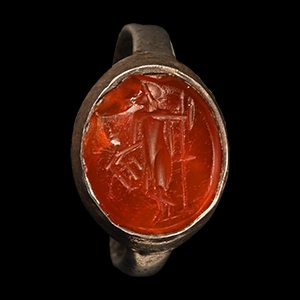
Roman Silver Ring with Poseidon Gemstone
1st-2nd century A.D.Sold for (Inc. bp): £351
With elliptical cell, inset carnelian cabochon with intaglio figure of Poseidon standing naked, only covered by a cloak on his shoulders, holding a trident with left hand, and a net with a stylised dolphin(?) with the right hand; possibly a marriage. 4.97 grams, 26.02 mm overall, 18.30 mm internal diameter (approximate size British P, USA 7 1/2, Europe 16.23, Japan 15)
UK private collection formed before 2000. Ex North London, UK, gallery.
On issues of the Roman colonial coinage of Patras, the image of nude standing Poseidon holding a trident and dolphin is reproduced simultaneously with the most common representations of the god shown standing with one foot resting on a support (rock or dolphin). This type of standing nude Poseidon holding a trident in his left hand and a dolphin in his right is also pictured on the reverse of coins of Agion. -
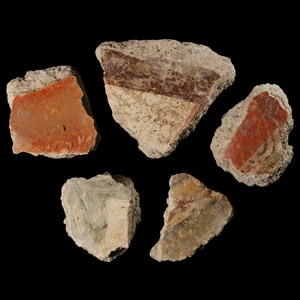
Roman Fresco Wall Plaster Collection
1st century B.C.Sold for (Inc. bp): £111
Second style, painted in red, blue and cream and decorated in contrasting colours. 631 grams total, 6.3-10.5 cm
Acquired in the 19th century. Ex Jeger collection, Switzerland.
These small fragments, with analogies with the fragments from Pompeii, seem to belong to the second style of Roman painting, where several simpler walls had an entirely yellow socle or a yellow socle with a darker main zone (more common in the middle phase of the style).
