
Loading, please wait...
LOT 0690
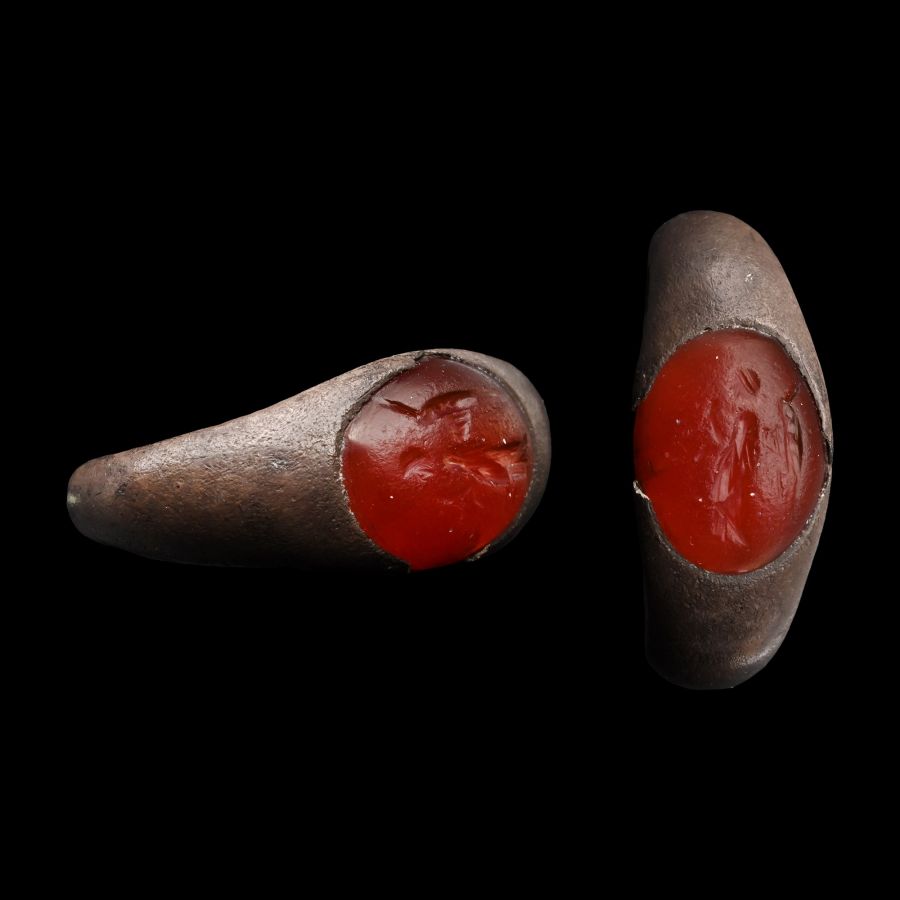
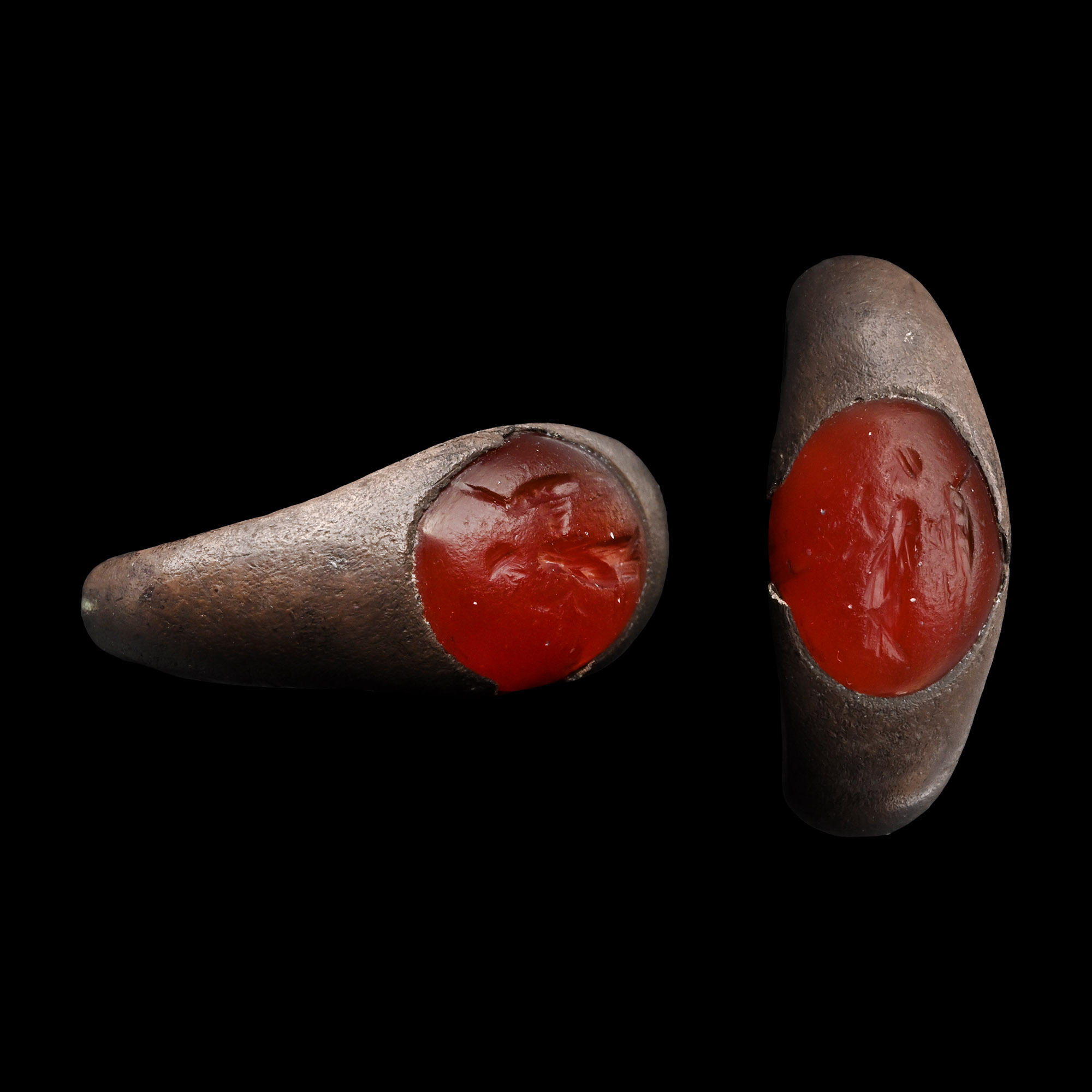
Roman Silver Ring with Victory Gemstone
CIRCA 2ND CENTURY A.D.
7/8 in. (5.81 grams, 22.51 mm overall, 16.87 mm internal diameter (approximate size British I, USA 4 1/4, Europe 7.44, Japan 7)).
With tapering shank and rounded shoulders, inset carnelian intaglio of winged Victory standing with cornucopia.
ProvenanceAcquired on the UK art market in the late 20th century A.D.
From the private collection of the late David King (1940-2024), Hoddesdon, Hertfordshire, UK.
Cf. Ruseva-Slokoska, L., Roman Jewellery, Sofia, 1991, item 246, for type.
CONDITIONTimeLine Auctions follows a vetting process to ensure the authenticity and legality of all items, reinforcing our commitment to integrity and responsible trading. Each antiquity, antique, and coin lot undergoes thorough examination by a vetting committee of at least ten external specialists, professional trade association members, scientists, and archaeologists: Our Vetting Process
AUCTIONS:
TimeLine is a leading auction house specialising in antiquities, ancient art, collectables, natural history, coins, medals, and books. Our auctions offer museums, collectors, historians, and enthusiasts the opportunity to acquire unique and historically significant pieces.
-

Late Roman Imperial Porphyry Fragment
4th-6th century A.D.Sold for (Inc. bp): £3,120
Formed as an irregular block with three possibly later polished sides, with the other three sides presenting a descending wall and two hollows carved in the upper and lower part; probably from an Imperial sarcophagus or monument; mounted on a custom-made stand. 10.55 kg, 31 cm including stand
Acquired from the private collection of a Somerset gentleman who was related to Sir Arthur Evans. From the private collection of a UK gentleman since before 2005.
For the Romans, porphyry was the Imperial marble par excellence, and from Constantine the Great until the end of the 5th century, but probably also later, it was used to create sarcophagi for the emperors and members of the Imperial families. This particular stone was connected with the Imperial family because of its red colour, recalling the violet and red shades of the purple (porphyra), the precious colour assigned only to emperors and their relatives. In Constantinople, a room of the Imperial palace was called Porphýra, located on one of the palace terraces overlooking the Sea of Marmara and the Bosphorus. It was perfectly square in shape with a pyramidal ceiling and was entirely covered in purple porphyry speckled with white dots: this was the room where the empresses gave birth to the heir of the Roman Empire, called Porphyrogénnētos, meaning ‘born in the purple room’. Porphyry was widely used for building churches in the Christian Empire, and Justinian exhausted the supplies from Egypt by building the Great Church of Hagia Sophia, where still today a great amount of this material can be seen. The impressive Imperial sarcophagi were kept in the Church of the Holy Apostles, as well as the great porphyry sarcophagus of Constantine the Great, of which only a small fragment survives today in the Archaeological Museum of Istanbul. -
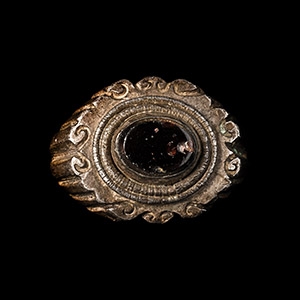
Roman Silver Ring with Garnet
Circa 3rd century A.D.Sold for (Inc. bp): £364
A D-section silver hoop expanding to ribbed shoulders forming the scrolled borders of the plaque, tiered beaded wire collars surrounding an elliptical cell with inset garnet cloison. 40.50 grams, 33.15 mm overall, 22.58 mm internal diameter (approximate size British Z+1 1/2, USA 13, Europe 30.69, Japan 29)
Ex property of a gentleman; acquired in the late 1960s-early 1970s. -

Roman Silver Ring with Iron Core and Mars Standing
2nd century A.D.Sold for (Inc. bp): £156
The hoop with expanded shoulders and a sub-rectangular bezel with a raised oval intaglio image of the God Mars standing right, wearing a helmet. 16.01 grams, 27.09 mm overall, 23.53 mm internal diameter (approximate size British S, USA 9, Europe 20, Japan 19)
From the collection of a North American gentleman, formed in the 1990s.
Mars Ultor was linked with Roman war imagery. Mars represented military power, the strength of the army and violence in battle. The ring was probably a gift for a soldier.
