
Loading, please wait...
LOT 0889
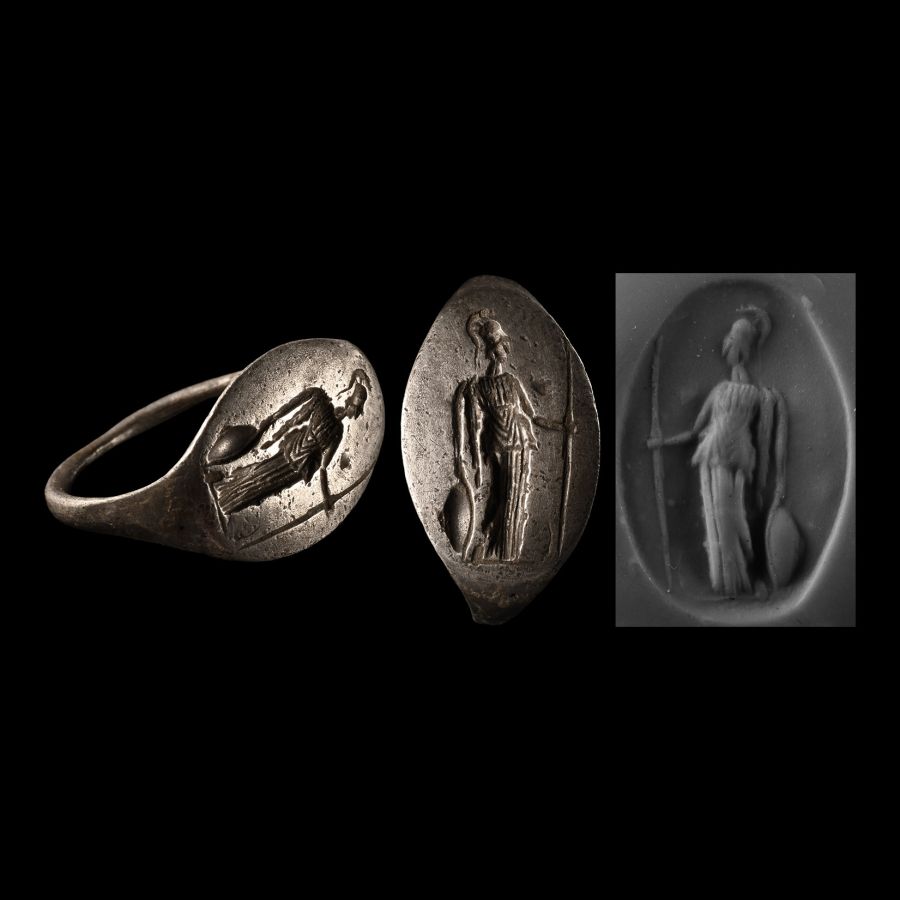
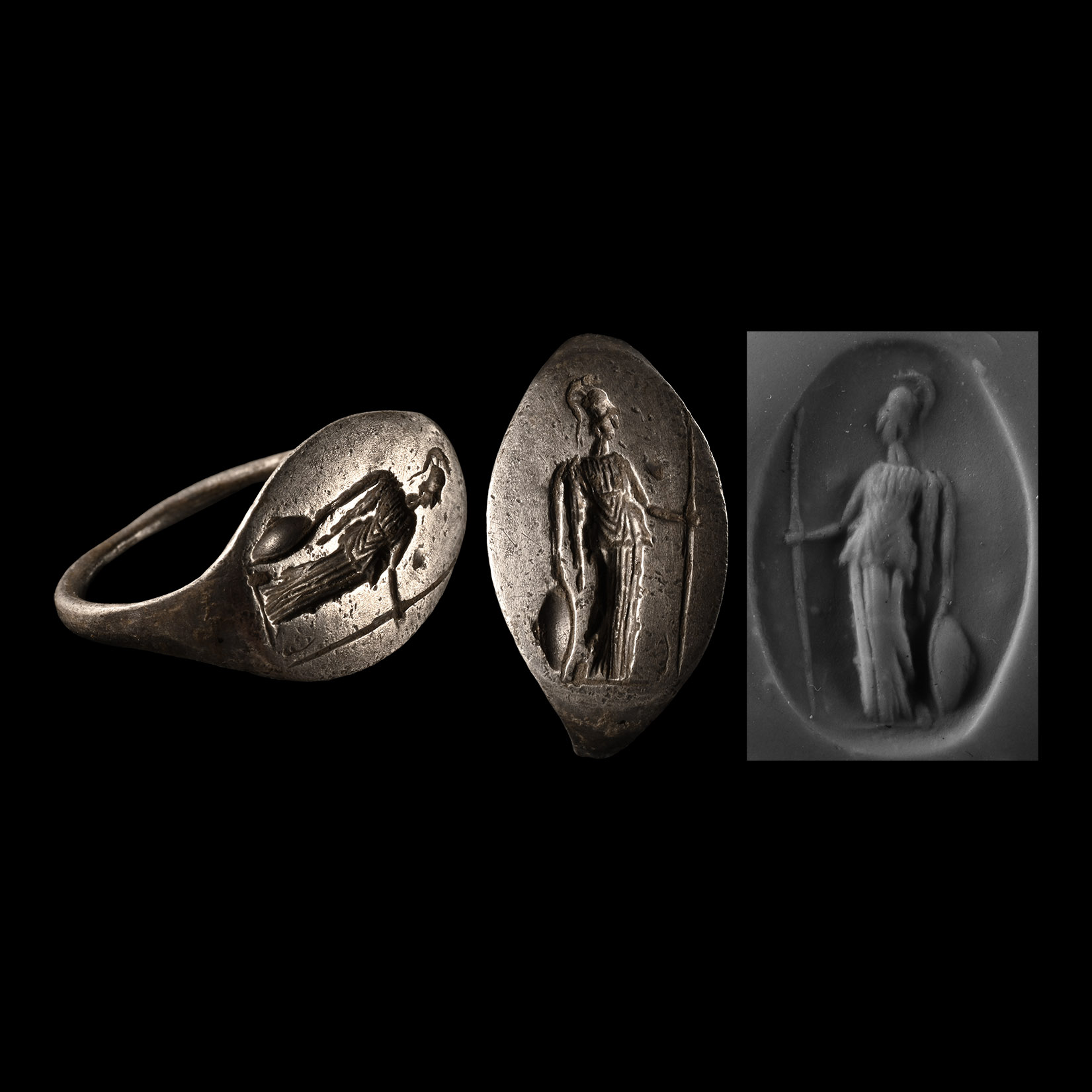
Roman Silver Ring with Minerva
CIRCA 1ST CENTURY A.D.
7/8 in. (3.71 grams, 22.95 mm overall, 19.56 mm internal diameter (approximate size British P 1/2, USA 7 3/4, Europe 16.86, Japan 16)).
Ellipsoid bezel with incuse image of Minerva standing helmetted holding spear and shield; supplied with a museum-quality impression.
ProvenanceAcquired on the London art market in the late 1980s-1990s.
From the family collection of an East London, UK, gentleman.
Cf. Chadour, A.B., Rings. The Alice and Louis Koch Collection, volume I, Leeds, 1994, item 246.
CONDITIONTimeLine Auctions follows a vetting process to ensure the authenticity and legality of all items, reinforcing our commitment to integrity and responsible trading. Each antiquity, antique, and coin lot undergoes thorough examination by a vetting committee of at least ten external specialists, professional trade association members, scientists, and archaeologists: Our Vetting Process
AUCTIONS:
TimeLine is a leading auction house specialising in antiquities, ancient art, collectables, natural history, coins, medals, and books. Our auctions offer museums, collectors, historians, and enthusiasts the opportunity to acquire unique and historically significant pieces.
-
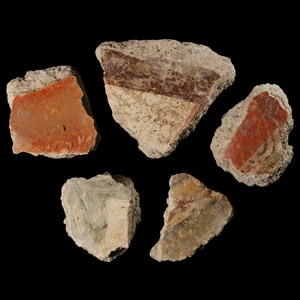
Roman Fresco Wall Plaster Collection
1st century B.C.Sold for (Inc. bp): £111
Second style, painted in red, blue and cream and decorated in contrasting colours. 631 grams total, 6.3-10.5 cm
Acquired in the 19th century. Ex Jeger collection, Switzerland.
These small fragments, with analogies with the fragments from Pompeii, seem to belong to the second style of Roman painting, where several simpler walls had an entirely yellow socle or a yellow socle with a darker main zone (more common in the middle phase of the style). -
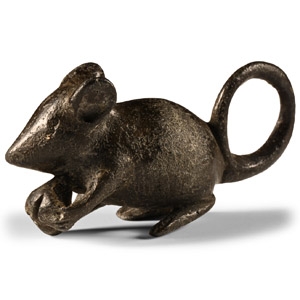
Roman Bronze Mouse Statuette
1st-2nd century A.D.Sold for (Inc. bp): £845
Modelled in the round, crouching, holding a nut in its raised forepaws, tail looped to the rear. 46.7 grams, 49 mm
From a collection acquired on the UK art market from various auction houses and collections mostly before 2000. From an important Cambridgeshire estate; thence by descent. -
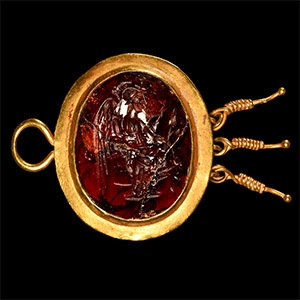
Roman Gold Pendant with Garnet Gemstone Depicting Victory
Circa 1st-2nd century A.D.Sold for (Inc. bp): £1,950
Comprising an oval cell with an applied suspension loop and three coiled drops below; set with a garnet cabochon engraved with a winged figure of the goddess Victoria (Victory), wearing a plumed helmet and holding arrows in her extended hand; stone cracked. 4.59 grams, 34 mm
Acquired from Royal Athena Gallery. From a major London, UK, collection, 1970s. Ex property of a North London, UK, gentleman. Accompanied by a previous catalogue information slip.
The winged goddess of victory not only represented a specific deity, but for the Romans she was the symbol of Rome's invincibility. She was not only the emperor's permanent companion but his guarantee for his success in military campaigns. For this reason she was frequently represented on monuments, standards and on coins, gems and statuettes.
