
Loading, please wait...
_900x900.jpg "Roman Silver Ring with Gemstone")
_200x200.jpg "Roman Silver Ring with Gemstone")
.jpg "Roman Silver Ring with Gemstone")
LOT 0682
Roman Silver Ring with Gemstone
3RD CENTURY A.D.
1 in. (10.92 grams, 26.70 mm overall, 21.03 mm internal diameter (approximate size British Q 1/2, USA 8 1/4, Europe 18.12, Japan 17)).
The hoop expanding to openwork double peltate shoulders, bezel set with intaglio gemstone portraying the goddess Fortuna. [No Reserve]
ProvenanceFrom the collection of a North American gentleman, formed in the 1990s.
LiteratureCf. Ruseva-Slokoska, L., Roman Jewellery, Sofia, 1991, item 206.
CONDITIONTimeLine Auctions follows a vetting process to ensure the authenticity and legality of all items, reinforcing our commitment to integrity and responsible trading. Each antiquity, antique, and coin lot undergoes thorough examination by a vetting committee of at least ten external specialists, professional trade association members, scientists, and archaeologists: Our Vetting Process
AUCTIONS:
TimeLine is a leading auction house specialising in antiquities, ancient art, collectables, natural history, coins, medals, and books. Our auctions offer museums, collectors, historians, and enthusiasts the opportunity to acquire unique and historically significant pieces.
-
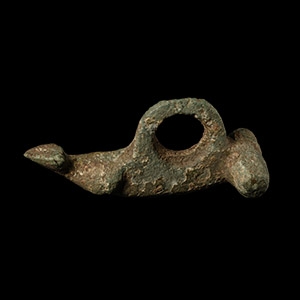
Roman Bronze Phallic Pendant
1st-3rd century A.D.Sold for (Inc. bp): £59
With large suspension loop, curved shank and leaf-shaped finial. 8.61 grams, 35 mm
Acquired on the German art market around 2000. From the collection of a Surrey, UK, gentleman. -
.jpg)
Roman Bronze Bull Collection
1st-4th century A.D.Estimate: £200 - 300 (+bp*)
Opening Bid: £111
Formed free-standing with stylised anatomical detailing; including one example on a base. 47 grams total, 22-33 mm
‘The Ancient Menagerie Collection’ formerly the property of a Cambridgeshire lady, collected since the 1990s and acquired from auctions and dealers throughout Europe and the USA, now ex London collection. -
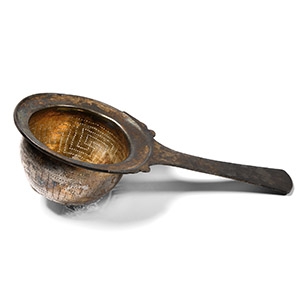
Roman Silver Wine Strainer
Circa 3rd century A.D.Sold for (Inc. bp): £2,210
Of bulbous form, with a broad everted rim, integral scallops at the neck and splayed handle, perforated floral motif to centre of bowl, scrolling waves around and Greek key pattern above; hole to bowl. 97 grams, 17.5 cm
Acquired 1990s-early 2000s. East Anglian private collection. This lot has been checked against the Interpol Database of stolen works of art and is accompanied by searcher certificate no. 200925.
Round-bowled strainers of various sizes occur in many late Roman hoards of domestic silver. They were used to strain the sediment from wine as it was poured into a drinking vessel. It is noteworthy that wine could have been a kind of gift from the Romans to the members of the foreign or provincial elite, often allies of the Roman leaders. Sets of bronze dishes (such as jars, scoops and strainers) along with glass horns (often with bronze fittings) and silver cups for drinking, usually placed in the so-called princely graves, confirm the wine consumption and indicate the area of its occurrence also outside the Empire.
