Loading, please wait...

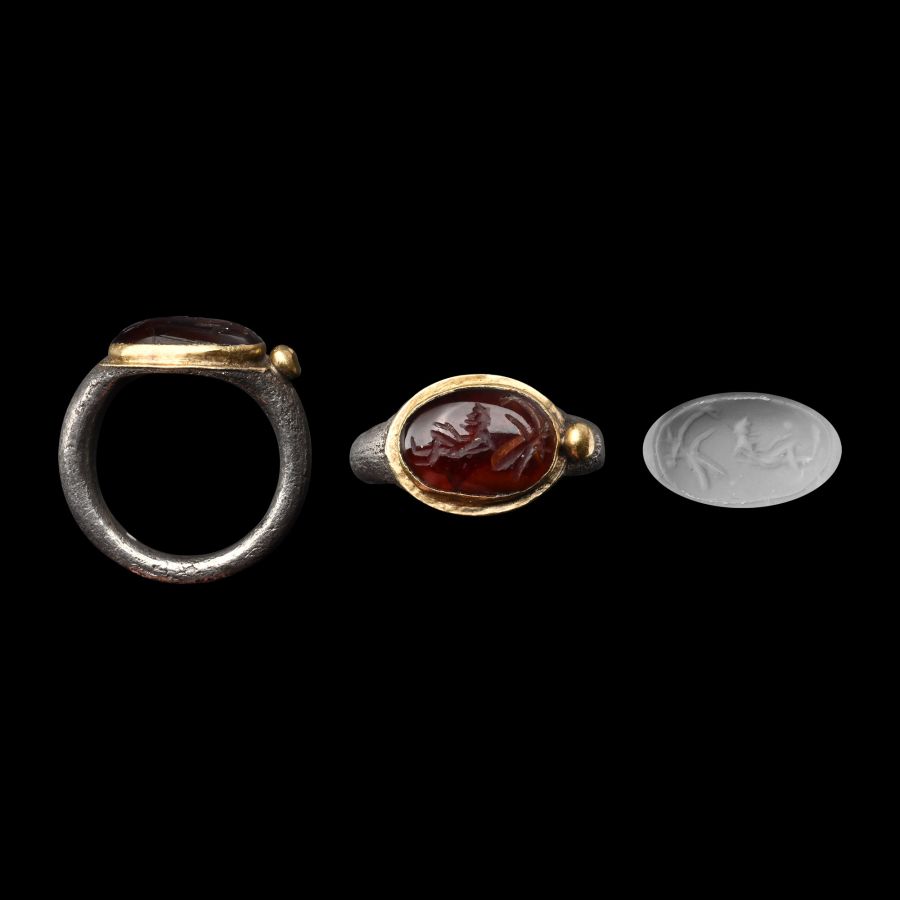
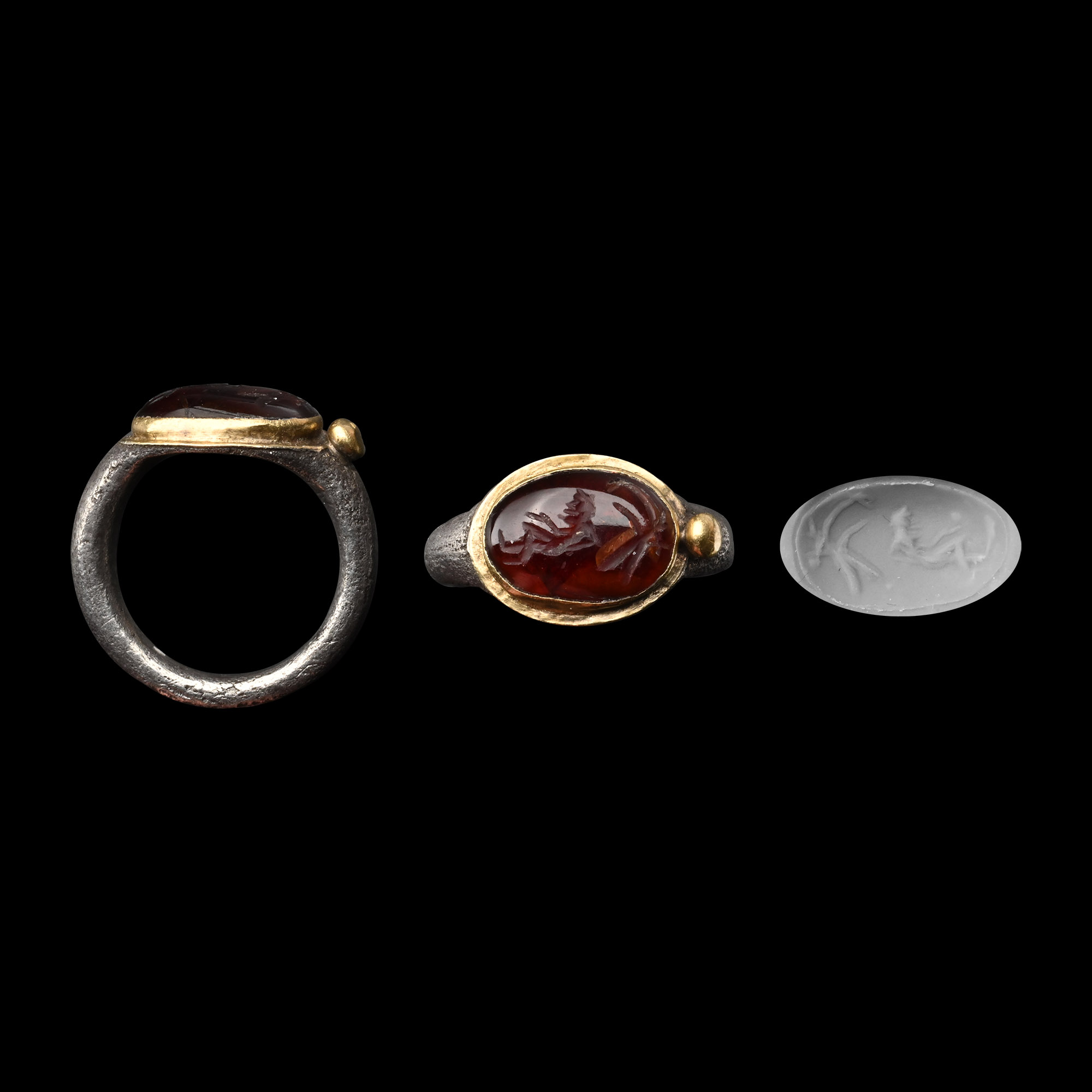
Roman Silver Ring with Crouching Figure Gemstone Roman Silver Ring with Crouching Figure Gemstone Roman Silver Ring with Crouching Figure Gemstone
Use mousewheel to zoom in and out, click to enlarge
Details

LOT 0950

Roman Silver Ring with Crouching Figure Gemstone

3RD-4TH CENTURY A.D.

3/4 in. (4.79 grams, 20.32 mm overall, 14.11 mm internal diameter (approximate size British F 1/2, USA 3, Europe 4.3, Japan 4)).

With disc bezel, gold cell with orienting knop to one shoulder, inset cabochon garnet with intaglio crouching figure with symbol above; accompanied by a museum-quality impression. [No Reserve]

Provenance

Property of a gentleman; acquired in the late 1960s-early 1970s.

Literature

Cf. Ruseva-Slokoska, L., Roman Jewellery, Sofia, 1991, item 201, for type.

CONDITION
VETTING:

TimeLine Auctions follows a vetting process to ensure the authenticity and legality of all items, reinforcing our commitment to integrity and responsible trading. Each antiquity, antique, and coin lot undergoes thorough examination by a vetting committee of at least ten external specialists, professional trade association members, scientists, and archaeologists: Our Vetting Process


AUCTIONS:

TimeLine is a leading auction house specialising in antiquities, ancient art, collectables, natural history, coins, medals, and books. Our auctions offer museums, collectors, historians, and enthusiasts the opportunity to acquire unique and historically significant pieces.

LOT 0950

Roman Silver Ring with Crouching Figure Gemstone

Sold for (Inc. bp): £156

Print page

RELATED LOTS
  • Roman Bronze Patera with Handle
    Roman Bronze Patera with Handle
    1st century B.C.-1st century A.D.

    Sold for (Inc. bp): £715

    The bowl with a wide flat bottom and convex sides; the inside with incised concentric circles; flat handle with raised edges and hooked finial for suspension. 483 grams, 39.5 cm


    German private collection, Mr O., collecting in the 1950s-1960s; thence by descent. with Bonhams, London, 7 July 2016, lot 191 (£3,000-5,000). Accompanied by an academic report by Dr Raffaele D’Amato. Accompanied by copies of the relevant Bonhams printed catalogue pages (full page). This lot has been checked against the Interpol Database of stolen works of art and is accompanied by search certificate number no.11735-201189.

    This vessel was part of Roman and provincial bronze instrumentum domesticum, i.e. culinary or domestic utility ware. Such cooking vessels are rare: some are found in central and northern Italy, in Pannonia, Germany and in Britain. The Aylesford Pan, today in the British Museum (inventory no.1886.1112.1), is one of the most important finds. This specimen (Eggers type 130), probably pre-Caesarian or Caesarian, was found in a grave together with a Celtic bucket and a jug.

    Lot Details

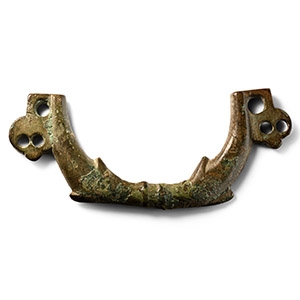
  • Large Roman Bronze Vessel Handle with Conjoined Dolphins
    Large Roman Bronze Vessel Handle with Conjoined Dolphins
    2nd century A.D.

    Sold for (Inc. bp): £27

    Comprising a crescentic band with ribbed detailing of two opposed dolphins, each with a pierced P-shaped lug to the lower end; 55 grams, 11.3 cm


    Found Gloucestershire, UK.

    Lot Details

  • Roman Garnet Gemstone with Bust of Julia Domna
    Roman Garnet Gemstone with Bust of Julia Domna
    2nd-3rd century A.D.

    Estimate: £3,000 - 4,000 (+bp*)

    Opening Bid: £1,600

    With incuse profile female bust with copious tiered curls and braids, palla to the shoulder; supplied with a museum-quality impression. 3.06 grams, 21 mm


    Ex London, UK, gentleman, 1990s. This lot has been checked against the Interpol Database of stolen works of art and is accompanied by search certificate number no.13002-244442.

    Julia Domna (170-217 A.D.) was one of the most honoured imperial women in the course of the Principate. Almost 600 inscriptions bear her name; numerous coin types portray her together with the emperors; important artworks where she is depicted (such as the Kassel Cameo, the Arch of the Argentarii and the Severan Arch in Leptis Magna) demonstrate that she occupied no secondary position in the Severan regime. She appears, consequently, to be a key figure of this period.

    Lot Details

Stay up-to-date with the latest from TimeLine Auctions by joining our mailing list