
Loading, please wait...

LOT 0853
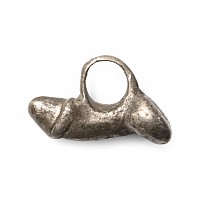
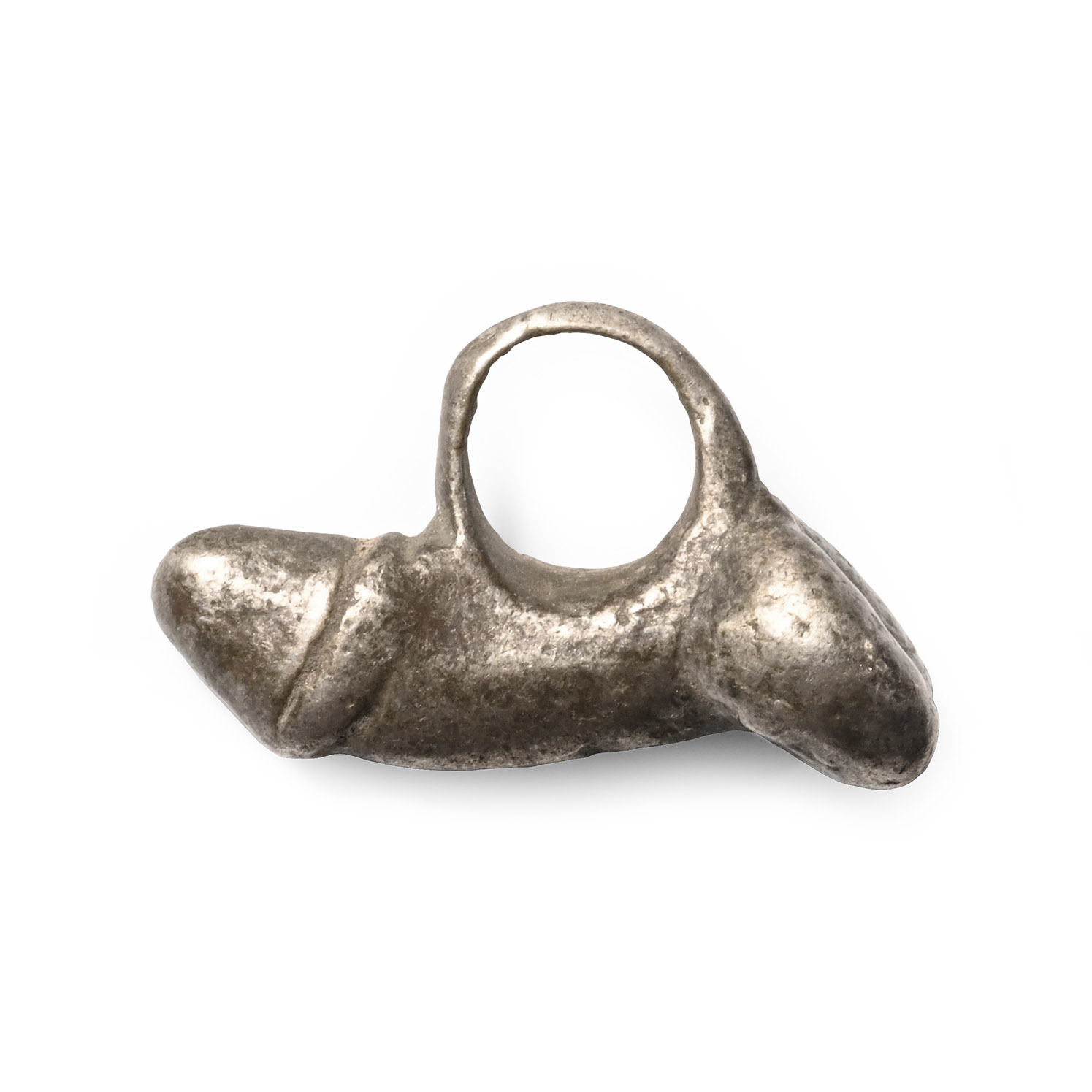
Roman Silver Phallic Pendant
1ST-4TH CENTURY A.D.
1 in. (9.3 grams, 26 mm).
Modelled in the round with a large suspension loop. [No Reserve]
ProvenanceEx German art market, 2000s.
Acquired from an EU collector living in London.
From the collection of Surrey, UK, gentleman.
TimeLine Auctions follows a vetting process to ensure the authenticity and legality of all items, reinforcing our commitment to integrity and responsible trading. Each antiquity, antique, and coin lot undergoes thorough examination by a vetting committee of at least ten external specialists, professional trade association members, scientists, and archaeologists: Our Vetting Process
AUCTIONS:
TimeLine is a leading auction house specialising in antiquities, ancient art, collectables, natural history, coins, medals, and books. Our auctions offer museums, collectors, historians, and enthusiasts the opportunity to acquire unique and historically significant pieces.
-
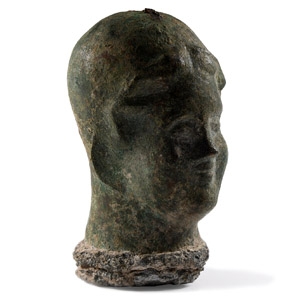
Large Eastern Roman Bronze Bust-Shaped Steelyard Weight
Circa 3rd-4th century A.D. or laterSold for (Inc. bp): £715
Modelled in the round as a facing female with head turned slightly right, with semi-naturalistic facial detailing and dressed hair; lead-filled. 4.2 kg, 13.5 cm high
Acquired 1990s-early 2000s. East Anglian private collection.
Steelyard weights in the form of human or deities' faces were not uncommon in the Roman period (see SWYOR-DA4426, OXON-4391B5, HAMP-BD4D67 and NARC-7A7B81 on the PAS). These were generally filled with lead and had iron or copper suspension loops projecting from the top of the head. -
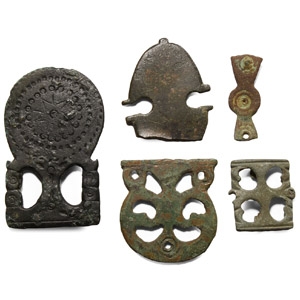
Roman Bronze Military Belt Mount Collection
4th-5th century A.D.Sold for (Inc. bp): £85
Comprising: an amphora-shaped strap end decorated with rings and dots, the centre ornamented by a star surrounded by small dots and circles; a shield-shaped strap end, with a concave crescent on each side; an openwork decorated fitting with a kidney shaped motif in each quarter; a shield-shaped decorated strap end, with kidney-shaped openwork design; and a propeller shaped mount. 75 grams total, 29-66 mm
From the collection of the famous author, writer and speaker, Gordon Bailey, Essex, UK; formed since 1968.
In Britain like in all of the West, all the elements intended for the embellishment of belts and harnesses also evolved towards new forms, the geometry of which bears witness to strong Germanic influences. Beside the typical propeller stiffener belts (Richborough), probably of Danubian origin, we have less ornate wide-belt types, represented by the Winchester example. Belt-plaques of triangular shape, often gilded, beast-shaped at the extremity, were excavated in the south of Britain (Cirencester). Rigid belt-plates with the buckle shaped like a dolphin came from Richborough, Wye and Sleaford (class 3, type B, Sommer), Tripontium, Mucking, Wycombe, Alwalton (type I-B, Hawkes, also in Richborough) and type Mainz, Savgar, Totanés (Colchester, often with associated propeller stiffeners). Type Hawkes I-A and I-B present similarities with the Simancas typologies, found in Lankhills. The type Tirig is attested at Lydney Park, the Böhme A in Richborough. Strap ends are usually heart-shaped or amphora-shaped (Richborough). These belt fittings were characteristic of the Roman army in Britain at the beginning of the 5th century. -
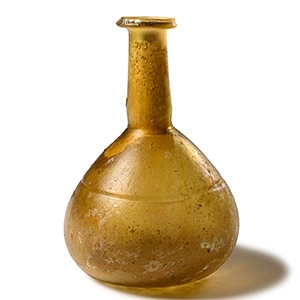
Roman Honey-Coloured Cast Glass Flask
1st century A.D.Estimate: £1,000 - 1,400 (+bp*)
Opening Bid: £500
With piriform body, tubular neck with everted rolled rim, raised rib below the shoulder. 54 grams, 97 mm
From an important London, UK, collection, 1970-1990s.
