
Loading, please wait...
LOT 0126
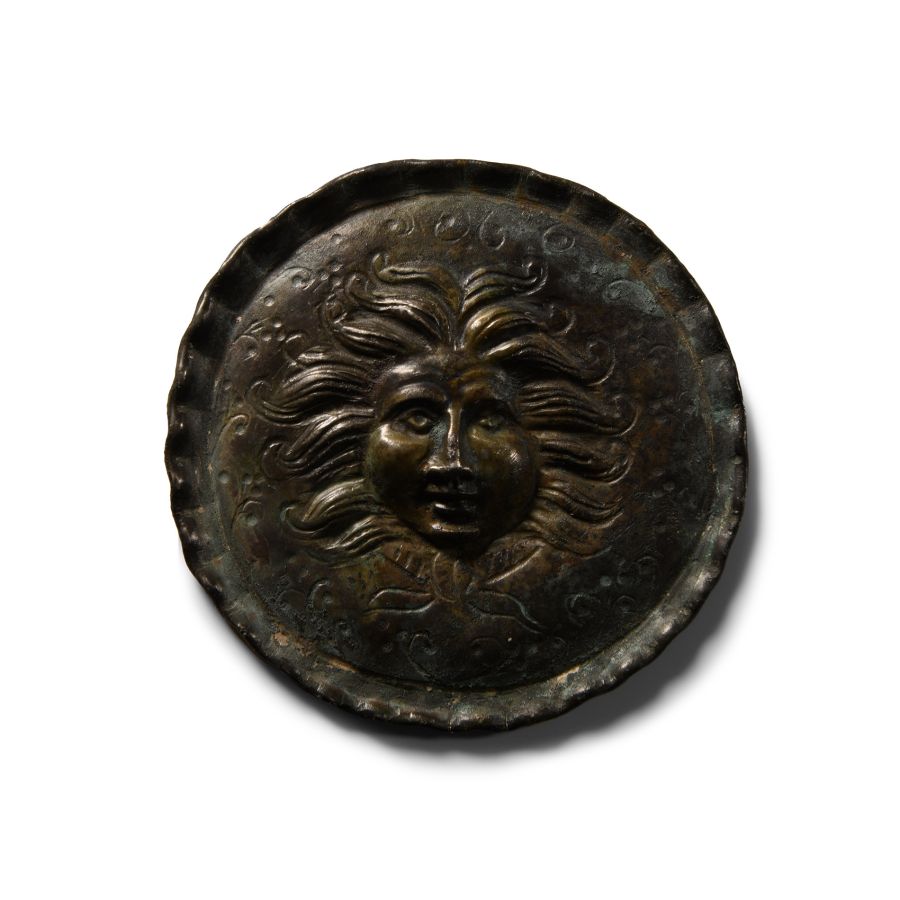
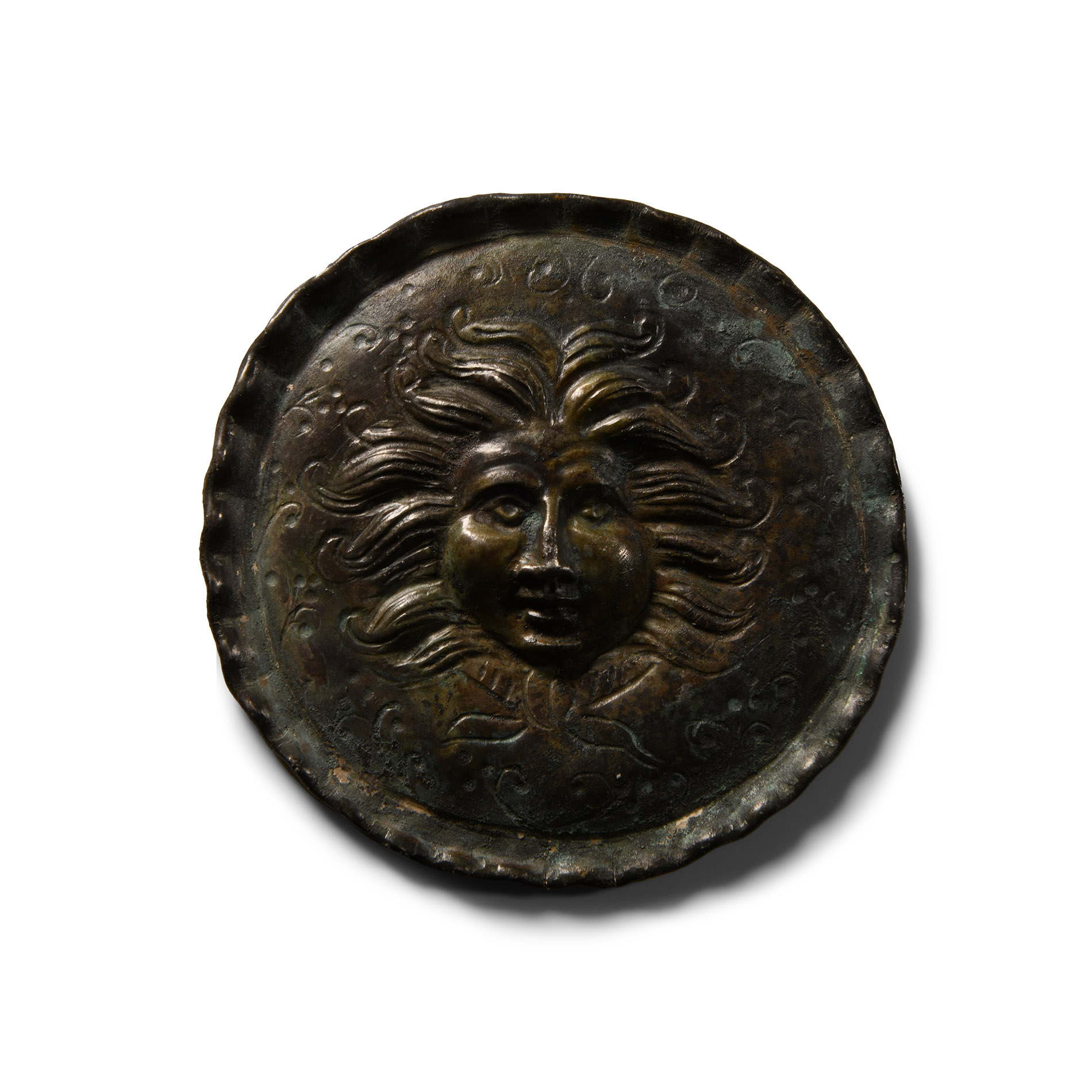
Roman Silver Phalera with Medusa
1ST-2ND CENTURY A.D.
2 3/8 in. (13.8 grams, 59 mm).
Discoid with fluted rim, central raised gorgoneion within scrolled tendrils.
ProvenanceEx German art market, 2000s.
Acquired from an EU collector living in London.
From the collection of Surrey, UK, gentleman.
Cf. Appels, A. & Laycock, S., Roman Buckles and Military Fittings, Witham, 2007, items AA9.2, AA9.3, for similar discoid elements.
FootnotesMilitary phalerae with representations of Medusa or the Gorgoneion were popular among the Roman army. They decorated horse harnesses and officers' armour. They were also used as appliqués for scabbards, caskets, or other items in military use. Our phalera is classical in style, recalling the style of the Gorgoneia of the Nemi's ship, and it could also have been used as decorative item for furniture.
CONDITIONTimeLine Auctions follows a vetting process to ensure the authenticity and legality of all items, reinforcing our commitment to integrity and responsible trading. Each antiquity, antique, and coin lot undergoes thorough examination by a vetting committee of at least ten external specialists, professional trade association members, scientists, and archaeologists: Our Vetting Process
AUCTIONS:
TimeLine is a leading auction house specialising in antiquities, ancient art, collectables, natural history, coins, medals, and books. Our auctions offer museums, collectors, historians, and enthusiasts the opportunity to acquire unique and historically significant pieces.
-
.jpg)
Over Life-Size Gallo-Roman Limestone Head of an Athlete
3rd-4th century A.D.Sold for (Inc. bp): £5,720
With short hair, cut and combed in regular lines, furrowed brow and wide deep-set eyes, small fleshy mouth, intense and powerful expression; weather-worn surface; mounted on a later 18th century stand. 16.35 kg total, 35 cm including stand
Acquired in the 1930s. From the family collection of Mr F. Morand, France. From the M.J. collection, Wales, UK. Accompanied by an academic report by Dr Raffaele D'Amato. This lot has been checked against the Interpol Database of stolen works of art and is accompanied by a search certificate number no.12070-217746.
The head shows a late Roman appearance in its features and hairstyle. The expression, the short thick neck and the style of the hair combined with the somewhat uncouth and forceful expression may indicate a local Gallo-Roman character. -
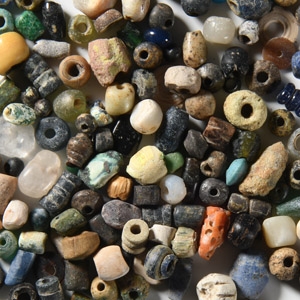
Roman Glass and Other Bead Group
1st-4th century A.D.Sold for (Inc. bp): £117
Including oblate, melon, tubular, fusiform and other types. 29 grams total, 2-11 mm
Acquired from Allan Cherry at the Birmingham Coin & Antiquities Fair, UK, in 2006. Ian Wilkinson collection, Nottinghamshire, UK. -
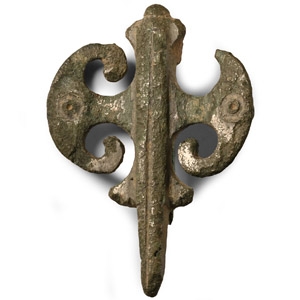
Roman Bronze Double Axe-Shaped Plate Brooch
2nd century A.D.Sold for (Inc. bp): £117
With vertical spine and peltoid lateral extensions with silvered surface, enamelled annular motif to the centre of each; pin and catchplate to the reverse. 10 grams, 42 mm
UK art market, acquired prior to 1980. Property of a Kent lady collector.
