
Loading, please wait...
LOT 0141
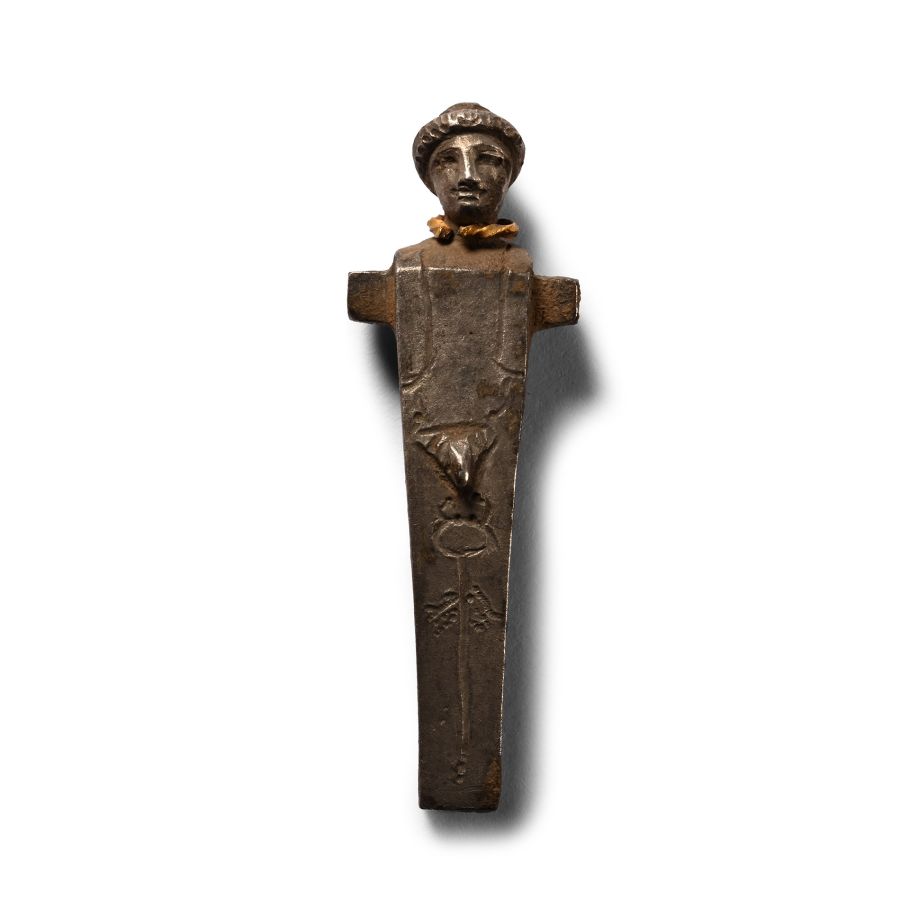
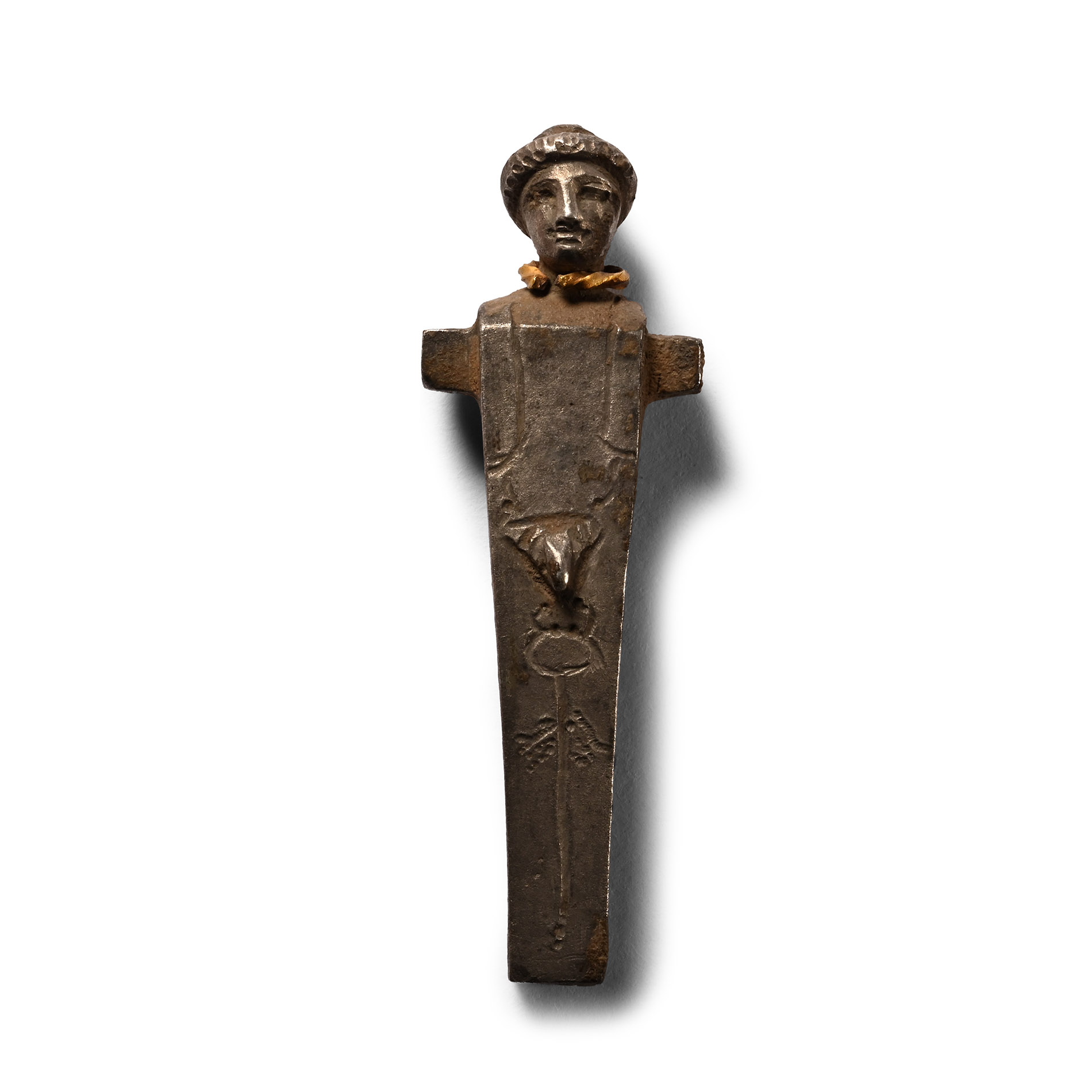
Roman Silver Miniature Herm
1ST-3RD CENTURY A.D.
2 in. (27 grams, 52 mm).
Comprising a square-section tapering body with lateral stub arms; head of Mercury (Greek Hermes) above with applied twisted gold collar, low-relief shoulder panels, genitals modelled in the round, low-relief horned figure below.
ProvenanceAcquired in the mid 1980s-1990s.
From the family collection of Mr S.A., Switzerland, thence by descent.
Private collection since the late 1990s.
This lot has been checked against the Interpol Database of stolen works of art and is accompanied by a search certificate number no.12103-218207.
Cf. similar figure of earlier date in the British Museum under accession no.1912,1125.13.
FootnotesThis object, was likely votive and perhaps belonged to a small domestic altar of the Roman imperial era, reproduced in miniature size a Hermaic pillar. These were terminals made of stone or wood which were often placed on the roads, near crossings; they served to indicate the right path and therefore were supposed to protect travellers when traveling. In Roman times, these pillars were often topped with busts or portraits and were also found in the gardens of wealthy homes; gods (Hermes and Bacchus in particular) or philosophers were the subjects thus represented.
CONDITIONTimeLine Auctions follows a vetting process to ensure the authenticity and legality of all items, reinforcing our commitment to integrity and responsible trading. Each antiquity, antique, and coin lot undergoes thorough examination by a vetting committee of at least ten external specialists, professional trade association members, scientists, and archaeologists: Our Vetting Process
AUCTIONS:
TimeLine is a leading auction house specialising in antiquities, ancient art, collectables, natural history, coins, medals, and books. Our auctions offer museums, collectors, historians, and enthusiasts the opportunity to acquire unique and historically significant pieces.
LOT 0141
Roman Silver Miniature Herm
Estimate £2,500 - 3,500€2,900 - 4,060 (for guidance only)$3,380 - 4,730 (for guidance only)
-
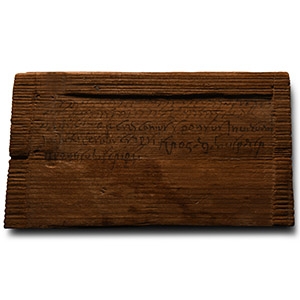
Roman Inked Wooden Legal Document Signed by Felicianus in Actum
Late 4th century A.D.Sold for (Inc. bp): £7,800
A reused tablet with a recessed panel on one side, the lower part absent, on the upper rim one of originally 3 holes necessary for binding together of the tablets of the document, 5 lines in Roman cursive on the recessed panel containing the end of a the record of a legal document in a formulaic legal language; part of a legal document which consisted of two (diptychon) or three tablets (triptychon), with the indication where it was done (actum in …) followed by the so-called chirographum (signature line) of a person called Felicianus, letter forms point to a date in the second half of the 4th century AD; with a recessed slot to verso. 12.4 grams, 14.7 cm
From an important London collection since 1975. Accompanied by a collection of six 1970s photographs of the the tablet.
The contract follows standard Roman legal formulae. -
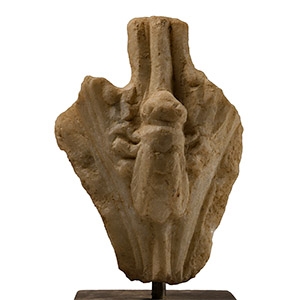
Roman Marble Cicada Fragment
1st-2nd century A.D.Sold for (Inc. bp): £780
Fragment of carved marble arcade with reserved cicada modelled in the half-round at the base; mounted on a custom-made display stand. 1.07 kg total, 16.8 cm high including stand
From the property of the late Mr SM, London, UK, 1969-1999. -
.jpg)
Roman Honey-Coloured Glass Amphora
1st-4th century A.D.Sold for (Inc. bp): £2,080
With broad rounded shoulder tapering to a conical foot, cylindrical neck and everted mouth with rolled rim, applied trail handles and collar; tip restored; supplied with a display stand. 97 grams, 18 cm (220 grams total, 20 cm including stand)
Ex property of a late Japanese collector, 1970-2000s. This lot has been checked against the Interpol Database of stolen works of art and is accompanied by a search certificate number no.12108-217865.
