
Loading, please wait...
LOT 0795
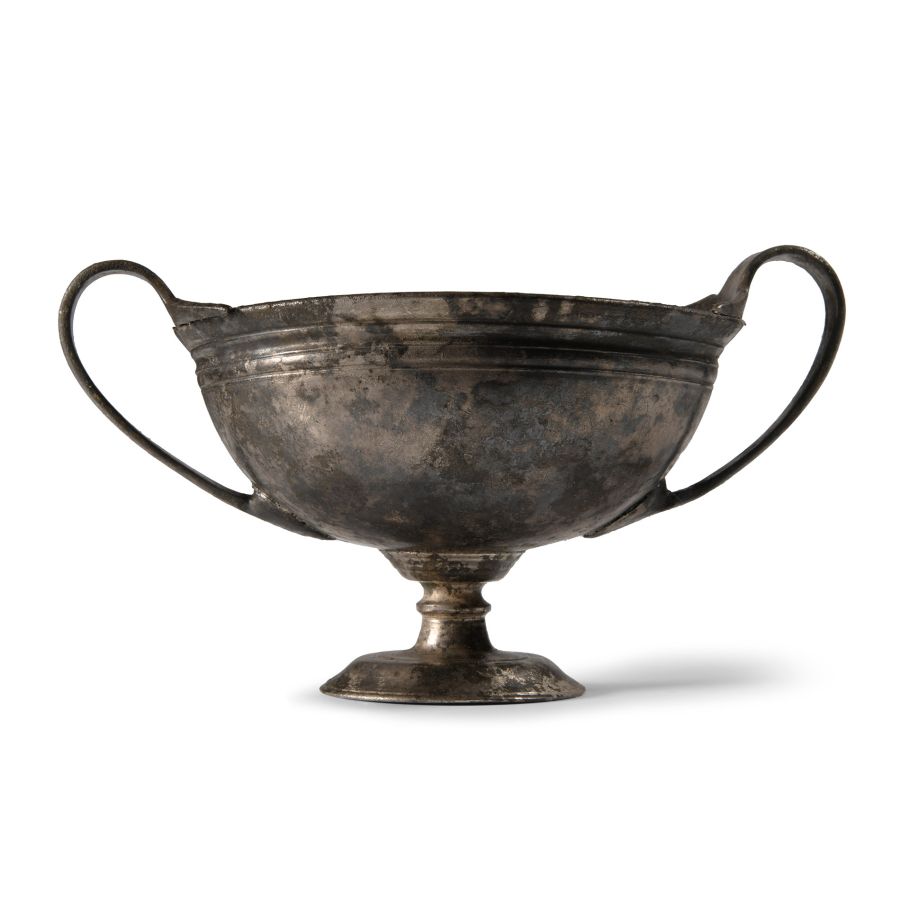
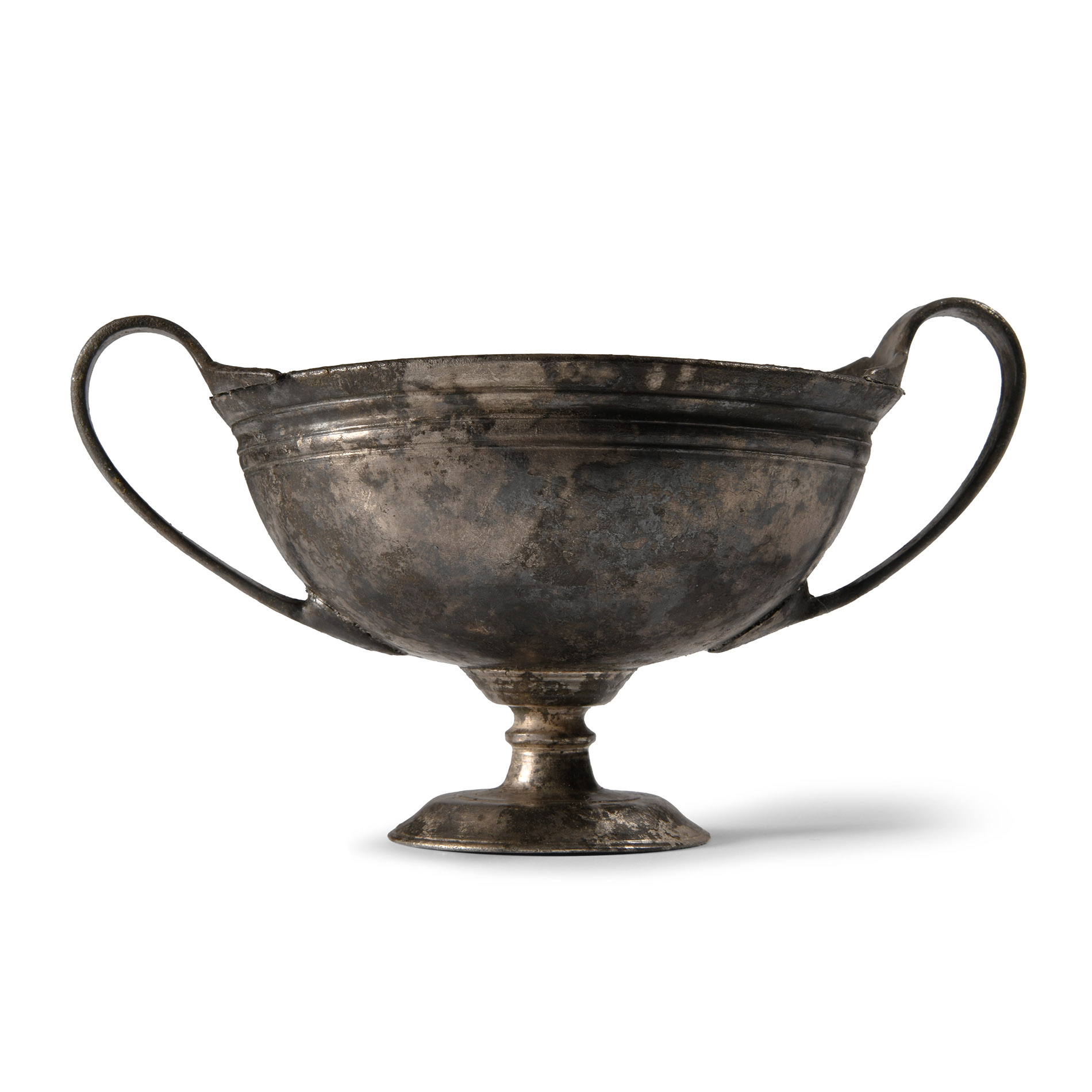
Roman Silver Kantharos Wine Cup
2ND CENTURY B.C.-1ST CENTURY A.D.
5 1/2 in. (156 grams, 14 cm wide).
With deep spherical body supported on a round stand; incised with a band around the inner surface and concentric circles on the outer body; two looped high handles, one with stipple engraved monogram on the upper side.
ProvenanceEx Mansees collection, formed 1950s-early 1990s.
From a large American collection formed in Chicago, Illinois, USA, in 1995.
From a European collection.
This lot has been checked against the Interpol Database of stolen works of art and is accompanied by search certificate no.11627-197618.
Exhibited at the Harwich Museum, Harwich, Essex, UK, 19th June-9th September 2024; accompanied by a copy of a photograph of the artefacts on display.
LiteratureCf. Roberts, P., Life and Death in Pompeii and Herculaneum, The British Museum, London, 2013, pp.238-9, for similar; cf. Mattusch, C.C., Pompeii and the Roman Villa: Art And Culture Around The Bay Of Naples, Washington, 2009, p.123, item 29, for a comparable vessel identified as 'probably late Republican'.
CONDITIONTimeLine Auctions follows a vetting process to ensure the authenticity and legality of all items, reinforcing our commitment to integrity and responsible trading. Each antiquity, antique, and coin lot undergoes thorough examination by a vetting committee of at least ten external specialists, professional trade association members, scientists, and archaeologists: Our Vetting Process
AUCTIONS:
TimeLine is a leading auction house specialising in antiquities, ancient art, collectables, natural history, coins, medals, and books. Our auctions offer museums, collectors, historians, and enthusiasts the opportunity to acquire unique and historically significant pieces.
LOT 0795
Roman Silver Kantharos Wine Cup
Estimate £3,500 - 4,500€4,060 - 5,220 (for guidance only)$4,730 - 6,080 (for guidance only)
-
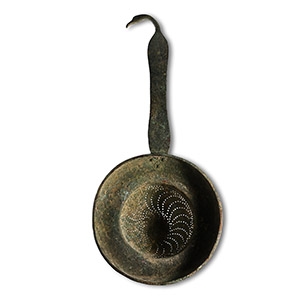
Roman Bronze Wine Strainer
1st-3rd century A.D.Estimate: £3,000 - 4,000 (‡+bp*)
Opening Bid: £1,500
Cup-shaped body with flared and curved rim, flat-section handle with swan-head finial; the body with pierced rosette pattern. 159 grams, 27.4 cm
Acquired in the mid 1980s-1990s. Private collection, Switzerland, thence by descent. Private collection, since the late 1990s. This lot has been checked against the Interpol Database of stolen works of art and is accompanied by search certificate number no.12233-222331. -
Roman Glass Toilet Bottle
1st century B.C.-1st century A.D.Estimate: £150 - 200 (+bp*)
Opening Bid: £83
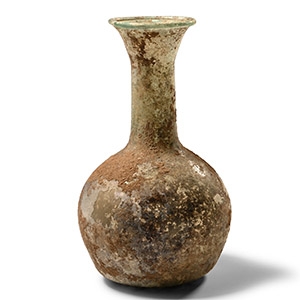
With globular body, everted rim, cylindrical neck, rounded shoulder merging with concave wall, rounded base. 61 grams, 14 cm
Ex London, UK, collection, 1980-1990s.
This toilet bottle could be associated with the Isings form 6 and De Tommaso type 7. These small bottles are among the earliest known blown glass. The everted rim seems to distinguish examples made in Italy and the western Mediterranean provinces from those of the Eastern Mediterranean, on which the rim is usually folded in the form of a flange. -
.jpg)
Roman Bronze Neptune Statuette
1st century B.C.-1st century A.D.Sold for (Inc. bp): £39
Standing nude with arms raised, legs in advancing pose. 37 grams, 60 mm
From a collection acquired on the UK art market from various auction houses and collections mostly before 2000. From an important Cambridgeshire estate; thence by descent.
The condition of the statuette does not allow a easy identification of its original characterization, but the position of the body shows a certain affinity with provincial statuettes of the god Neptune, especially produced in Gallo-Roman ateliers. Some statuettes of Sucellus, the Gallic divinity assimilated into the Roman Pantheon as the equivalent of the Dispater, brother of Jupiter, could possibly also bear resemblance with our statuette for the position of the body.
