
Loading, please wait...
LOT 0830
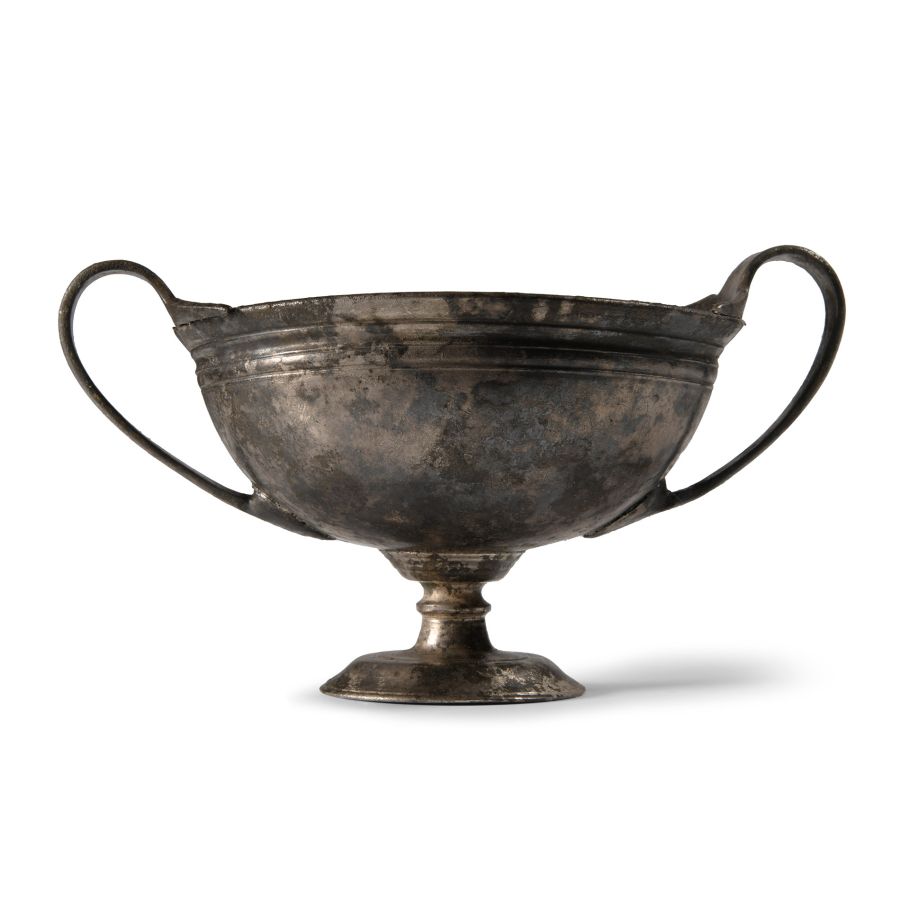
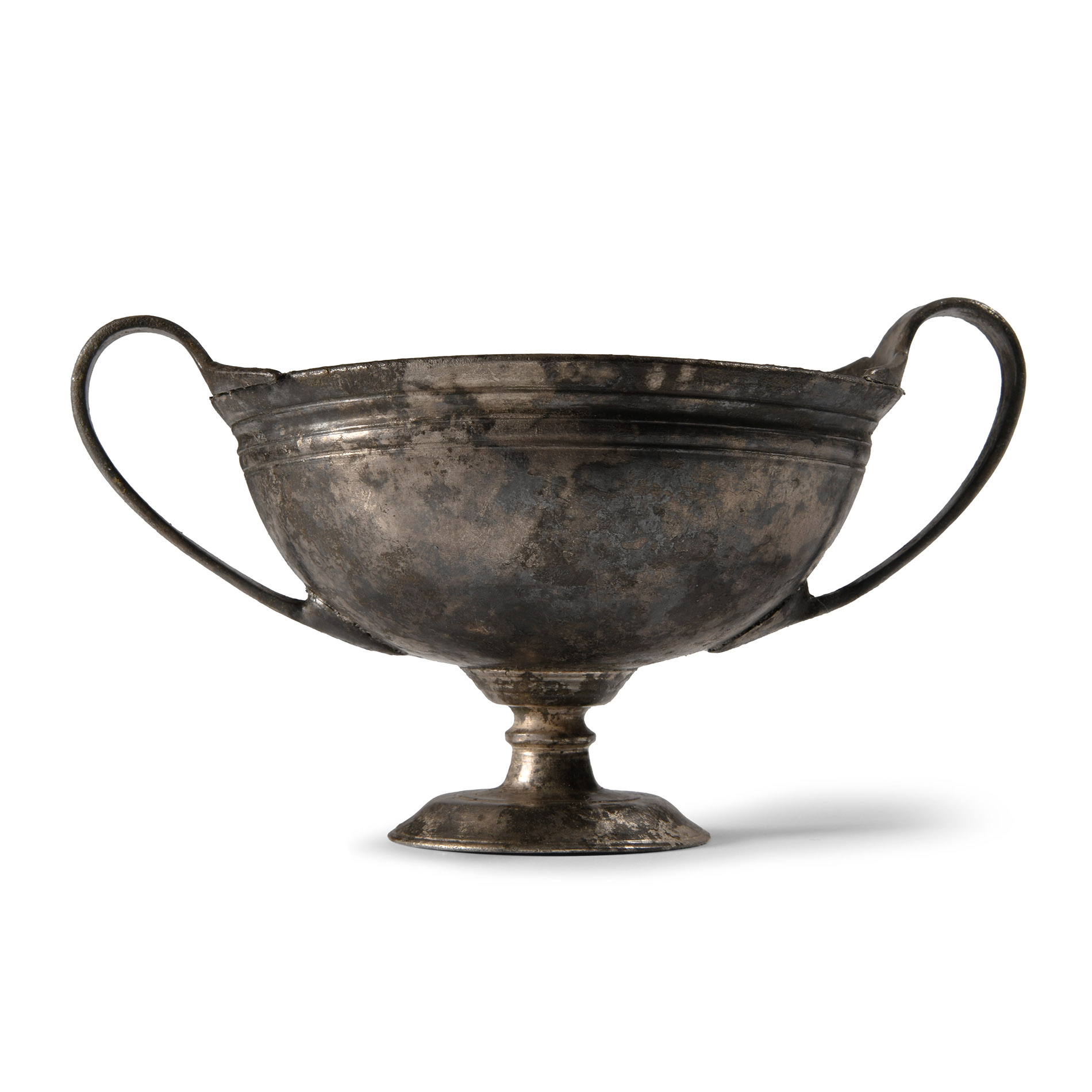
Roman Silver Kantharos Wine Cup
2ND CENTURY B.C.-1ST CENTURY A.D.
5 1/2 in. (156 grams, 14 cm wide).
With deep spherical body supported on a round stand; incised with a band around the inner surface and concentric circles on the outer body; two looped high handles, one with stipple engraved monogram on the upper side.
ProvenanceEx Mansees collection, formed 1950s-early 1990s.
From a large American collection formed in Chicago, Illinois, USA, in 1995.
From a European collection.
This lot has been checked against the Interpol Database of stolen works of art and is accompanied by search certificate no.11627-197618.
Cf. Roberts, P., Life and Death in Pompeii and Herculaneum, The British Museum, London, 2013, pp.238-9, for similar; cf. Mattusch, C.C., Pompeii and the Roman Villa: Art And Culture Around The Bay Of Naples, Washington, 2009, p.123, item 29, for a comparable vessel identified as 'probably late Republican'.
CONDITIONTimeLine Auctions follows a vetting process to ensure the authenticity and legality of all items, reinforcing our commitment to integrity and responsible trading. Each antiquity, antique, and coin lot undergoes thorough examination by a vetting committee of at least ten external specialists, professional trade association members, scientists, and archaeologists: Our Vetting Process
AUCTIONS:
TimeLine is a leading auction house specialising in antiquities, ancient art, collectables, natural history, coins, medals, and books. Our auctions offer museums, collectors, historians, and enthusiasts the opportunity to acquire unique and historically significant pieces.
LOT 0830
Roman Silver Kantharos Wine Cup
Estimate £3,500 - 4,500€4,060 - 5,220 (for guidance only)$4,730 - 6,080 (for guidance only)
-
.jpg)
Roman Bronze Medical Tool Collection
3rd century A.D.Sold for (Inc. bp): £1,300
Including suture needle, bulbous probe, cosmetic or medical spoon, tweezers and other items, all mounted on a rigid board in a wooden frame. 501 grams, 32.4 x 26.4 cm
with Auktionshaus Owl, Bielefeld, Auction 37, 28 September 2013, no.37609. European private collection. -
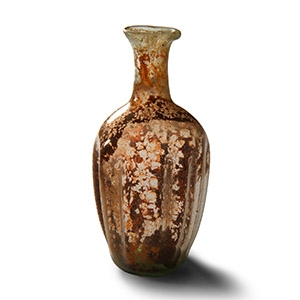
Roman Ribbed Glass Vessel
4th-5th century A.D.Sold for (Inc. bp): £130
With dimple base, radiating ribs to the bulb, gently tapering neck, flared rim with rolled edge. 20.11 grams, 95 mm
Acquired 1980-2015. Ex Abelita family collection. -
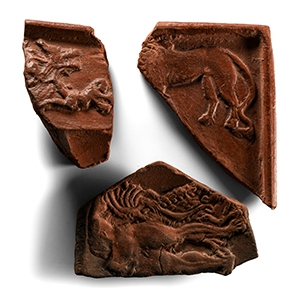
Roman Redware Pottery Fragment Group Including Jonah and the Whale
1st-4th century A.D.Sold for (Inc. bp): £111
Comprising: triangular fragment with raised rim, hindquarters of a lion; irregular fragment of a dish, nude body of a male entwined with tentacles of an octopus; irregular rim fragment with carinated profile and raised outer flange, male figure and large beast (Jonah?) modelled in high-relief. 158 grams total, 6.5-10.5 cm
Acquired 1960s-1990s. From the late Alison Barker collection, a retired London barrister.
