
Loading, please wait...
_900x900.jpg "Roman Silver-Gilt Military Strap End")
_200x200.jpg "Roman Silver-Gilt Military Strap End")
.jpg "Roman Silver-Gilt Military Strap End")
LOT 0091
Roman Silver-Gilt Military Strap End
CIRCA LATE 3RD CENTURY A.D.
2 1/2 in. (39.8 grams total, 64-65 mm).
Comprising scalloped outer faces, shallow dashed borders framing scrolling vines with gilt leaves to one face and horizontal bar of conjoined ellipses with pelta finial and pecked borders to the other, also with gilt elements. [2]
ProvenanceEx German art market in the late 1990s.
CONDITIONTimeLine Auctions follows a vetting process to ensure the authenticity and legality of all items, reinforcing our commitment to integrity and responsible trading. Each antiquity, antique, and coin lot undergoes thorough examination by a vetting committee of at least ten external specialists, professional trade association members, scientists, and archaeologists: Our Vetting Process
AUCTIONS:
TimeLine is a leading auction house specialising in antiquities, ancient art, collectables, natural history, coins, medals, and books. Our auctions offer museums, collectors, historians, and enthusiasts the opportunity to acquire unique and historically significant pieces.
-
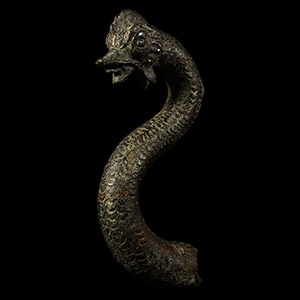
Large Roman Bronze Basilisk
4th century A.D.Estimate: £500 - 700 (+bp*)
Opening Bid: £278
The upper body, neck and head of a mythical basilisk (cockatrice), modelled in the round with the body of a serpent and head of a cockerel, the body with a tapering round-section profile, stylised detailing to the head. 260 grams, 88 mm
‘The Ancient Menagerie Collection’ formerly the property of a Cambridgeshire lady, collected since the 1990s and acquired from auctions and dealers throughout Europe and the USA, now ex London collection.
The basilisk, known from the Renaissance onwards as a cockatrice, was a Graeco-Roman mythical two-legged dragon or serpent-like creature with a cock's head. It had the reputed ability to kill people by either looking at them, touching them, or sometimes breathing on them. According to legend a cockatrice would die instantly upon hearing a rooster crow, and having a cockatrice looking at itself in a mirror was one of the few sure ways to kill it. -
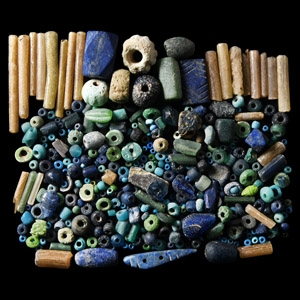
Roman Mixed Bead Group
2nd-5th century A.D.Sold for (Inc. bp): £59
Composed of mainly opaque polychrome glass, faience and stone beads of a variety of sizes and types, including melon, tubular, facetted, annular and barrel types, and others. 54 grams total, 2-36 mm
Ex W.J. collection, 1990s. -
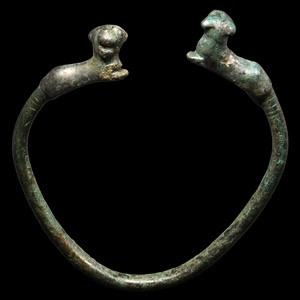
Roman Bronze Bracelet with Panthers
2nd-4th century A.D.Sold for (Inc. bp): £85
The penannular round-section hoop terminating in opposed couchant pantheresses, their heads turned in opposite directions. 30.8 grams, 75 mm
UK collection, early 1990s and before. Acquired on the UK art market since the early 2000s. From a private collection, Lancashire, UK.
