
Loading, please wait...
_900x900.jpg "Roman Silver Fish Brooch")
_200x200.jpg "Roman Silver Fish Brooch")
.jpg "Roman Silver Fish Brooch")
LOT 0938
Roman Silver Fish Brooch
2ND CENTURY A.D.
1 1/2 in. (4.98 grams, 38 mm).
Plate brooch formed as a fish with broad, gently curved lozengiform body, small lateral fins, chevron tail, D-shaped head with large discoid eye; the body with five rows of crescent punchmarks denoting scales; hinge-plate and catch to the reverse. [No Reserve]
ProvenanceProperty of a gentleman from Vienna; from his private collection formed since 1970.
LiteratureCf. Hattatt, R., Iron Age and Roman Brooches, Oxford, 1985, item 616.
FootnotesThe brooch is of a type found in Britain, corresponding to Hull's type 223. The fish represented here is likely a salmon.
CONDITIONTimeLine Auctions follows a vetting process to ensure the authenticity and legality of all items, reinforcing our commitment to integrity and responsible trading. Each antiquity, antique, and coin lot undergoes thorough examination by a vetting committee of at least ten external specialists, professional trade association members, scientists, and archaeologists: Our Vetting Process
AUCTIONS:
TimeLine is a leading auction house specialising in antiquities, ancient art, collectables, natural history, coins, medals, and books. Our auctions offer museums, collectors, historians, and enthusiasts the opportunity to acquire unique and historically significant pieces.
-
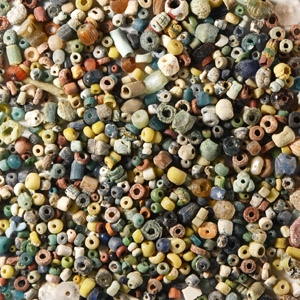
Roman and Other Glass and Stone Bead Group
1st millennium B.C. and laterSold for (Inc. bp): £208
Comprising a quantity of mixed beads, mainly oblate and cylindrical in form, including glass, modelled, faience and stone etc. 58.5 grams total, 1-14 mm
UK gallery, early 2000s.
The use of amber beads as amulets in the Roman world is well attested, even in Britain (series of bracelets have been found in late Roman graves at Cirencester and Colchester). The amber beads were associated with pierced coins, pierced dog’s teeth and a lunate pendant. Pliny said that amber was beneficial to infants ‘when attached to the body in the form of an amulet'. -
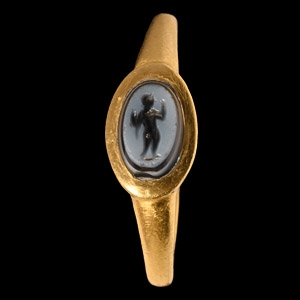
Roman Gold Ring with Apollo Gemstone
2nd-3rd century A.D.Estimate: £2,000 - 3,000 (+bp*)
Opening Bid: £1,100
With a solid ellipsoid hoop expanding at the shoulders from the mid 3rd century, with oval bezel set with a blue nicolo gemstone engraved with the figure of standing crowned god Apollo, depicted nude and holding a staff (or lyre?) in his raised right hand, gazing towards his raised left hand. 4.49 grams, 26.13 mm overall, 21.70 mm internal diameter (approximate size British L 1/2, USA 6, Europe 11.87, Japan 11)
From the private collection of the late A.B., London, UK; acquired before 1989. Accompanied by an academic report by Dr Raffaele D’Amato. This lot has been checked against the Interpol Database of stolen works of art and is accompanied by a search certificate number no.12005-213036.
The god’s body is depicted in three-quarter view, whereas the head is in full profile. The casual posture of the figure on the gemstone is taken from the common iconography of the god. Apollo is frequently portrayed in this fashion, although often leaning against a small column. -
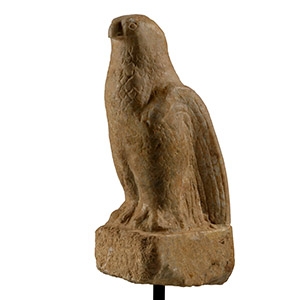
Roman Marble Epigraphic Eagle Statue
Circa 2nd-3rd century A.D. or laterSold for (Inc. bp): £1,300
Standing on a rectangular plinth with folded wings, gripping claws and feather detail to the chest and wings; on the front face of the plinth carved inscription in seriffed capitals 'M TITIO / MAXIM[.] / [.]TER[..]'. 2.75 kg total, 17 cm (24 cm high including stand)
Acquired in the 1990s. Private collection, Suffolk, UK. Property of a European gentleman. Accompanied by a copy of a French cultural passport no.140839.
