
Loading, please wait...
_900x900.jpg "Roman Silver Armilla Snake Bracelet")
_200x200.jpg "Roman Silver Armilla Snake Bracelet")
.jpg "Roman Silver Armilla Snake Bracelet")
LOT 0778
Roman Silver Armilla Snake Bracelet
2ND-3RD CENTURY A.D.
1 3/4 in. (65.50 grams, 47 mm).
With narrow D-section shank and lobe terminals with punched snake-head detailing. [No Reserve]
ProvenancePrivate collection, Arundel, West Sussex, UK, 1975-late 1990s.
LiteratureCf. Ruseva-Slokoska, L., Roman Jewellery, Sofia, 1991, item 161, for similar.
CONDITIONTimeLine Auctions follows a vetting process to ensure the authenticity and legality of all items, reinforcing our commitment to integrity and responsible trading. Each antiquity, antique, and coin lot undergoes thorough examination by a vetting committee of at least ten external specialists, professional trade association members, scientists, and archaeologists: Our Vetting Process
AUCTIONS:
TimeLine is a leading auction house specialising in antiquities, ancient art, collectables, natural history, coins, medals, and books. Our auctions offer museums, collectors, historians, and enthusiasts the opportunity to acquire unique and historically significant pieces.
-
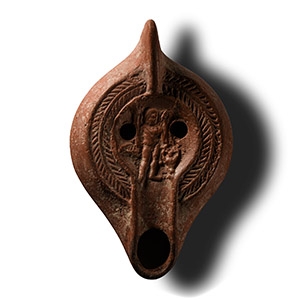
Roman Terracotta Oil Lamp with Cupid
4th-5th century A.D.Sold for (Inc. bp): £338
Burnished surface, broad discus with wreath to the shoulders, stub nozzle, low-relief image of Cupid between the vents. 110 grams, 11.2 cm
Property of a Gloucestershire, UK, collector. Property of an East Sussex, UK, gentleman. -
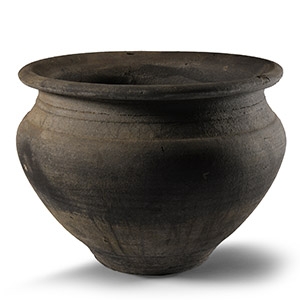
Large Roman 'Upchurch' Greyware Storage Jar
2nd century A.D.Sold for (Inc. bp): £845
With everted rim and decorative geometric band to the shoulder. 1.98 kg, 28 cm wide
Found Upchurch Marshes, Kent, UK, in the 1980s. Ex Winter Collection, Kent, UK.
The Roman pottery kilns on what are now the tidal marshes at Upchurch, Kent, are justly famed as a thriving pottery production area with many kiln and related sites. The London clay in this area is of fine quality and was thus suitable for pottery making. With the rise in the sea level, the area is now mostly inundated and, as tidal forces erode the silts, pottery (often 'seconds'), is sometimes exposed. The soft muds and general inaccessibility of the area make collection difficult. -
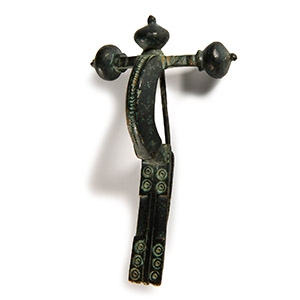
Roman Bronze Crossbow Brooch
4th century A.D.Sold for (Inc. bp): £124
With onion-knop finials, herringbone detailing to the bow, ring-and-dot motifs and chamfered sections to the foot, hinged pin to the reverse. 52 grams, 84 mm
Ex German art market, 2000s. Acquired from an EU collector living in London. From the collection of Surrey, UK, gentleman.
