
Loading, please wait...
LOT 0091
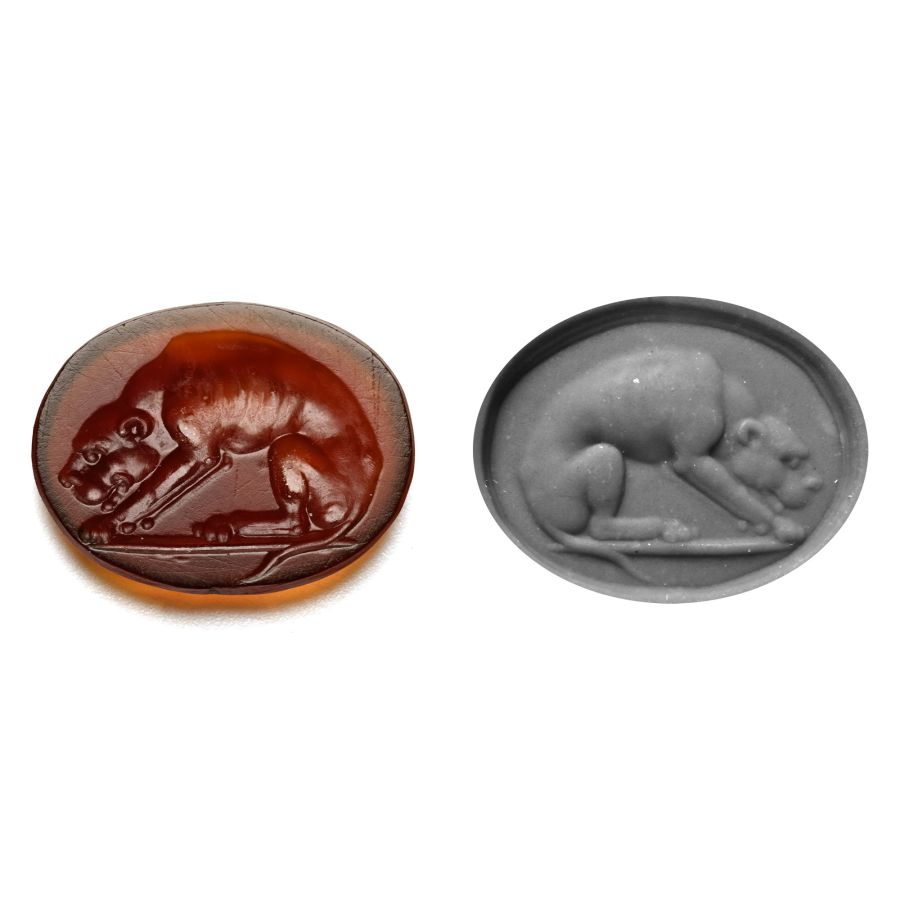
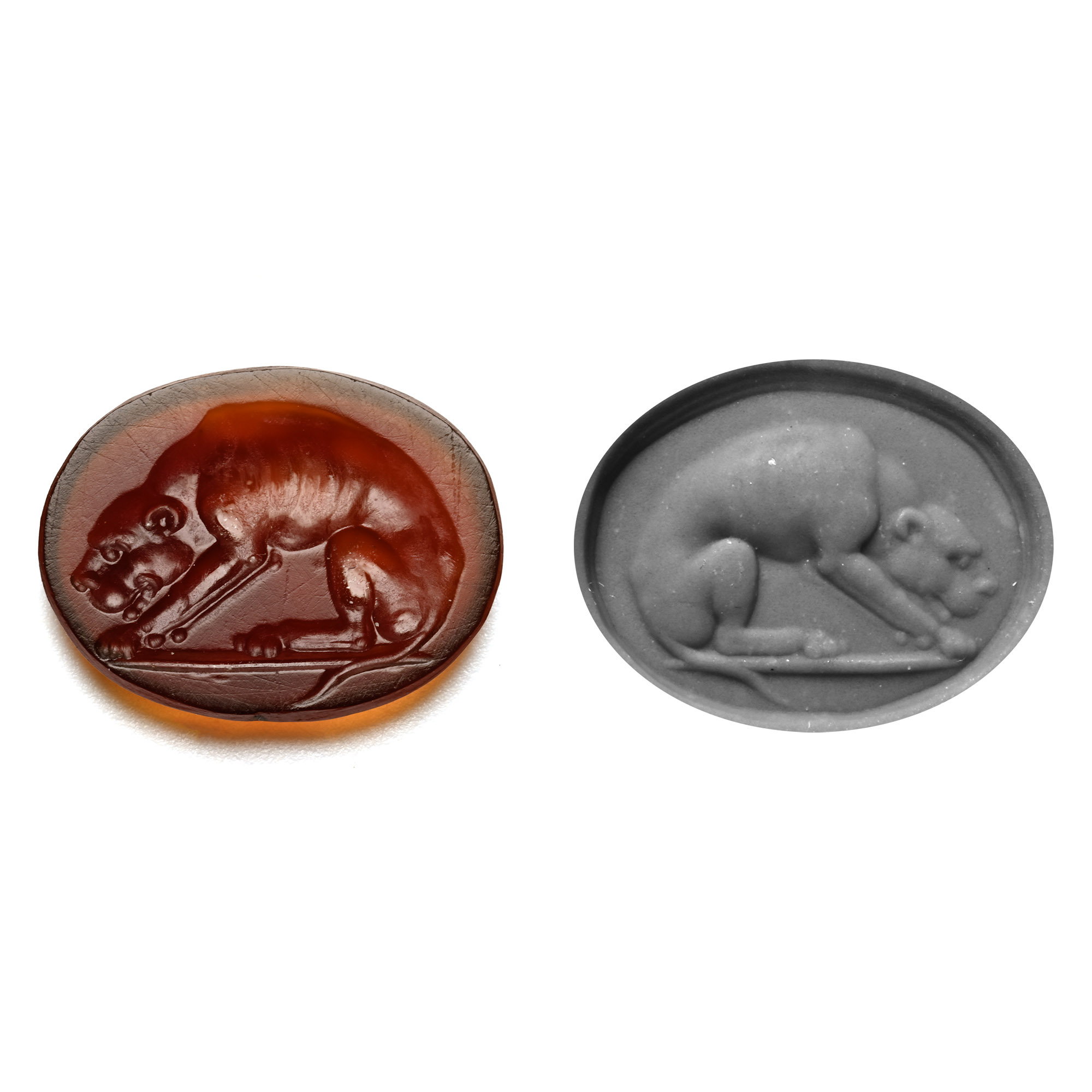
Roman Sard Gemstone of a Panther
1ST CENTURY A.D.
3/8 in. (0.32 grams, 11 mm).
With intaglio profile image of a large cat prone to the left; supplied with a museum-quality impression.
ProvenancePrivate English collection, formed between the late 1970s and early 1990s.
Private collection, London, UK.
This lot has been checked against the Interpol Database of stolen works of art and is accompanied by search certificate number no.12951-246458.
Cf. Sagiv, I., Representations of Animals on Greek and Roman Engraved Gems, Oxford, 2018, fig.30, a panther with a thyrsus on nicolo gemstone, for a similar but not identical panther.
FootnotesThis depiction clearly belongs to a series of renderings of felines as the mounts, draught animals, and companions of Dionysus/Bacchus, and of the personages connected with him. Lions, panthers and leopards are among the attributes of the god Bacchus and a part of his thiasos (retinue).
CONDITIONTimeLine Auctions follows a vetting process to ensure the authenticity and legality of all items, reinforcing our commitment to integrity and responsible trading. Each antiquity, antique, and coin lot undergoes thorough examination by a vetting committee of at least ten external specialists, professional trade association members, scientists, and archaeologists: Our Vetting Process
AUCTIONS:
TimeLine is a leading auction house specialising in antiquities, ancient art, collectables, natural history, coins, medals, and books. Our auctions offer museums, collectors, historians, and enthusiasts the opportunity to acquire unique and historically significant pieces.
-
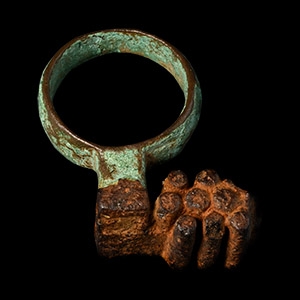
Roman Bronze Key Ring
1st-2nd century A.D.Sold for (Inc. bp): £33
Comprising a barrel-shaped ring with cranked shank and cluster of wards. 13.7 grams, 29 mm
From the collection of a Buckinghamshire, UK, collector established from the earlier 1960s. -
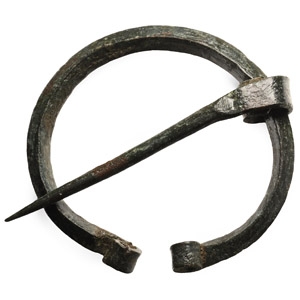
Roman Bronze Penannular Brooch
3rd-4th century A.D.Sold for (Inc. bp): £104
Diamond-section penannular body with scrolled finials and a round-section tapering pin. 4.12 grams, 35 mm
Ex European collection, 1990s. Ex Cambridgeshire, UK, collection. -
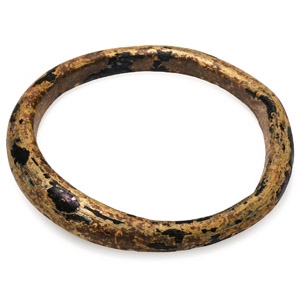
Roman Glass Bangle with Golden Iridescence
1st-4th century A.D.Sold for (Inc. bp): £72
Round-section with iridescent surface. 9.1 grams, 52 mm
From the private collection of the late Mr S.M., 1969-1999.
