
Loading, please wait...
_900x900.jpg "Roman Rock Crystal Sleeping Dog")
_200x200.jpg "Roman Rock Crystal Sleeping Dog")
.jpg "Roman Rock Crystal Sleeping Dog")
LOT 0895
Roman Rock Crystal Sleeping Dog
1ST-2ND CENTURY A.D.
1 5/8 in. (14.2 grams, 40 mm).
Carved in the round model of a recumbent canine with head resting on the forelegs; leaf-shaped ears, and deep-set eyes.
ProvenanceAcquired in the mid 1980s-1990s.
Private collection, Switzerland, thence by descent.
Private collection, since the late 1990s.
This lot has been checked against the Interpol Database of stolen works of art and is accompanied by a search certificate number no.12588-232168.
Cf. Kozloff, A.P., Animals in Ancient Art from the Leo Mildenberg Collection, Mainz am Rhein, 1981, nos.185-186, for similar images on cameos.
FootnotesThe small rock crystal sculpture is modelled on similar figures representing sleeping hunting dogs. The subject occurs in cameos, plastic vases, as well as in lamps. These images have symbolic value, implying something of the fidelity of the dogs they depict, as well as their bravery and dependability as guardians.
CONDITIONTimeLine Auctions follows a vetting process to ensure the authenticity and legality of all items, reinforcing our commitment to integrity and responsible trading. Each antiquity, antique, and coin lot undergoes thorough examination by a vetting committee of at least ten external specialists, professional trade association members, scientists, and archaeologists: Our Vetting Process
AUCTIONS:
TimeLine is a leading auction house specialising in antiquities, ancient art, collectables, natural history, coins, medals, and books. Our auctions offer museums, collectors, historians, and enthusiasts the opportunity to acquire unique and historically significant pieces.
-
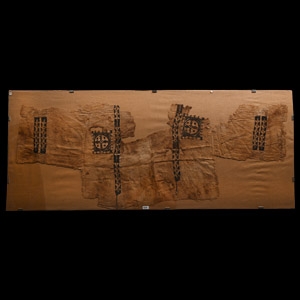
Large Mounted Roman Linen Tunic
Circa 4th-5th century A.D.Sold for (Inc. bp): £5,200
Comprising half of the upper part of a tunica manicata in light fabric, S-twist tapestry, ornamented with dark purple clavi with orbiculi and tablia, wool over linen; mounted in fabric backing and perspex display frame. 7.7 kg total, mount: 1.64 m
Acquired 1970s-1996. Property of a North American collector. London collection, 2016.
The tunic is decorated in purple with opus phrygium embroidery. The archaeological evidence from the dry desert cemeteries of Egypt offers striking confirmation of pictorial sources about late Roman clothing around the empire. -
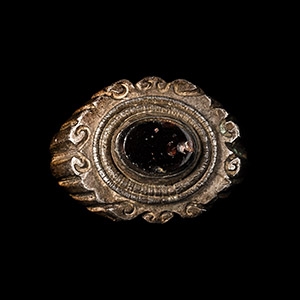
Roman Silver Ring with Garnet
Circa 3rd century A.D.Sold for (Inc. bp): £364
A D-section silver hoop expanding to ribbed shoulders forming the scrolled borders of the plaque, tiered beaded wire collars surrounding an elliptical cell with inset garnet cloison. 40.50 grams, 33.15 mm overall, 22.58 mm internal diameter (approximate size British Z+1 1/2, USA 13, Europe 30.69, Japan 29)
Ex property of a gentleman; acquired in the late 1960s-early 1970s. -
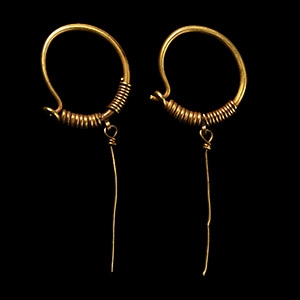
Roman Gold Earring Pair
1st century B.C.-1st century A.D.Sold for (Inc. bp): £455
Matched pair, each hoop with hook-and-eye closure, filigree wound round the shank, wire dangle. 3.92 grams total, 21 mm each
Acquired on the UK art market before 2000. Property of an Essex, UK, gentleman.
