
Loading, please wait...
LOT 0623
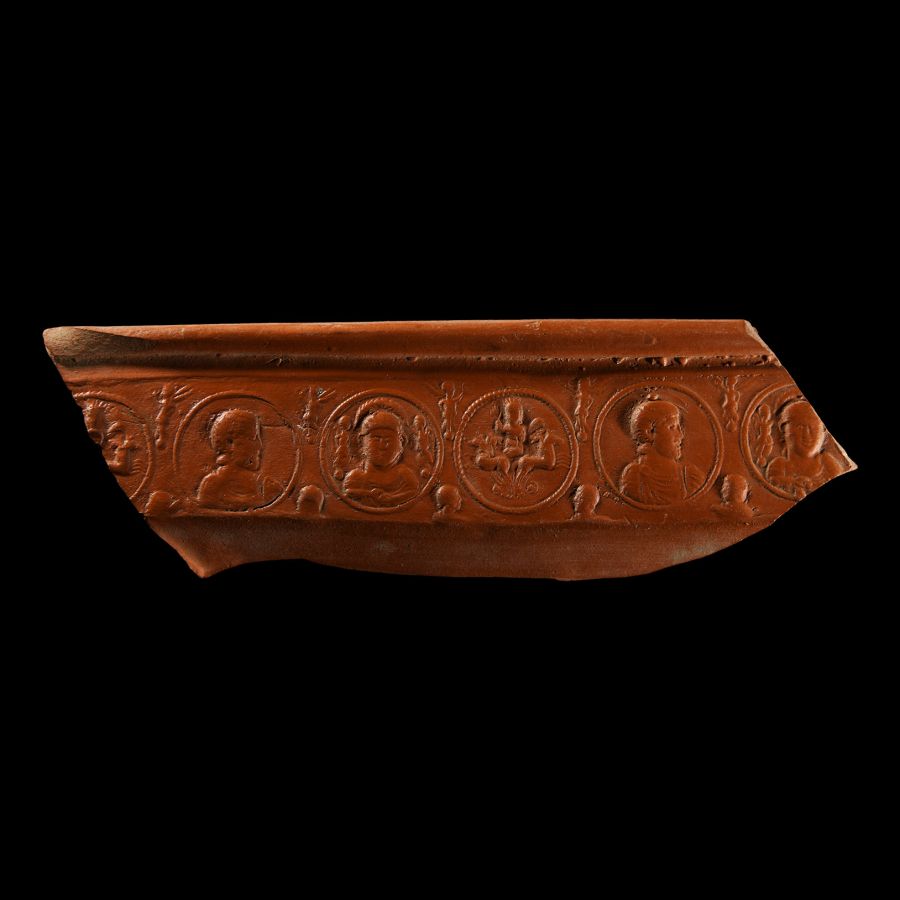
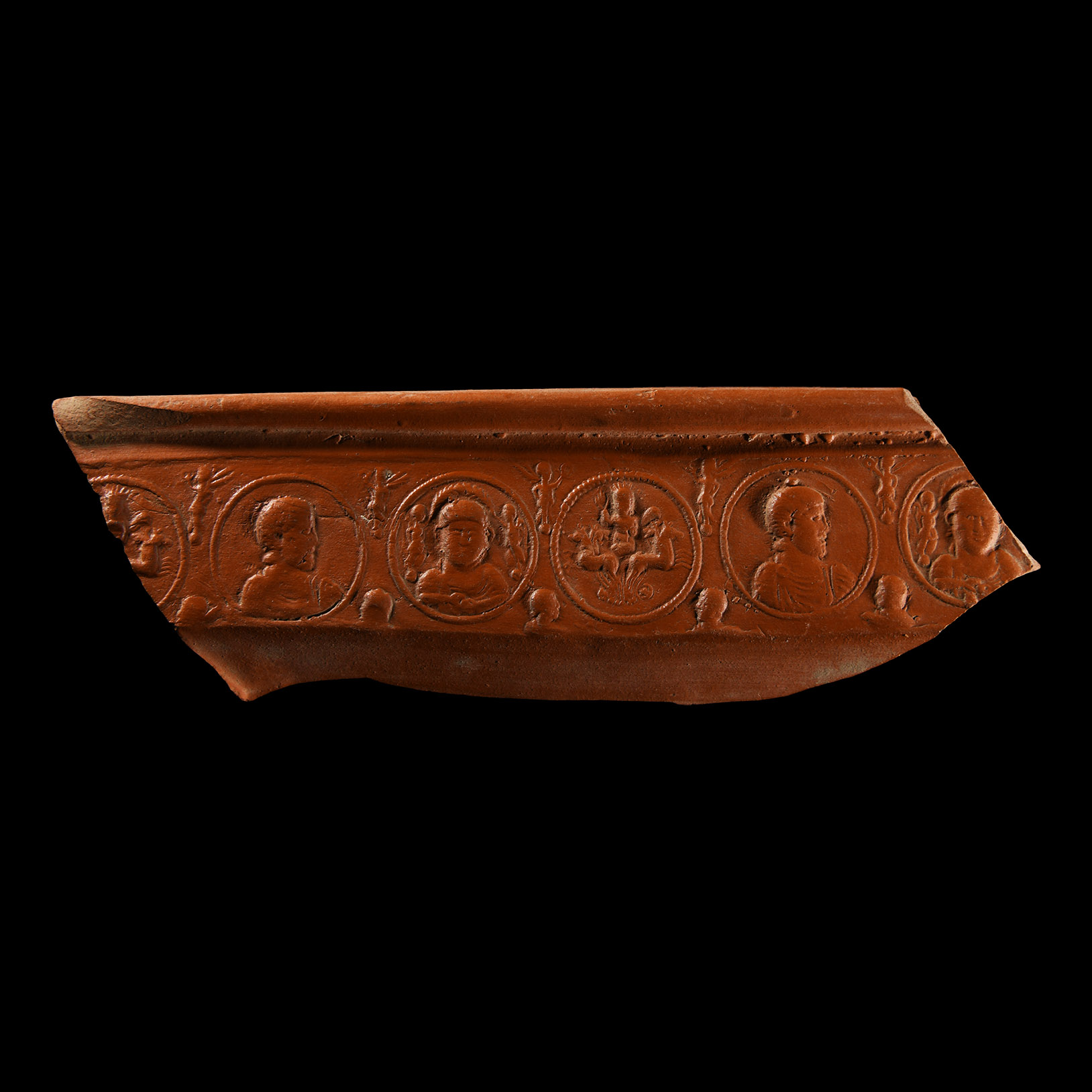
Roman Redware Sherd with Constantinian Portraits
4TH CENTURY A.D.
7 1/4 in. (155 grams, 18.5 cm).
From the upper part of the vessel, displaying a frieze of profile busts and figural scenes within roundels, winged Victory holding a wreath and standing on globe between the roundels; the central roundel with Sol Invictus and a sun chariot. [No Reserve]
ProvenanceAcquired 1960s-1990s.
From the late Alison Barker collection, a retired London barrister.
Cf. Demandt, A., Engemann, J., Imperator Caesar Flavius Constantinus - Konstantin der Grosse, Mainz, 2007, for similar Constantinian portraits on medallions (p.81), cameos (p.134), lead tokens (p.373).
FootnotesThis terra sigillata fragment appears to have been part of a large tray, celebrating the imperial triumph of an early 4th century emperor, possibly Constantine or a member of his family such as Crispus. The combination of triumphal symbols (palms, quadriga, radiated crown) with imperial figures is typical of the tetrarchy and early Constantinian era, where elements of dying paganism were still used to celebrate imperial glory. Note the detailed late Roman clothing, with a closed chlamys-paludamentum on the right shoulder and, in the profile figure, a thorax with hemispherical shoulder protections.
CONDITIONTimeLine Auctions follows a vetting process to ensure the authenticity and legality of all items, reinforcing our commitment to integrity and responsible trading. Each antiquity, antique, and coin lot undergoes thorough examination by a vetting committee of at least ten external specialists, professional trade association members, scientists, and archaeologists: Our Vetting Process
AUCTIONS:
TimeLine is a leading auction house specialising in antiquities, ancient art, collectables, natural history, coins, medals, and books. Our auctions offer museums, collectors, historians, and enthusiasts the opportunity to acquire unique and historically significant pieces.
-
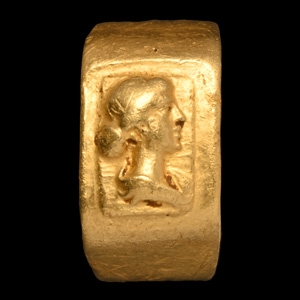
Roman Gold Ring with Bust of a Lady
Late 2nd century A.D.Sold for (Inc. bp): £4,940
Composed of a broad, flat-section hoop and a rectangular bezel displaying a high-relief bust of a lady in profile right. 6.15 grams, 18.78 mm overall, 16.51 mm internal diameter (approximate size British K 1/2, USA 5 1/2, Europe 10.58, Japan 10)
Acquired in the 1970s. From a deceased lady’s estate, by descent. This lot has been checked against the Interpol Database of stolen works of art and is accompanied by search certificate no.202900.
In 2014, a grave of a woman was discovered in Gerulata cemetery III, containing an unusual number of rings. The buried woman, aged 40-49, had two rings on each hand, one of which was a signet ring with a gem depicting the Egyptian deities Serapis and Isis, whose hairstyle and profile are identical to the present ring. Although, the bust of Isis is opposed to Serapis in the rings, the cult of the goddess was widespread inside the provinces already in the 1st century A.D. -
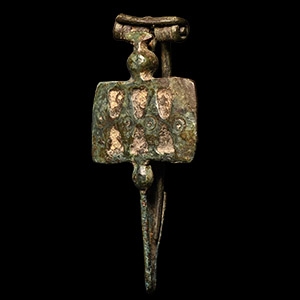
Roman Bronze Hod Hill Type Brooch
1st century A.D.Sold for (Inc. bp): £78
Of unusual style, similar to the Hod Hill type with a rectangular plate, two bulbs above and below, integral spring and pin to the reverse; below the plate a fine extension returned beneath to form the catchplate. 6.56 grams, 50 mm
Acquired 1970s-1980s. From a London brooch collector. -
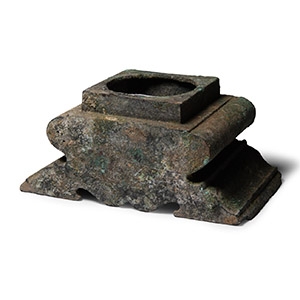
Roman Bronze Statue Base
Circa 2nd-3rd century A.D.Sold for (Inc. bp): £130
Featuring moulded legs and scalloped lower edge to front face; circular hole to the top; hollow-formed. 556 grams, 14.5 cm
Acquired 1990s-early 2000s. East Anglian private collection.
Some bronze supports found in the dedication shrines in temples are peculiar: they often have no frames of architectural derivation and have a central hole to the top. These bases seem to have not been intended for statuettes but for objects that may have needed support on a wall due to their height, possibly military standards, numerous fragments of which have been found in the Northern Italian regions. If this hypothesis is correct, this base could confirm the dedication of 'standards' as ex voto, positioned in the temple as a place for the conservation of military insignia.
