
Loading, please wait...
_900x900.jpg "Roman Redware Ram Pottery Sherd")
_200x200.jpg "Roman Redware Ram Pottery Sherd")
.jpg "Roman Redware Ram Pottery Sherd")
LOT 0827
Roman Redware Ram Pottery Sherd
CIRCA 4TH-5TH CENTURY A.D.
3 in. (50 grams, 77 mm wide).
Fragment of a terracotta votive statuette representing a ram, detail to the horns, ears and fleece; set with a suspension ring on the reverse. [No Reserve]
ProvenanceAcquired 1960s-1990s.
From the late Alison Barker collection, a retired London barrister.
Cf. Burr, D., ‘The terracotta figurines’ in Hesperia: The Journal of the American School of Classical Studies at Athens, Vol. 2, No. 2, The American Excavations in the Athenian Agora: First Report, (1933), pp.184-194, fig.7, no.636, T50, for similar.
FootnotesMany figurines of this type have been found in the Hellenised Roman provinces of the east and one identical in the Athenian Agora. They are all rendered with incisions that are characteristic of the technique of the late fourth century. Many similar examples were found in the Kerameikos and some are in the National Museum of Archaeology, Athens. A similar technique is observable in the handles representing animal heads which occur on red pottery ornamented with white paint.
CONDITIONTimeLine Auctions follows a vetting process to ensure the authenticity and legality of all items, reinforcing our commitment to integrity and responsible trading. Each antiquity, antique, and coin lot undergoes thorough examination by a vetting committee of at least ten external specialists, professional trade association members, scientists, and archaeologists: Our Vetting Process
AUCTIONS:
TimeLine is a leading auction house specialising in antiquities, ancient art, collectables, natural history, coins, medals, and books. Our auctions offer museums, collectors, historians, and enthusiasts the opportunity to acquire unique and historically significant pieces.
-
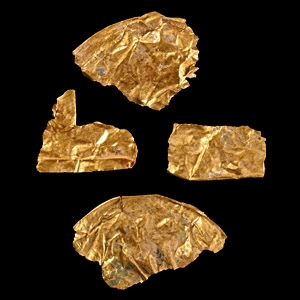
Roman Sheet Gold Phalera Cover Fragment Group
4th-5th century A.D.Sold for (Inc. bp): £65
Group of fragments of phalera covers with repoussé designs. 1.77 grams total, 10-37 mm
Acquired in the early 1990s. From the collection of an London antiquarian. -
.jpg)
Roman Silver Ring with Isis Gemstone
1st century A.D.Sold for (Inc. bp): £520
Ellipsoid cell to the bezel, inset carnelian gemstone with intaglio Isis standing by the curved prow of a boat holding a sistrum in her raised hand. 5.53 grams, 23.13 mm overall, 17.36 mm internal diameter (approximate size British N 1/2, USA 6 3/4, Europe 14.35, Japan 13)
Old private collection, 1980s. European art market. -
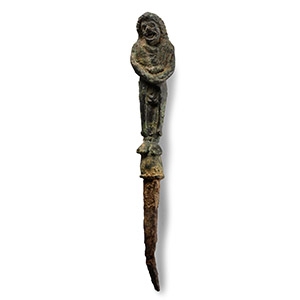
Roman Bronze Pin Finial with Actor
1st-2nd century A.D.Sold for (Inc. bp): £156
With an iron pin, the finial formed as a standing comedy actor with long curly hair, hands clasped together. 22.7 grams, 89 mm
Ex German art market, 2000s. Acquired from an EU collector living in London. From the collection of Surrey, UK, gentleman.
