
Loading, please wait...
LOT 0947
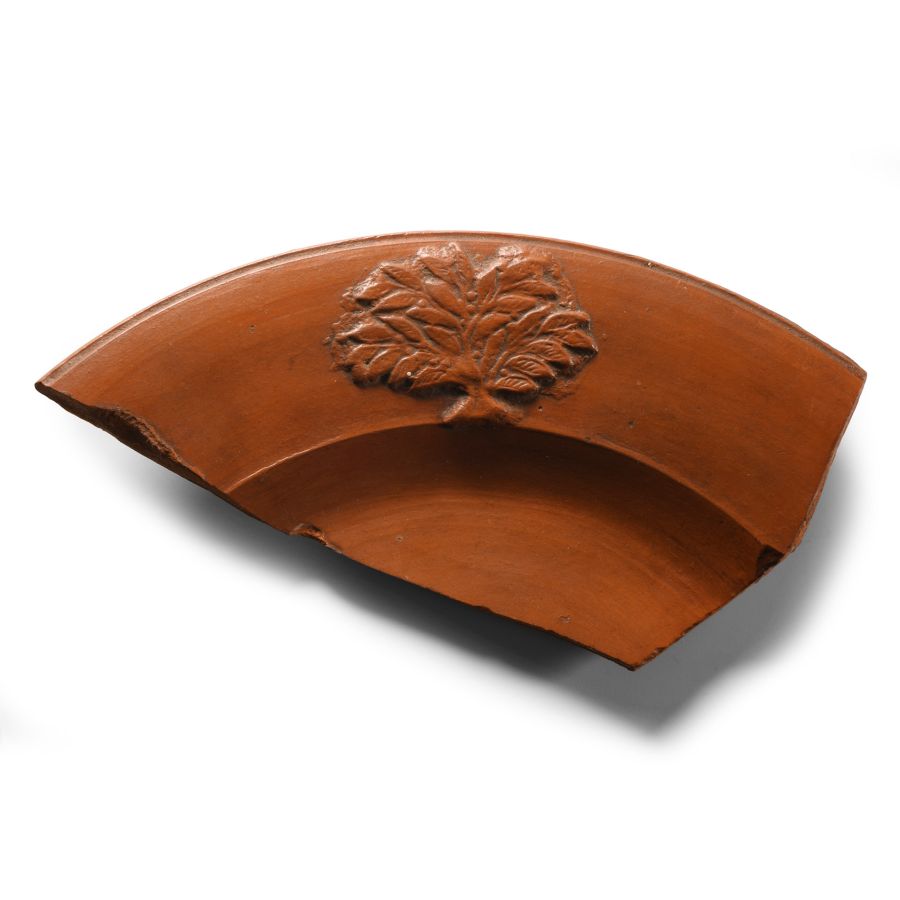
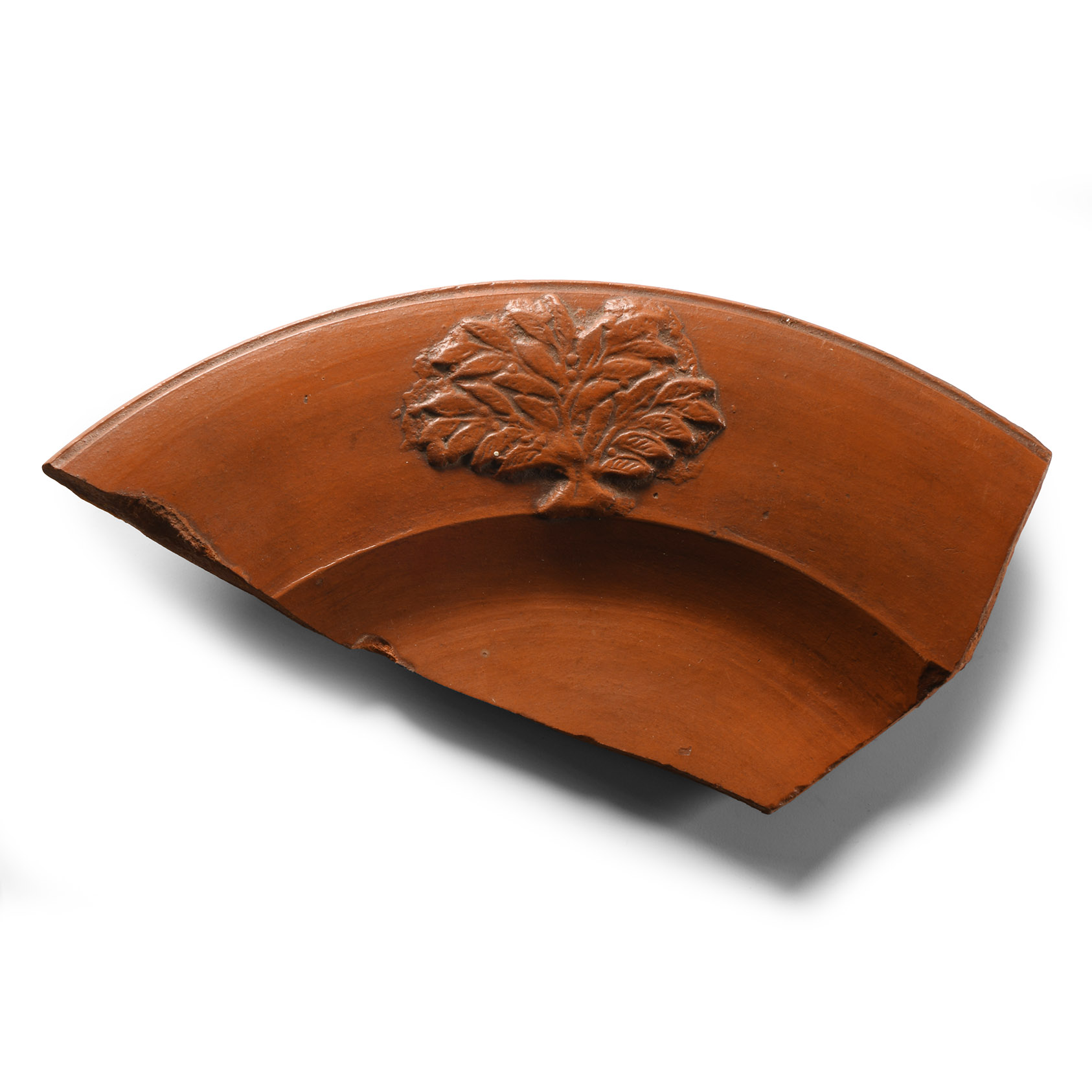
Roman Redware Pottery Sherd with Olive Tree
CIRCA 4TH-5TH CENTURY A.D.
6 3/4 in. (87 grams, 17 cm).
Comprising a large edge section with impressed olive tree, with details of branches, fruit and foliage. [No Reserve]
ProvenanceAcquired 1960s-1990s.
From the late Alison Barker collection, a retired London barrister.
For similar foliage and vegetal applique on terra sigillata see Mackensen, M., 'The study of 3rd century African red slip ware based on the eividence from Tunisia' in Malfitana, D., Poblome, J. and Lund, J., Innovating Perspectives on Roman Pottery Studies, Atti del Convegno Internazionale di Studi Catania, 22-24 Aprile 2004, Catania, 2006, pp.105-124, fig.13.
FootnotesThe representation of an olive tree on this sigillata is not casual. In the early Imperial period the export of the Adriatic olive oil, following the amber road, moved from Aquileia to the provinces of Roman Pannonia. During the 3rd century, the production of the Spanish olive oil reached the Northern Roman provinces. Olives were transported in particular amphorae and served with specific vessels, distinguishing the black olives (olivae nerae) from the white olives (olivae albae).
CONDITIONTimeLine Auctions follows a vetting process to ensure the authenticity and legality of all items, reinforcing our commitment to integrity and responsible trading. Each antiquity, antique, and coin lot undergoes thorough examination by a vetting committee of at least ten external specialists, professional trade association members, scientists, and archaeologists: Our Vetting Process
AUCTIONS:
TimeLine is a leading auction house specialising in antiquities, ancient art, collectables, natural history, coins, medals, and books. Our auctions offer museums, collectors, historians, and enthusiasts the opportunity to acquire unique and historically significant pieces.
-
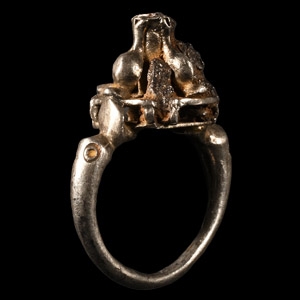
Roman Silver Key Ring with Dolphins
3rd-4th century A.D.Estimate: £600 - 800 (+bp*)
Opening Bid: £300
The hoop formed with dolphin-head shoulders supporting an openwork tiered bezel with four outward-facing dolphins on a disc, their tails joining to form a tube with inset garnet cloison; possibly originally a key-ring with the tune forming a mandrel. 7.13 grams, 31.06 mm overall, 19.89 mm internal diameter (approximate size British N, USA 6 1/2, Europe 13.72, Japan 13)
Ex Cotswold collection, UK, 1990s. Accompanied by a copy of a statement of opinion from Striptwist Ltd, a London-based company run by precious metal specialist Dr Jack Ogden, reference number 221202. -
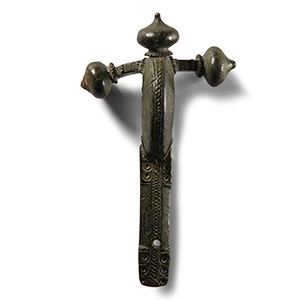
Roman Bronze Crossbow Brooch
4th century A.D.Sold for (Inc. bp): £85
With onion-knop terminals, carinated bow with a median band of guilloche decoration; the footplate with ring-and-dot decoration to each end, central guilloche panel with chamfered sides; hinged pin and pierced catch-plate to reverse. 64 grams total, 90 mm
Property of a Gloucestershire, UK, collector. Property of an East Sussex, UK, gentleman.
The piercing runs through both the body and catchplate. Such alterations, for the attachment of a securing chain or thong, are not uncommon on heavy brooches, but the hole is usually restricted to the reverse (the catch). -
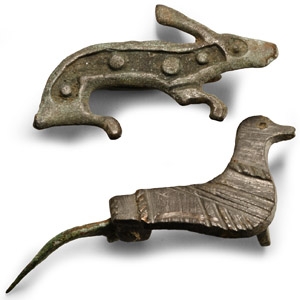
Roman Animal Brooch Collection
2nd century A.D.Sold for (Inc. bp): £143
Comprising: bird plate brooch with hinged pin and catch to the reverse; running hare plate brooch with recessed body to accept enamel fill, pin and catch to the reverse. 18.8 grams, 46-58 mm
Ex UK art market. Property of a Scottish collector, acquired in 2013.
