
Loading, please wait...
_900x900.jpg "Roman Redware Lamp with Radiate Head of Serapis")
_200x200.jpg "Roman Redware Lamp with Radiate Head of Serapis")
.jpg "Roman Redware Lamp with Radiate Head of Serapis")
LOT 0567
Roman Redware Lamp with Radiate Head of Serapis
3RD-4TH CENTURY A.D.
4 3/4 in. (145 grams, 12.2 cm wide).
Comprising a squat body with thick nozzle and lug handle, band of leaves and bunches of grapes to the discus, surrounding a bust of Serapis with modius and radiate crown; maker's initials to the underside 'S. S. L.'.
ProvenanceEx London gallery 1980s.
From the collection of a deceased Lancashire gentleman.
See Bussière, J., Lindros Wohl, B., Ancient Lamps in the J. Paul Getty Museum, Malibu, 2017, p.349, for the type, close to the Atlante VI.
FootnotesSerapis was a Graeco-Egyptian god, whose cult was popularised during the 3rd century B.C. on the orders of Ptolemy I of Egypt, to facilitate the religious syncretism of his kingdom. During the Roman Empire his image was widely diffused in the east, and the image of Zeus-Serapis was often fitted with the radiate crown, linking it with the cult of Sol Invictus; the position as the main divinity of the Roman Pantheon strengthened by Lucius Domitius Aurelian (270-275 A.D.).
CONDITIONTimeLine Auctions follows a vetting process to ensure the authenticity and legality of all items, reinforcing our commitment to integrity and responsible trading. Each antiquity, antique, and coin lot undergoes thorough examination by a vetting committee of at least ten external specialists, professional trade association members, scientists, and archaeologists: Our Vetting Process
AUCTIONS:
TimeLine is a leading auction house specialising in antiquities, ancient art, collectables, natural history, coins, medals, and books. Our auctions offer museums, collectors, historians, and enthusiasts the opportunity to acquire unique and historically significant pieces.
LOT 0567
Roman Redware Lamp with Radiate Head of Serapis
Estimate £300 - 400€350 - 460 (for guidance only)$410 - 540 (for guidance only)
-
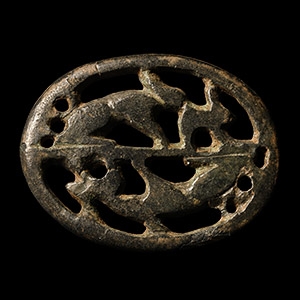
Roman Bronze Hare and Hound Brooch
1st-2nd century A.D.Sold for (Inc. bp): £98
Composed of an openwork plaque with two inverted panels each depicting a hound with a hare in its mouth; remains of pin lug and catchplate to reverse. 14.9 grams, 42 mm
Acquired prior to 1980. From the UK art market. -
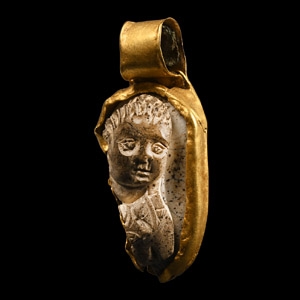
Roman Gold Pendant with Cameo
Circa 1st-2nd century A.D.Estimate: £600 - 800 (+bp*)
Opening Bid: £240
Suspension loop to one edge, the stone cameo fragment portraying a young boy. 3.84 grams, 30 mm
Acquired 1990s-early 2000s. East Anglian private collection. -
.jpg)
Gemstone Group
Roman, circa 1st century A.D. and laterSold for (Inc. bp): £520
Comprising agate, carnelian, jasper and other stones, displaying intaglio busts and scenes including: Hercules wrestling the Nemean lion; female busts in profile; cockerel standing right; seated winged deity; an erotic scene; peacock or other bird; eagle grappling with a snake; two figures, possibly gladiators in combat; each accompanied by a museum-quality impression. 6.97 grams total, 11-15 mm
Ex property of a Bristol family collection formed between 1960-late 1970s. Two from a London collection, UK.
